pollination pt 4
 Call Kai
 Learn
 Practice Test
 Spaced Repetition
 Match
 Flashcards
 Knowt Play
1/21

There's no tags or description
Looks like no tags are added yet.
Name | Mastery | Learn | Test | Matching | Spaced | Call with Kai | Chat |
|---|
No analytics yet
Send a link to your students to track their progress
22 Terms
why are angiosperms so diverse?
coevolution w/ pollinators
Bats or moths
white flowers
highly fragrant
opens at night
flies
pale/dark brown/ purple flower
rotting meat smell
“corpse” flowers
birds
red/yellow/orange flowers
odorless
tubular shape
beetles
white/green flowers
highly fragrant
exposed/tough sexual organs
fig wasps
entire lifecycle in the fig
females are the only ones that leave

Fruits evolved in relation to dispersal agents
Wind-borne fruits/seeds
Fleshy, sweet fruits (animals!)
•Hooks and spines (animals!)
Fruit strict definition
matured ovary
Fruit broad definition
A matured ovary along with whatever noncarpellary tissue, or accessory tissue, becomes united with the ovary during its maturation.
parthenocarpy
Fruits can develop without fertilization and seed development
this is widespread in species with large numbers of ovules (e.g., banana, citrus, pumpkin, fig, pineapple)
what humans select for
carpel/pistil

fruit classification depends on
arrangement if carpels/pistils
simple
aggregate
multiple

simple
single pistil with either a single carpel or 2+ united carpels
most diverse group of the 3 types of fruits
drupes
berries
pomes
aggregate
fruit forms from a single flower with many pistils (separate carpels), the ovary of
each develops into a fruitlet; each carpel retains its individual identity in the mature state
(magnolias, raspberries, strawberries)

multiple
fruit is derived from an entire inflorescence (from many entirely separate flowers) (mulberry, pineapple)
legumes (Fabaceae)
pod
usually dehiscent
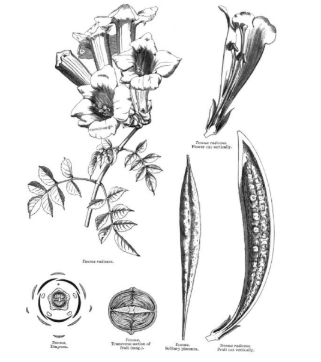
bignoniaceae
can also have a bivalved capsule
Microsporogenesis
the generation of microspores (pollen grains)
Microgametogenesis
the generation of microgametophytes (pollen tube)
pollen grain
2 haploid cells (vegetative/tube and generative) arise from microspore
mitosis = microgametophyte


the ovule
Integument(s) – surrounding layers of tissue; gymnosperms have 1, angiosperms have 2
Micropyle – opening, where 1n microspores can be received.
Megasporangium – produces the
megaspore → embryo sac