BIO2 Reading 6
 Call Kai
 Learn
 Practice Test
 Spaced Repetition
 Match
 Flashcards
 Knowt Play
1/18

There's no tags or description
Looks like no tags are added yet.
Name | Mastery | Learn | Test | Matching | Spaced | Call with Kai | Chat |
|---|
No analytics yet
Send a link to your students to track their progress
19 Terms
Catalyst
Substance that increases the rate of a reaction while remaining itself unchanged; lowers the activation energy threshold for a reaction to take place

Enzyme
Protein that acts as a biological catalyst

Ribozyme
Catalyst composed of RNA

Active Site
Region of an enzyme where the substrate binds; composed of a unique group of amino acid r groups (residues) that interact with the substrate

Induced Fit
Enzymes and their substrates undergo slight conformational changes before binding

How do enzymes catalyze reactions? (4)
1. Bring substrates together in the proper orientation
2. Compromise substrates' bond structure to be more readily broken
3. Provide optimal environmental conditions for a reaction
4. Form transient covalent bonds with substrates

How are enzymes regulated? (4)
Temperature
pH
Compartmentalization within the cell
Activated/inhibited by other molecules

Competitive Inhibition
A molecule binds to an enzyme's active site, blocking substrates; impacts initial reaction rate but not maximum reaction rate

Noncompetitive Inhibition
A molecules binds to an enzyme in a secondary/allosteric site (not the active site) to reduce its activity

Allosteric
Describes a region of an enzyme that can bind a regulatory molecule and is not the active site

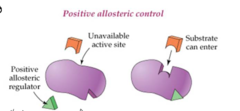
Positive Allosteric Regulation
Small molecule that increases the enzyme activity and binds outside the active site (allosteric)
Feedback Inhibition
Products of a metabolic pathway serve as (usually allosteric) inhibitors of the enzyme(s) involved in producing them

What do enzymes change and not change?
Change: Activation energy
Do not change: ΔG, spontaneity

How does temperature impact enzymes?
As temperature increases, enzyme activity increases; however, as temperature increases, enzymes will begin to denature at a certain point (begins with the breakdown of the tertiary structure)

Enzyme-Substrate Complex
Temporary complex formed when an enzyme binds to its substrate(s)

Holoenzyme
An enzyme and its cofactor/coenzyme

Cofactor
Inorganic ions that help enzymes function

Coenzyme
Organic molecules mainly made up of carbon and hydrogen that help enzymes function
Prosthetic Group
A larger protein acting in conjunction with the enzyme
