Inorganic Exam 3
 Call Kai
 Learn
 Practice Test
 Spaced Repetition
 Match
 Flashcards
 Knowt Play
1/42

There's no tags or description
Looks like no tags are added yet.
43 Terms
Naming metal-ligand complexes…
Is there a cation?
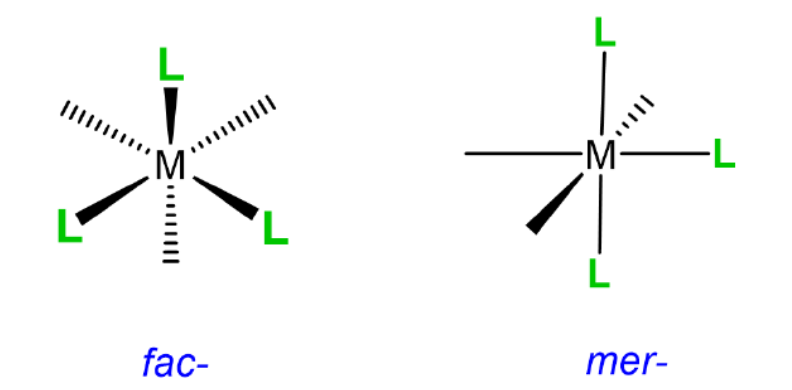
Is there noticeable stereochemistry of the ligands? (cis-, trans-, fac-, mer-)
What are the ligands? And how many are there? (Name alphabetically)
What is the metal and its oxidation state?
Neutral/Cationic metal =
Name stays the same
Anionic metal =
-ate replaces -ium, -en, or -ese
Water in the outer-sphere =
Hydrate/solvent isomerism
1 = monohydrate
2 = dihydrate
3 = trihydrate
Anionic ligands end in….
-O
ex: NO2 = nitrito
Octahedral coordination number
coordination number of 6
Trigonal bipyramidal coordination number
coordination number of 5
Square planar coordination number
complexes in which PtII , PdII , or RhI, or IrI have a coordination number of 4
Tetrahedral coordination number
Coordination number of 4
Coordination number =
number of ligands * denticity
Denticity
Property of a ligand: the number of sites that can be used to bind to a metal center
Bidentate = 2
Tridentate = 3
Tetradentate = 4
Pentadentate = 5
Hexadentate = 6
Heptadentate = 7
Octadentate = 8
d-electron count of a metal =
valence electrons in neutral atom - oxidation state
Structural isomers
Hydrate/solvent isomerism
Ionization isomerism
Coordinate isomerism
Linkage of ambidentate isomerism
Ionization isomerism
When there are two or more ions that can act as ligands

Coordinate isomerism
Exists in compounds containing two or more complexes; each have differing ligands which in principle can be swapped with a ligand of the other complex

Linkage/Ambidentate isomerism
They differ in how one or more ambidentate ligands bind to metal centers in a complex

Stereoisomerism
Optical isomerism/Chirality
Cn, Dn, or C1
Geometric isomerism
cis and trans
fac and mer
cis and trans
at least two of the same atoms
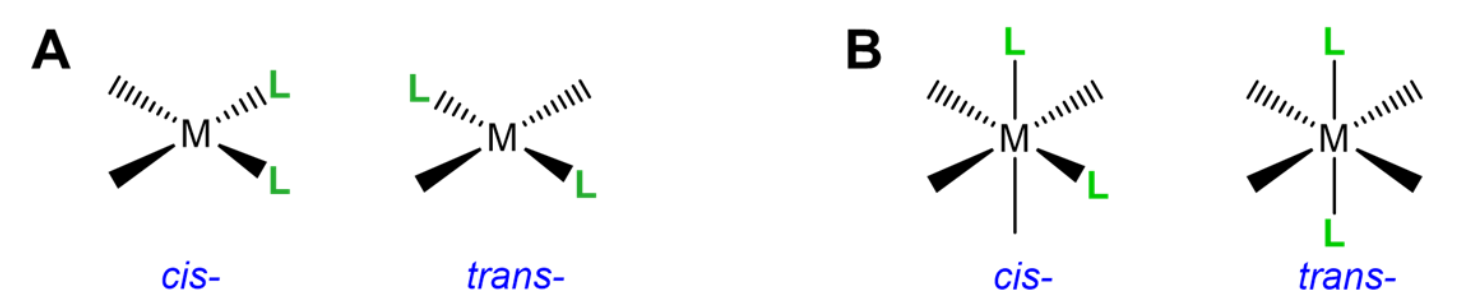
fac and mer
At least three of the same thing
Rules for writing chemical formulas…
prefix-[Metal(Ligands)]charge
ligands: alphabetical order
Copper (anionic latin name)
Cuprate
Gold (anionic latin name)
Aurate
Iron (anionic latin name)
Ferrate
Lead (anionic latin name)
Plumbate
Silver (anionic latin name)
Argentate
Tin (anionic latin name)
Stannate
H2O
Aqua
NH3
ammine
NH2-
amido
CO
carbonyl
Pph3
triphenyl phosphine
O
oxo
Hard acids
Small size
High energy LUMO
Weak polarizability
High positive charge
Hard Bases
small size
high energy HOMO
weak polarizability
high electronegativity
Soft Acids
large size
low energy LUMO
high polarizability
low positive charge
Soft Bases
large size
low energy HOMO
high polarizability
intermediate electronegativity
Water exerts a ____ effect…
Leveling
Water converts acids and bases into stronger acids and bases
Ligand endings (anionic/cationic)
Anion: -o
*can still end in -ido, but not a big deal as long as cations do not end in -o
Cation: -ido
Diastereomers
non-mirror image, non-identical stereoisomers
Enantiomers
a pair of stereoisomers that are non-superimposable mirror images of each other
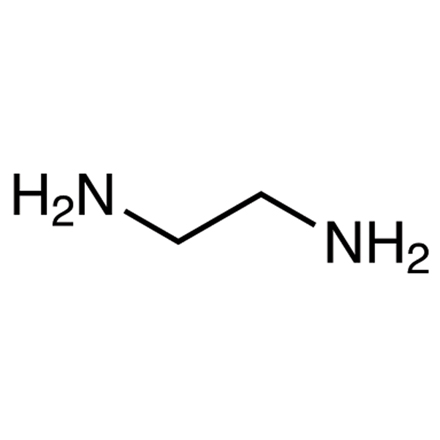
en
ethylene diammine
bpy
bipyridyl

acac
acetylacetonato