fw 353 material after midterm 1
 Call Kai
 Learn
 Practice Test
 Spaced Repetition
 Match
 Flashcards
 Knowt Play
1/100

There's no tags or description
Looks like no tags are added yet.
101 Terms
what is a native species?
species that normally lives & thrives in a particular ecosystem
A species that has developed over hundreds or thousands of years in a particular ecosystem or region
Also refers to a species existing prior to European contact (1492)
what is a non-native species and are they always invasive?
one that has been brought by humans into an ecosystem where it did not historically occur
NOT ALL non-natives are invasive
Invasive species
non-native species that can outcompete native species & whose introduction may cause economic and/or environmental harm
Habitat diversity =
species diversity
naturalize species
A species non-native to an ecosystem
qualified w/ natural range expansion
Considered benign
ex: Cattle egret
how did the cattle egret become naturalized to south america
Naturally from Africa, likely carried by storms or strong winds
first recorded breeding in the U.S. in 1941 (Florida) Adapted to agricultural landscapes, livestock, and fire-maintained habitats
characteristics of invasives
High repro rate
Long-lived
High dispersal
High genetic variability
Habitat generalist
Flexible diet
European species
Alters environmental conditions
invasive ex: cheatgrass (where is it native to? where did it invade? what characteristics allow it to be so invasive?0
Native to Europe, Asia, Africa
‘The invader that won the west’
invasive in semi-arid and arid ecosystems
Dominates rangelands, disturbed areas, & open
Changes Natural Environment
Prolific seed producer
Germinates in Fall AND Spring
Increases fire frequency
invasive ex: tall fescue (where did it invade? what can it do to livestock?)
invasive cool-season grass in North America
Contain Epichloë coenophiala (fungal endophyte that produces alkaloids that harms livestock, causing fescue toxicosis)
Allelopathic effects
invasive ex: Asiatic clam (corbicula fluminea) (where is it native to? what traits allow it to survive?)
Native to Asia & Africa
Reproduces very rapidly (70,000 larvae/year) & very tolerant of varying water conditions
Short-lived (1-7 years)
Tolerate pollution better than natives
Self-fertilization
Multiple fish hosts for glochidia
invasive ex: hemlock wooly adelid (native to? what does it do?)
Native to Asia
Destroying Hemlock Trees
who introduced Sericea lespedeza (Lespedeza cuneata) & when?
introduced by biologists & DOT – 1890’s
who introduced Autumn Olive (Eleagnus umbellata) & when?
agencies food and cover, shelterbelts – 1830’s
honeysuckle: japanese vs coral
Japanese (invasive): Lonicera japonica
80 feet
Prolific growth and seeds
White and yellow flowers
Insects and birds
Coral (native): Lonicera sempervirens
15-25 feet
Red and yellow flowers
Moths, hummingbirds, birds
short term benefits vs long term problems of invasives
Short-term benefits:
Both are used by some wildlife
Long-term problems
Outcompete native
Hummingbird?
Overtake entire areas & reduce species diversity
invasive feral pigs (how fast do populations grow? what diseases do they spread?)
Populations can double in 14 months
Salmonella
Clostridium difficile
Toxoplasma gondii (cats)
Trichinella
Brucella suis
Classical Swine Fever
PCV-2
Pseudorabies
Cats: how many ppl in the US own a cat? how many stray/feral cats? what do outdoor cats do?
~88.2 million pet cats owned in U.S., (about 37% of U.S. households hv at least one)
Outdoor Cats: 60 to 100 million feral/stray cats across the country
Have been linked to the extinction of 63 species
prey on a wide range of species, contributing to biodiversity loss.
Compete w/ native predators
transmit disease (Toxoplasma, cat-scratch)
Wisconsin cat study
Rural cats kill up to 217 million birds
114 cats/square mile
virginia cat study
One cat killed 27 native species
myths of outdoor cats
Well-fed cats are not a danger to wildlife
Putting a bell on a cat is an effective way to deter predation
Interrupting an attack by a cat allows the prey to escape and live
Stray cat colonies present no danger to wildlife
Ring-necked Pheasant (Phasianus colchicus)
Native to China, Korea, and parts of Russia
In 1881, established in Oregon’s Willamette Valley from China stock
Spread throughout Midwest
State bird of South Dakota - 1943
Though a popular game species, they disrupt & dominate prairie chickens on booming grounds
Overall, why is introducing non-native species not an effective management strategy?
Introducing exotics is outdated approach
Mostly failures
Better to focus on restoring native species
invasive ex: saltcedar
Northern strains invested more in root growth in low temperatures
Increased winter survival
Allows for tolerance and ability to invade broader latitudes
Native to Europe and Asia
Occurs in Nebraska and Kansas
concerns: genetic swamping
elk from NA released in Poland (hybrids hv poor antlers)
concerns: disease & parasites
feral pigs in NC
reducing species diversity
concerns: competition with native species
European starlings
Japanese honeysuckle vs coral honeysuckle
ambush predators
sit-and-wait
remain motionless and concealed, waiting for prey to come within striking distance before launching a rapid attack
Ambush behavior selects “all” (i.e., whatever is available)
active predators
pursuit
actively search for and chase prey, relying on speed, endurance, agility, and sometimes teamwork
energy intensive, aims to tire out prey
Chase behavior selects “odd man out” (?)
how were/are predators viewed? How did Hornday view them?
Attitudes towards predators vary
Predaceous fish (ok), mammals (not so good)
Persecuted by Western man
European attitude became American attitude
Hornaday:
He viewed “good” vs. “bad”
NOT as a community
how does predation affect natural selection?
it promotes the selection of fit individuals, which typically strengthen predators & prey populations over time (tho not always)
which individuals in a population are most vulnerable to predation?
fringes & dispersers (those living at habitat edges or moving to unfamiliar areas)
theoretical graphical relationship between prey & predators

smooth oscilation
Lotka-volterra predator-prey model
(baboon vs cheetah)

Key dynamics:
prey surge: when cheetah #’s drop low enough, the baboon populations rebound sharply
predator lag: the cheetah pop rises after baboon peak, delayed by time needed for predators to reproduce
prey decline: as cheetah #’speak, heavy predation causes baboon pop to drop back down
limitations to the lotka-volterra model
exceptions (ie. hare & lynx)
too simple
Mobility, food, cover seem to ensure survival of prey
Paul Errington study
studied muskrats & mink
Mink killed “social outcasts” in dense muskrat populations
bc of winter carrying capacity, surplus animals are going to die anyways
Mortality is compensatory rather than additive
C.S. Holling field study
Studied sawflies & small mammals
Functional response
Numerical response
Functional response
As prey populations increase, number of prey eaten increases (in 3 different ways)
type I, II, & III

Functional response: type I
Constant proportion, linear
Only likely at small prey population
Predators eat at a steady, constant rate as prey show up
ie. filter feeders


Functional response: type II
decreasing proportion, asymptotic
Predator eats very quickly at first, then slows down & levels off bc it runs out of time to catch, eat, & digest every meal (most common)
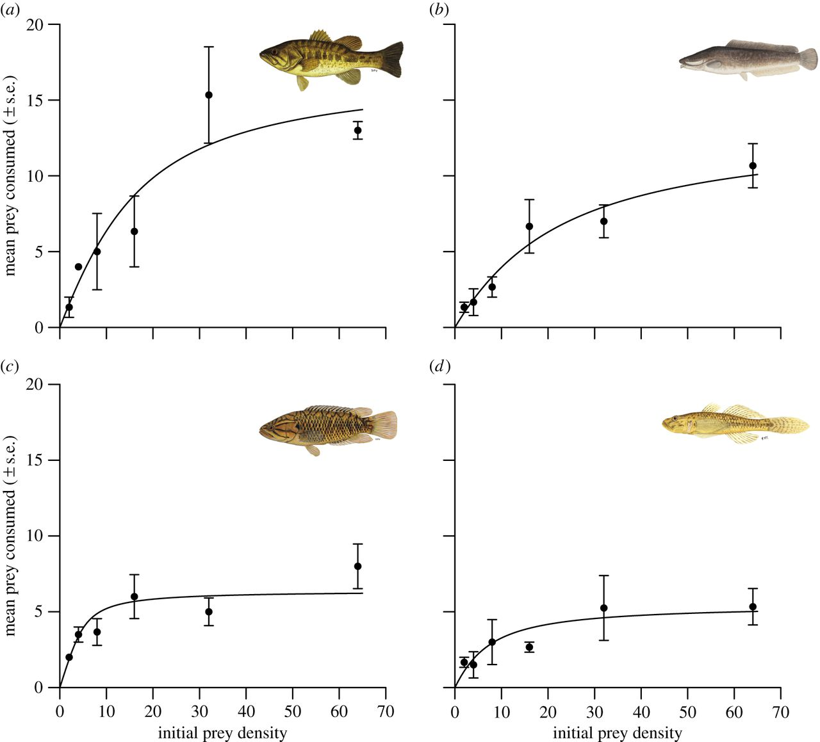

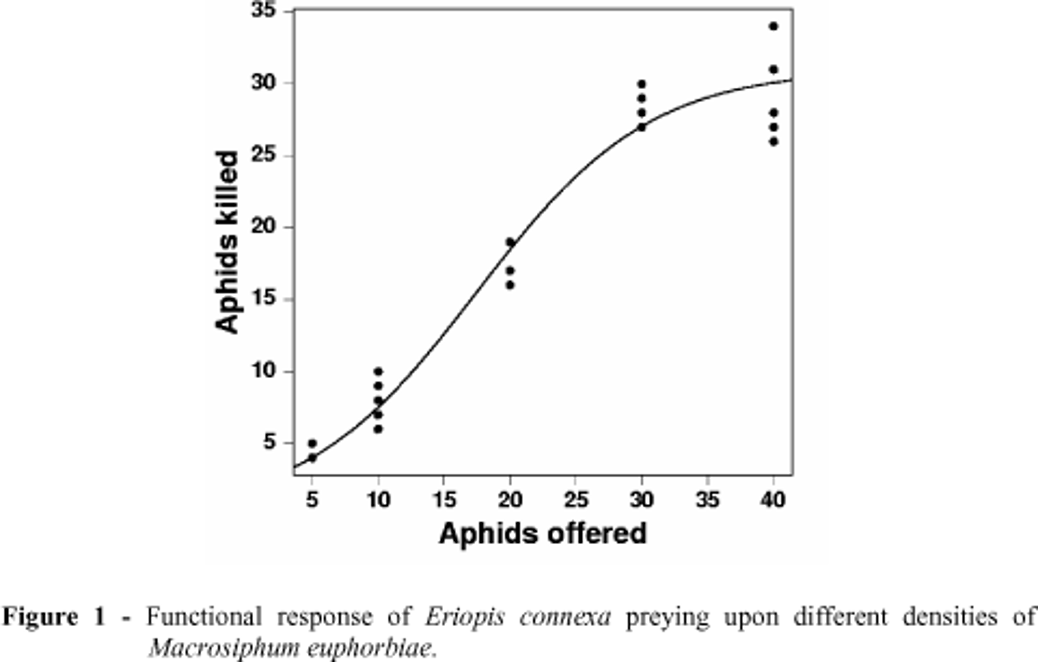
Functional response: type III
Increasing, then decreasing proportion
Switching, sinusoidal
Predator ignores prey when there are only a few around as it is easier to hunt other foods. Once prey becomes more common, the predator switches to hunting it heavily
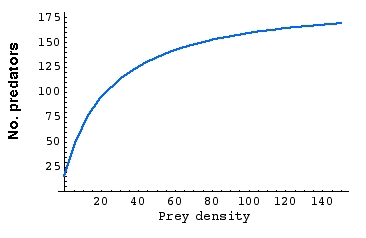
numerical response
Asymptotic increase in predators as prey increases
Leopold’s 5 Factors for Predator-Prey Interactions
Density of prey
Density of predator
Density & quality of alternate foods
Characteristics of prey
Characteristics of the predator
Predators can change reproduction when prey is abundant
Northern harrier polygyny
(when voles abundant)
Subadults breed more often
(when voles abundant)
Prey behavior: Herding and spacing: musk-ox & wolves
Group size of musk-ox increased with increased number of wolf sightings
Birth synchrony swamping predators
when many offspring are born at the same time
can reduce predation risk by overwhelming predators’ ability to capture all the young
altricial young
born very immature & helpless, requires extensive parental care for survival
prey w/ altricial young forced to stay
precocial young
born already very mature
prey w/ precocial young can move
trophic cascade: effect of a high-density of large herbivores
High densities of large herbivores like deer and elk can significantly alter plant communities, which affects other species of animals -- trophic cascades
isle royale
Moose population increased and crashed
Wildfire improved habitat
Wolves arrived and “culled” older, weaker individuals
In “balance” for a while, then difficult winters
Moose congregated; some range depletion
more calves were killed
healthy moose more vulnerable
(shifted predation pressure)
Wolf population grew to 50
Moose declined
Wolves fought, population crashed to 14-15
Moose increased 2,500 at peak
Mild winters, fewer wolves, better nutrition
Moose crashed to 500
L-V cycle!

Isle Royale Lessons
Things change
Long term studies needed
Unpredictable weather, fires, disease, etc.
Stochastic
Involves some element of chance
Wolves are individuals
Individual differences in behavior
Dominance
Attack strategy
why are predator-prey relationships hard to study?
“Buffer” species (alternate prey)
Generalists can switch when primary prey limited
Stay on territories and risk starvation OR disperse
Random effects can play a significant role
Secretive behavior
Diet analysis
Pred. removal: what happened when Beasom (TX) removed coyotes (short term) compared to when Kie removed coyotes long term?
Short term: doe:fawn ratios inc
Long term: doe:fawn ratio initially inc, but then increased deer populations over-browsed and the ratio fell
what happened when Kilgo (SC) removed coyotes for 3 yrs
Fawn survival doubled, then no change, then intermediate
Summary of how the removal of coyotes affected deer
Removal of predators inc deer short term, but malnutrition & disease caused the deer population to return to original level
Evidence of compensatory mortality factors
Predator removal does not work
effects of predator control on waterfowl
inc nesting success
female ducks had high mortality (unbalanced sex ratio)
predators can still return quickly & continuous removal is not practical
adequate
T or F: lower density in a large area is better than high density in a small area
true
What were the conclusions after Bromley did predator removal for quail?
Predator removal alone had little effect on quail productivity, but in conjunction with habitat improvement, productivity increased
do predators control prey?
somtimes they do, sometimes they dont
there are many other factors that affect prey
motivation for wolf control in alaska; downsides?
Game for sportsmen
Reduce livestock depredation
Recovery of depressed prey populations
Downsides:
In Alaska wolves keep moose below pop that habitat could support, except after a large fire
Bears important predators of moose too
Removing one predator could hurt the whole system
comprehensive management plan for deer-predator management
Monitor both deer and predator populations
Evaluate deer hunting success
Does predator control = more deer bagged?
Habitat condition monitoring
ARM -- adaptive resource management
explain the shift in predator management opinions around 1960s
historically, objective was to extirpate predators & all methods of control accepted
in 1960’s, concerns emerged
ecological role
inhuane
grazing on federal lands
coyote control methods
trapping
den hunting
shooting
poisoning
leopold’s opinions on predator control
1964
All native animals have value
Local control sometimes necessary
Branch of Predator and Rodent Control renamed Division of Wildlife Services (in USFWS)
cain’s opinion on poisons
Prohibited use of 1080 (poison bait)
Some said poisons were not the problem--it was how they were used
Ranchers, biologists, and public not on same page
public policy for predator control
Nonlethal preferred over lethal
Control should be justified economically & ecologically
Complex market forces
Complex ecological communities
The Wildlife Society
Position statement on animal damage control
effect of coyotes in the southeast
Low fawn survival (AL, SC, NC)
Coyotes are leading cause of mortality
Cover does not appear to drive survival
Coyotes can have profound impacts on deer population dynamics (Chitwood et al. in press)
Removal may not be perfect solution
consumer types: herbivores
Quality most important, not quantity
A lot of low quality forage
“starve” with full stomach
consumer types: carnivores
Quantity most important, not quality
Limited amount of high quality prey
Can’t catch enough to survive
relationship between energy requirements & body weight
Energy requirements are inversely related to body weight
Small animals hv higher requirements
large animals hv lower requirements

energy sources: carbs (small & large)
Small molecules - sugar (glucose, sucrose)
Digests quickly
Large molecules -- cellulose, lignin
Lignin part of the cell wall as plant matures
Physical barrier to microbial enzymes
More lignin reduces quality of forage
A lot of energy, most animals can’t digest
energy sources: fats
High in energy, but slow to digest
Essential fatty acids - not used as fuel
energy sources: protein
Amino acids building blocks of proteins
Deer synthesize in gut from plant proteins
Crude protein and digestible protein
Herbivores:
Body maintenance 6%
14% lactation
Corn 2-8%
Average Forb 20-30%
Coevolution
One-upmanship between predators & prey
But also mutual dependency
Ex: Seed dispersar, Scatter hoarding (Squirrels & acorns)
Defenses by plants
Spines, chemicals
Defenses by animals
Coloration, speed