3.10 Mitosis
 Call Kai
 Learn
 Practice Test
 Spaced Repetition
 Match
 Flashcards
 Knowt Play
1/18

Earn XP
Description and Tags
3.10 Understand the role of mitosis and the cell cycle in producing identical daughter cells for growth and asexual reproduction.
19 Terms
What is the cell cycle?
the regulated sequence of events that occurs between one cell division and the next
Three phases of the cell cycle
interphase
nuclear division (mitosis)
cell division (cytokinesis)

What happens in interphase?
cell growth
synthesis of new organelles
DNA copying and checking of genetic information
What phases is interphase split up into?
G1 phase
S phase
G2 phase
What happens during the G1 phase?
cell increases in size in preparation for DNA replication
What happens during the S phase?
DNA replication occurs resulting in two identical sets of chromosomes
What happens during the G2 phase?
(same as G1)
period of growth and preparation for cell division
cell increases in size
Mitosis is the process of _______ ________
nuclear division
What does mitosis produce?
two genetically identical daughter nuclei
Stages which mitosis can be split into
prophase
metaphase
anaphase
telophase
Diagram of a chromosome

Mitosis Stage 1: prophase
chromosomes condense and are now visible when stained
nuclear membrane dissolves
centrosome replicates and moves to opposite poles of the cell, forming spindle fibres

Mitosis Stage 2: Metaphase
spindle fibres continue to extend from centrosomes
chromosomes line up at the equator of the spindle
spindle fibres reach the chromosomes and attach to the centromeres
each sister chromatid is attached to a spindle fibre originating from opposite poles
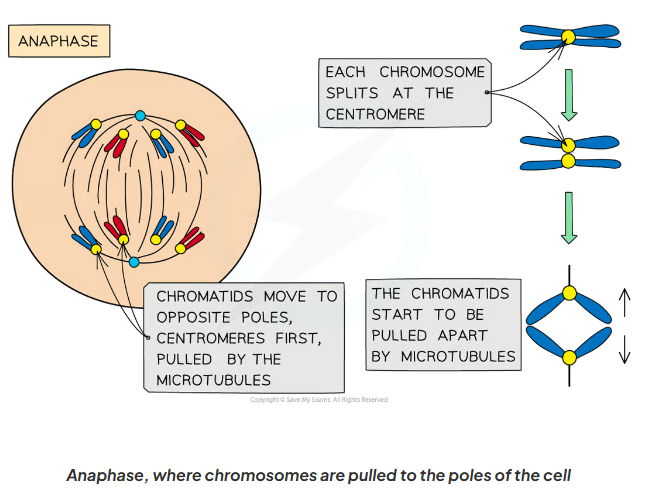
Mitosis Stage 3: Anaphase
sister chromatids separate at the centromere
spindle fibres begin to shorten
separated sister chromatids (now called chromosomes) are pulled to opposite poles by the spindle fibres
Mitosis Stage 4: Telophase
spindle fibres break down
chromosomes decondense
nucleoli/nucleolus form
nuclear membrane/envelope forms
two separate nuclei/sets of chromosomes or sets of chromosomes arrive at opposite sides of the cell

Cytokinesis
after the nucleus has divided into two genetically identical nuclei
cell membrane and cytoplasm divided
to create two genetically identical daughter cells
Mitosis images

Mitosis EM images

Reasons for division
used in asexual reproduction
required for growth of multi cellular organisms
repair damaged tissue