MCAT CHEM (gen and orgo)
 Call Kai
 Learn
Learn Practice Test
 Spaced Repetition
 Match
Match Flashcards
 Knowt Play
1/24

There's no tags or description
Looks like no tags are added yet.
Name | Mastery | Learn | Test | Matching | Spaced | Call with Kai | Chat |
|---|
No analytics yet
Send a link to your students to track their progress
25 Terms
Half-life problem: 1.5 half lives have passed, what is the concentration?
1 half life: concentration /2
0.5 half life= 1/sqrt 2 =0.707 MEMORIZE .7 (multiply this)
*Another easy way is to look at starting concentration, divide that by half see where that gets you on the x axis, and then see how much you need to add on based on that to get the second part of the half life then divide the answer to that by the concentration to get the concentration
Alpha Decay
2 protons + 2 electrons lost
→ mass # is -4
→ atomic # is -2
*Away with 4
Beta(-) decay
1 electron lost
→ mass stays the same
→ atomic # is + 1
→ goes from neutron to protron
Beta(+) decay
1 positron lost
→ Mass # is the same
→ atomic # is - 1
→ protron to neutron
Gamma Decay
High energy PHOTON comes out, mass and atomic # stays the same,
Radioactive Decay - where does it occur
Nucleus
Finding the amount of IONS present in a sample
Must use AVOGADRO’S NUMBER (6.02 × 10^23)
Mass number
Protons + Neutrons (Mass number + protons)
Valence Electron problem
Say it gives you 1s2 2s2 2p6 3s2 3p6 4s2 3d10 4p1
You would look for the highest energy level → 4
Count those electrons: 1 + 2 = 3
thats how many valence electrons are in that element
If you wanna see how many electrons are left if those are lost, find the number of protons because if its neutral then that number will be the same as the electrons, then you just subtract from that number
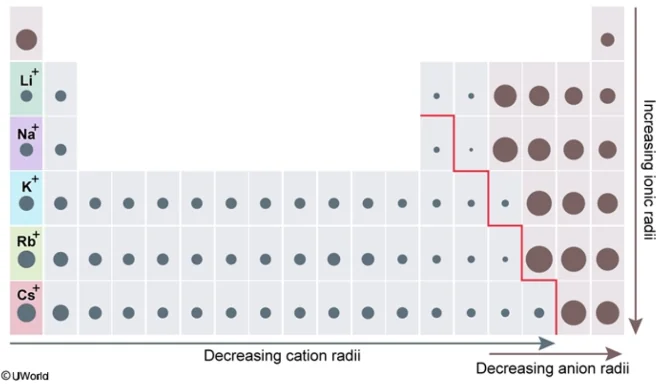
Ionic Radii Trend
Division between the metals and non metals
What do you look at when trying to compare two elements to see if they have similar chemical behavior?
You look at the number of VALENCE ELECTRONS, because those determine the chemical behavior.
Look at the same column, this will tell you same number of valence electrons and therefore the stability
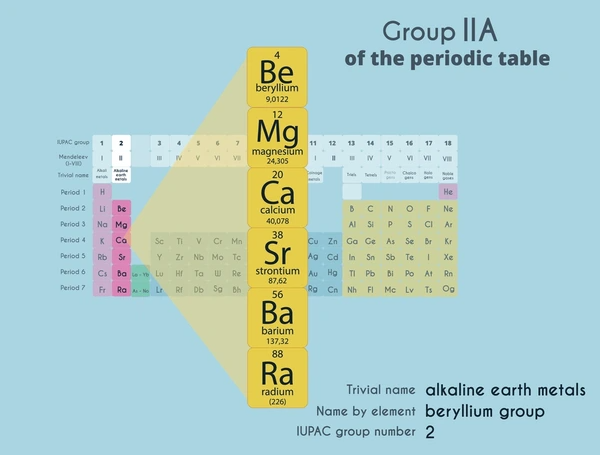
Alkaline-Earth Metals (IIA)
2, Down, H2
2= forms +2 ions
Down → reactivity increases down the group
H2 → react with water to form hydrogen gas
They are group 2 metals
Representative Elements
Elements OUTSIDE of the periodic table (middle groups 3-12 is just boring transition metals)
The elements that show the most predictable periodic trends and represent the major families of the periodic table
Groups 1,2,13-18
Group 1 → alkali metals
Group 2 → alkaline-earth metals
Group 17 → halogens
Group 18 → noble gases
Pauli Exclusion Principle
The “spin” principle
No two identical particles with half integer spin can occupy the same quantum state at the same time, also each orbital can only contain a maximum of 2 electrons (with opposite spin)

Nuclear Charge (nuclear decay)
Z eff - Z - S
Z= atomic number
S= shielding constant or number of core electrons → to find this, subtract the number of valence electrons based on what group it’s in
Ex. 18F vs 18O
Same # of core electrons bs they are both in period 2
Fluroine has one more proton, so it has a higher Zeff
Diamagnetic vs Paramagnetic
Diamagnetic: all electrons are paired in their orbitals (filled)\
Paramagnetic: contains at least one unpaired electron
Polarizability
the extent to which an electron cloud of an atom can be distorted by an external charge or by an applied electric field to produce a dipole
Electronegativity
Tendency of an atom to attract electrons within a bond
Electron affinity
assesses the tendency of an atom to accept an additional electron by measuring the energy change when an electron is added to an atom
Ionization energy
(opposite of electron affinity)
measures the energy required to REMOVE an electron from an atom
Which group on the periodic table has the LOWEST 2nd ionization energy?
Group 2 → first ionization removes the ns1, second will remove the remaining valence electron, which is relatively easy to remove
NOT group 1, it would have a LARGE 2nd ionization because after losing its first electron, it has a noble gas configuration and the second electron would have to come from the core
What volume does 1 mol of gas occupy at STP (standard temperature and pressure)
22.4 L/mol (using the ideal gas law)
Finding Mass Percent (%)
Mass of solute / total mass of solution *100
total mass will be solute + solvent mass
ethyl alcohol in water - mass of ethyl alcohol / mass of ethyl alcohol + mass of water
If a liquid is cooled
Its volume decreases
If an object is less dense than the surrounding fluid
It will float