Amino acids and protein folding
 Call Kai
 Learn
 Practice Test
 Spaced Repetition
 Match
 Flashcards
 Knowt Play
1/82

There's no tags or description
Looks like no tags are added yet.
83 Terms
Describe the traits of aliphatic amino acids (4)
hydrocarbon chains of variable lengths and branching
non-polar, hydrophobic
cluster together in protein structures, away from water
methionine contains an S
Name the aliphatic amino acids (5)
alanine ala a
valine val v
leucine leu L
isoleucine ile i
methionine met m
describe the traits of aromatic amino acids (5)
•Stable ring of atoms with shared, delocalised electrons
•Larger and variable hydrophobicity
•Tyrosine has a hydroxyl (OH) group → hydrogen bonds
•Nitrogen in tryptophan indole ring → hydrogen bonds
•π-stacking – aromatic rings stack on top of each other
name the aromatic amino acids (3)
phenylalanine, phe, f
tyrosine, tyr, Y
tryptophan, trp, W
Describe the traits of polar amino acids (3)
•Hydrophillic – prefer to interact with water outside the protein, or with each other through hydrogen bonds
•Histidine can also be considered polar
•Cysteine can form disulfide bonds
name the polar amino acids (5)
cysteine, cys, c
serine, ser, s
threonine, thr, T
asparagine, asn, n
glutamine, glm, q
describe the traits of charged amino acids (4)
•Ionisable sidechains – become charged in the cellular environment
•Basic amino acids are positively charged
•Acidic amino acids are negatively charged
•Histidine is not always/fully charged
name the basic amino acids (3)
lysine, lys, k
arginine, arg, r
histidine, his, H
name the acidic amino acids (2)
aspartic acid, asp, d
glutamic acid, glu, E
Beer-Lambert Law
A = ε c l
A = absorbance
ε = extinction coefficient
c = concentration
l - path length
calculating the extinction coefficient
5690(#Tryptophans) + 1280(#Tyrosines)
zwitterionic form definition
molecule where net charge is 0, but atleast one functional group has positive charge, and atleast one functional group has negative charge.
isoelectric point (pI)
pH at which particular molecule carries no charge
pH below pKa, weak acid is…
protonated
pKa below pH, weak acid is
dissociated
CORN rule spells CORN
L amino acid
CORN rule spells not corn
D amino acid
priority rule has priority groups highest to lowest clockwise
R amino acid
priority group has priority groups highest to lowest anticlockwise
S amino acid
the only natural amino acid that is R
L-cysteine
absolute nomenclature (r / s)
uses relative ranking of the priority of various functional groups, based on molecular weight
Label groups from 1 - 4, 1 having the highest MW
flip so lowest priority group is pointing backwards
priority groups 1 - 4 clockwise, R
priority groups 1 - 4 anticlockwise, S
Nomenclature L or D
flip molecule horizontal so H is pointing towards you
Look down H-C bond
clockwise CORN - L amino acid
clockwise CONR - D amino acid
What’s more common: L or D amino acids?
L amino acids
Amino acid shape dictates ____ shape and protein ____ determines _____
protein
structure
function
Dextrorotatory / +
Amino acid rotates plane polarised light in CLOCKWISE direction
LEVOROTATORY / -
amino acid rotates plane polarised light in COUNTERCLOCKWISE direction
Proteins are ______, so they are a series of amino acids linked together by ____ bonds, and so can be referred to as _____
polymers
peptide
polypeptides
peptide bonds are formed from the reaction of the _____ group of one amino acid with the ______ of another, in a ____ reaction
carboxyl
amino
Condensation
peptide bond stable (in absence of catalyst) in water for ____
~1000 years
residue
each amino acid unit in a polypeptide chain
why does a polypeptide chain have polarity
ends have opposite charges
polypeptides have regular repeating ____ or ______
backbone or main chain
varying region of polypeptide compromising ______
distinctive side chain
the polypeptide backbone is rich in hydrogen bonding potential because the…
the carbonyl groups are hydrogen bond acceptors
NH groups are hydrogen bond donors
most polypeptide chains contain _____ amino acid residues
50-2000
average mass of amino acid
mass of most proteins between ___
110 Da / 110g/mol
5500 Da and 220000 Da, or 5.5kDa and 22.5kDa
Polypeptides can form tightly packed _____ because peptide bonds are ____-
globular structures
peptide bonds are uncharged
peptide bonds have partial ____ character, so they are ____ with limited rotation
double bond
planar
what’s longer, a single bond or a double bond?
single bond
peptide bonds in proteins prefer the _____ configuration due to unfavourable ______ in the cis form
trans
steric clashes
sterich clash definition
when two atoms, not covalently bonded to each other, are impossibly close to each other
2 configurations, or ________ are possible for a peptide bond: cis or trans, explaining how the two _____ are positioned about the peptide bond
geometric isomers
alpha carbon atoms
Phi Φ
dihedral angle of rotation about the bond between nitrogen and alpha carbon atom
Psi ψ
dihedral angle rotation about the bond between an alha carbon atom and a carbonyl carbon
Ramachandran Plot
plot that assesses all possible conmbinations of phi and psi
patches of favoured angles define secondary structure
secondary structure
local spatial conformatino of the protein backbone, and its stabilisation through hydrogen bonding
alpha helices (6)
rod-like structure
tightly coiled backbone
side chains arrayed around the outside
rise of 5.4 Å per turn (1.5 Å per residue)
strongly stabilised by hydrogen bonds, formed between i and i+4 residues
3.6 residues per helical turn (12 main chain atoms)
dihedral angles in an alpha helix
phi= -57 degrees
psi - -47 defrees
Why do alpha helices have an electronic dipole (dipole movement)
N terminus - delta pos and stabilised by negative charged residues, can bind to negatively charged molecules eg phosphate
C terminus - delta negative, stabilised by positive charged residue
alpha helices can present chemically _____ surfaces
“distinct”
helical wheels have angles of 100 degrees (360 / 3.6)
polar / hydrophilic on one surface, hydrophobic on the other → amphiphilics
structure of b strands (2)
almost fully extended
side chains of adjacent amino acids point in opposite directions
dihedral angles of amino acids in beta strand
phi: -120
psi: +120
structure of b sheets (2)
formed by linking to or more b strands by hydrogen bonds
adjacent chains in a b sheet can run in opposite directions (antiparallel) or in the same direction (parallel)
hydrogen bonds for antiparallel beta sheets are between…
one amino acid’s NH and CO group of another amino acid on the adjacent strand
parallel beta sheet hydrogen bond
one amino acid on one strand with 2 amino acids on the adjacent strand
why don;t beta sheets have a dipole
dipoles on adjacent amino acids cancel out
beta sheets cannot be ____ because of the _______ between sidechains, so they ___ to minimise _______ of the side chains, but retain maximum ___—-
planar
steric clashes
twist
conformational energies
hydrogen bonding
lower conformational energy…
higher stability
amino acids with longer side chains prefer…
alpha helices
beta turns /hairpin bends/loops (3)
loop regions in secondary structure, to fold back in on itself
typically lie on the surface of proteins
often participate in protein=protein interactions
Circular dichroism spectroscopy (3)
utilises circularly polarised light
chiral molecules absorb circularly polarised light differently
useful for distinguishing protein secondary structure
Hydrogen bonding (4)
electrostatic attraction between a lone pair of electrons on an electronegative atom and a hydrogen atom that is bonded to an electronegative atom
between NH and CO on secondary structure
part of the side chain reactions that drive the formation of tertiary structure
neutralises polarity in the hydrophobic core of proteins
hydrophobic effect (5)
hydrophobic regions of a protein cluster together, minimising interactions with water
entropic, not a formal interaction
water molecules form hydrogen bonds amongst themselves but cannot form favourable interactions with hydrophobic molecules
A) ordered / low entropy, limited number of conformations for H2O molecules to maintain H bond network
B) less ordered / higher entropy, decreases hydrophovic water interface, fewer ordered water molecules
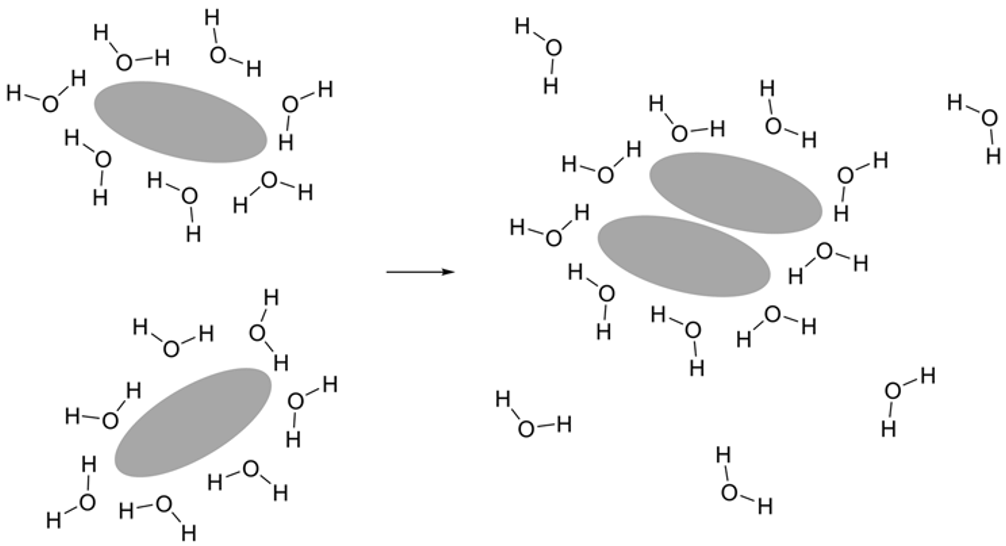
Van der Waals interactions (4)
between uncharged atoms held in proximity
many weak interactions produce significant cumulative stability
facilitates dense packing of protein hydrophobic cores
random movement of electrons generates transient electron dipole, inducing dipole in nearby atom
ionic interactions (2)
classic ionic bond: one atom donates an electron to fill the valence shell of another
opp. charged amino acid sidechains held in proximity will form electrostatic attractions
pi interactions (6)
non covalent interactions involving electron density of aromatic rings
6 p orbital overlap form delocalised electron cloud above and below plane
partial negative charge in cloud
partial positive at edge of rings
pi stacking: opposite particle charges of edge and cloud in proximity cause different orientations
cation pi interactions: positive charge can form favourable interaction with negative cloud of electron density
di sulfide bonds can link together 2 _____ residues
cysteine
unfolded polypeptides are ____, they move ____ to form ____ interactions and the most ____ conformation.
Once part of a folded structure has formed, it may ___ the likelihood of subsequent _______ interactions forming.
_____ to ____ energy conformation, often assisted by ____ ____ within cells
dynamic
randomly
stable
increase
favourable
cascade
lowest
chaperone proteins
The _____ effect of all interactions within a protein lead to a _____ _____ structure. Different interactions and bonds ____ eachother
cumulative
particular folded
affect
β-mercaptoethanol
reducing agent - breaks sulfide bonds
8M Urea
chaotropic agent - disrupts non covalent interactions e.g. ionic

Why did this happen?
thermodynamics: decrease in free energy as scrambled ribonucleases are converted to stable, native confirmation
alpha keratins (4)
quaternary structur
main component in hair, claws, nails, hooves
evolved for varying strength and rigidity
formed from intertwined alpha helices, stabilised from disulfide bonds
quaternary structure
arrangement of protein subunits into 3D complexes
post translational modifications (PTMs)
modulate protein function
e.g. phosphorylation, lipidation, glycosylation, addition of proeins, proteolytic processing
escherichia coli as a producer of proteins in the laboratory (4)
fast, cheap, easy to use
can be manipulated to produce any protein by transformation of a plasmid
can select for genes which have been successfully transformed due to genes for antibiotic resistance
recombinant expression induced by IPTG
protein purification workflow with e coli (5)
e coli cells produce desired protein
cell lysis using chemical, homogenisation or sonication (high frequency sound waves) protocols
chromatography - separate protein from interest from unwanted bacterial proteins in the lysate
sds - page / gel electrophoresis
protein assay
column chromatography 3 types and function
size exclusion: separation depends on molecular size
ion exchange - separation depends on molecular charge
affinity chromatography - siparation depends on specific binding interaction
size exclusion chromatography (SEC)
aka gel filtration
separates proteins based on molecular size, with porous gel beads

ion exchange
proteins separated based on difference in molecular charge
wanted proteins bind to oppositely charged beads
then removed using salt or pH gradients

affinity chromatography
proteins separated based on specific binding interactions
e.g. antibody affinity chromatography, Ni-NTA column

Checking protein purity using gel electrophoresis
use SDS PAGE
SDS - anionic detergent, denaturing proteins and binding to them, so that they have a negative charge
migration towards anode separates proteins according to their size
protein assay (3)
determining concentration of protein
e.g. measure light absorbance at 280nm
fluorescent dye / colour-metric