Economics Terms Chapters 6 and 19-22
 Call Kai
 Learn
Learn Practice Test
 Spaced Repetition
 Match
Match Flashcards
 Knowt Play
1/85

Earn XP
Description and Tags
exam prep
Name | Mastery | Learn | Test | Matching | Spaced | Call with Kai | Chat |
|---|
No analytics yet
Send a link to your students to track their progress
86 Terms
price elasticity of demand (Eₚ)
the responsiveness of quantity demanded of commodity to changes in its price —> or the percentage change in quantity demanded divided by the percentage change in price
price elasticity of demand (Eₚ) formula
- percentage change in quantity demanded
Eₚ = ————————————————————
- percentage change in price
price of elasticity example
price of petroleum increases 10 percent, quantity demanded decreases 2 percent

price elasticity: relative quantities ONLY and always NEGATIVE
elasticity measuring the change in quantity relative to the change in price (measurement units don’t matter)
law of demand states an increase in price decreases the quantity demanded (but, by convention, the minus sign is ignored
formulas to calculate elasticity
(see image)

elasticity calculations example
price elasticity of 0.53 = each 1 percent decrease in price generated a 0.53 percent increase in the quantity of Tesla vehicles purchased

price elasticity ranges….
elastic demand
unit elasticity of demand
inelastic demand

elastic demand
a given percentage change in price will result in a larger percentage change in quantity demanded —> Eₚ > 1 or % change in Q > % change in P →inverse relationship between changes in prices and total revenue
unit elasticity of demand
the quantity demanded changes exactly in proportion (equal) to the change in price —> Eₚ = 1 or % change in Q = % change in P →changes in price do not change total revenue
inelastic demand
a given percentage change in price will result in a less-than-proportionate (smaller) percentage change in quantity demanded —> Eₚ < 1 or % change in Q < % change in P → positive relationship between change in prices and total revenue
perfectly inelastic demand (extreme elasticities)
demand that exhibits zero responsiveness to price changes (no matter what price is, quantity demanded remains the same) = zero elasticity, demand curve is a vertical line

perfectly elastic demand (extreme elasticity)
the slightest increase in price leads to zero quantity demanded = infinite elasticity, the demand curve is a horizontal line

total revenue formula
product of price per unit x number of units purchased
price elasticity of demand and total revenue relationship
(see image)

determinants of the price elasticity of demand
the existence/number of substitutes
the share of a consumer’s total budget devoted to purchases of that commodity
the length of time allowed for adjustment to changes in the price of that commodity
the existence of substitutes (determinant of Eₚ)
the closer the substitutes and the more substitutes there are, the more elastic the demand
share of budget (determinant of Eₚ)
the greater the share of the consumer’s total budget spent on a good, the greater the price elasticity
time for adjustment (determinant of Eₚ)
the longer any price change persists, the greater the elasticity of demand (other things held constant), —> elasticity of demand is greater in the long run than in the short run
short run vs. long run (time for adjustment - dofEₚ)
short run: a period too short for consumers to fully adjust to a price change
long run: a period long enough for consumers to fully adjust to a change in price, other things being constant

cross price elasticity of demand (Eₓᵧ)
the percentage change in the amount of an item demanded (holding its price constant) divided by the percentage change in the price of a related good
cross price elasticity of demand (Eₓᵧ) formula
- % change in amount of good X demanded
Eₓᵧ = ————————————————————
- % change in price of good
cross prices and substitutes
Eₓᵧ > 0 —> an increase in the price of X would increase the quantity of Y demanded at each price
cross prices and substitutes
Eₓᵧ < 0 —> an increase in the price of X would decrease the quantity of Y demanded at each price
income elasticity of demand (Eᵢ)
the percentage change in the amount of a good demanded (holding price constant) divided by the percentage change in income or the responsiveness of demand to changes in income (holding the good’s relative price constant)
income elasticity of demand (Eᵢ) formula
- % change in amount of good demanded
Eₓᵧ = ————————————————————
- % change in income
price elasticity of demand displayed on a curve
refers to a movement along the curve in response to price changes
income elasticity of demand displayed on a curve
refers to a horizontal shift in the demand curve in response to changes in income
price elasticity of supply (Eₛ)
the responsiveness of the quantity supplied of a commodity to a change in its price or the percentage change in quantity supplied divided by the percentage change in price
price elasticity of supply (Eₛ) formula
- percentage change in quantity supplied
E = ————————————————————
- percentage change in price
perfectly elastic supply
the quantity supplied falls to zero when there is the slightest decrease in price (the supply curve is horizontal at a given supply)

perfectly inelastic supply
the quantity supplied is constant, no matter what happens to the price (the supply curve is vertical at a given price)

price elasticity of supply and time adjustment
the longer the time allowed for adjustment, the more resource can flow into (out of) and industry through expansion (contraction) of existing firms
the longer the time allowed for adjustment, the entry (or exit) of firms increases (or decreases) production in an industry

elasticity of demand measures…
how sensitive the quantity demanded of a good/service is to a change in price
the responsiveness of consumers to changes in prices in the market
utility
the want-satisfying power of a good or service (the ability of a good or service to satisfy a want)
utility analysis
the analysis of a consumer decision-making based on utility maximization
util
a representative unit by which utility is measured
marginal utility
the change in total utility due to a one-unit change in the quantity of a good or service consumed
the extra satisfaction a person gets from consuming one additional unit of a good or service
change in total utility
————————————————— = marginal utility
change in number of units consumed
utility theory (marginal section)
marginal utility falls as more is consumed
marginal utility equals zero when total utility is at its maximum
when marginal utility becomes negative, goods in effect become “bads” →a rational consumer will stop consuming the good even when it’s available at a price of 0
types of marginal utility
positive: each extra item adds to overall satisfaction
zero: an extra item adds no satisfaction
negative: an extra item causes discomfort or lowers total satisfaction
diminishing marginal utility
the principle that as more of any good or service is consumed, its extra benefit declines
increases in total utility from consumption of a good or service become smaller and smaller as more is consumed during a given time period
the law of diminishing marginal utility
extra satisfaction shrinks as consumption increases.
first unit: provides high satisfaction and value.
later units: provide smaller additions to total happiness.
as an individual consumes more of a commodity, the total level of utility (satisfaction) derived from that consumption increased →eventually, the rate at which it increases diminishes as more is consumed
consumer optimum
a choice of a set of goods or services that maximizes the level of satisfaction for each consumer, subject to limited income
substitution effect
the tendency of people to purchase cheaper commodities when expensive commodities of the same type are priced higher
principle of substitution
the principle that consumers shift away from goods and services that become priced relatively higher in favor of goods and services that are now priced relatively lower
(consumers shift to goods that are priced lower when prices of original goods rise)
purchasing power
the value of money for buying goods and services
if your income stays the same while the price of one good that you’re buying rises, your effective purchasing power falls (VV)
real-income effect
the change in people’s purchasing power that occurs when (other things constant) the price of one good that they can’t purchase changes
when that price rises, real income/purchasing power falls, and when that price decreases, real income increases
indifference curve
a curve composed of a set of consumption alternatives, each of which yields the same total amount of satisfaction
downward slope, not a straight line, convex

indifference map
a set of indifference curves
a higher indifference curve = possibility of higher rates of consumption of both goods (more preferred than a lower one, more is better than less)

budget constraint
all the possible combinations of goods that can be purchased (at fixed prices) with a specific budget

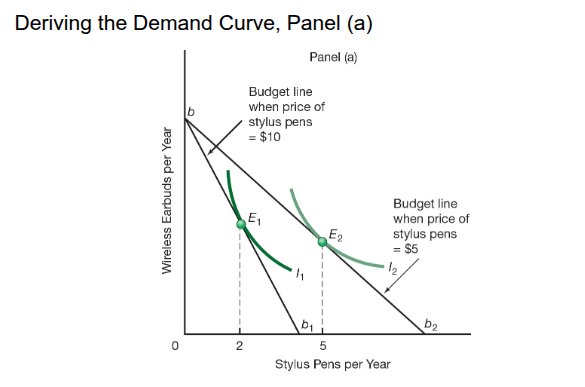
deriving the demand curve
when the price of one good changes, (holding both the price of another good and income constant) the budget line rotates, resulting in a new optimum point
demand curve slopes downward
economic rent
a payment for the use of any resource over and above its opportunity cost
ex. house rent: payment for use of land

economic rent for labor
entertainment figures would undoubtedly work for less than they earn, much of their rent occurs because specific resources cannot be replicated exactly (no one can duplicate todays most paid entertainment figures)
examples of economic rent for labor
paychecks delivered to: professional sports superstars, r&b entertainers, movie stars, world-class models, successful inventors and innovators, world-famous opera performers
economic rent and resource allocation
economic rent allocates resources to their highest-valued use
firms
an organization that brings together factors of production: labor, land physical capital, human capital, and entrepreneurial skill, to produce a product or service that is hoped to sell at a profit
seek to earn the highest possible returns
normally owns and operates one “plant” or facility in order to produce
the 3 legal organizations of firms
proprietorship
partnership
corporation
proprietorship (legal organization of firms)
a business owned by one individual who:
makes the business decisions
receives all the profits
is legally responsible for all the debts of the firm
advantages of proprietorships
is easy to form and end
all decision-making power is given to the sole proprietor
profit is only taxed once
disadvantages for proprietorships
is subject to unlimited liability:
a legal concept whereby the personal assets of the owner of a firm can be taken to pay off the firm’s debts
limited ability to raise funds
ends with the death of the proprietor
partnership (legal organization of firms)
a business owned/managed by two or more co-owners, or partners, who:
share the responsibilities and profits of the firm
are individually liable for all of the debts of the partnership
advantages of partnerships
easy to form and end
limits the costs of monitoring job performance
permits more effective specialization
subject only to personal taxation
disadvantages of partnerships
partners each have unlimited liability
decision-making is generally more costly than a proprietorship
dissolution occurs when a partner dies or leaves the firm
corporation (legal organization of firms)
a legal entity that may conduct business in its own name, just as an individual does
the owners of a corporation are shareholders who:
own shares of the firms profits
are protected by limited liability
the responsibility, or liability, of the owners of a corporation is limited to the value of the shares in the firm that they own
advantages of corporations
limited liability
continues to exist when owners leave
positioned to raise large sums of financial capital
disadvantages of corporations
double taxation (profits of firm and dividends)
portion of a corporation’s profits paid to it’s owners (shareholders)
separation of ownership and control
limited liability company (LLC)
a hybrid form of business enterprise that offers the limited liability of a corporation and the tax advantages of a partnership
accounting profit
total revenue - explicit costs
explicit costs
costs that business managers must take account of because they must be paid off
ex. wages, taxes, and rent
implicit costs
expenses that managers do not have to pay out of pocket and hence do not normally explicitly calculate
ex. opportunity cost of factors that are production-owned, owner provided capital, owner provided labor
normal rate of return (or opportunity cost of capital)
the amount that must be paid to an investor to induce investment in a business
the available return on the next-best alternative investment
economic profit
total revenue - total opportunity costs of all inputs used
total revenue - (implicit + explicit costs)
the goal of firms
profit maximization and utility (or satisfaction) maximization
pm: firms that can provide relatively higher risk-corrected returns will have an advantage in obtaining financing needed to continue or expand production
financial capital
funds used to purchase physical capital goods, such as buildings and equipment, and patents and trademarks
interest
price paid by debtors to creditors for the use of loanable funds
the payment for current rather than future command over resources
the cost of obtaining credit
determinants of the interest rate
length of loan, risk, handling charges
nominal rate of interest
the market rate of interest expressed in today’s dollars
real rate of interest
nominal rate of interest - anticipated rate of inflation
iₙ = iᵣ + anticipated rate of inflation
the allocative role interest
interest is a price that allocates loanable funds (credit) to consumers and businesses
allocates financial capital, thus ultimately allocating physical capital
present value (PV)
the value of a future amount expressed in today’s dollars
the most that someone would pay today to receive a certain sum at some point in the future

examples of present value
$105 to be received one year from now with an interest rate of 5%
PV₁ = $105/(1.05) = $100
for distant periods: $105 to be received two years from now with an interest rate of 5% per year, compounded annually
PV₁ = $105/(1.05)² = $95.24
discounting
the method by which the present value of a future sum or a future stream of sums is obtained
rate of discount
the rate of interest used to discount future sums back to present value

share of stock
a legal claim to a share of a corporation’s future profits (common stock)
common stock: incorporates certain voting rights regarding major policy decisions of the corporation
preferred stock: accords owners preferential treatment in the payment of dividends but does not include voting rights
bond
a legal claim against a firm
usually entitles its owner to receive a fixed annual coupon payment, plus a lump-sum payment at the bond’s maturity date
issued in return for funds lent to the firm
reinvestment
profits (or depreciation reserves) used to purchase new capital equipment
sales of stock are an important source of financing for new firms
reinvestment and borrowing are the primary means of financing for existing firms
inside information
information that is not available to the general public about what is happening in a corporation
one way to “beat the market,” although it is illegal and is punishable by substantial fines and imprisonment