FAH101 Final Exam
 Call Kai
 Learn
 Practice Test
 Spaced Repetition
 Match
 Flashcards
 Knowt Play
1/28

Earn XP
Description and Tags
Based on 2026 study slides
29 Terms
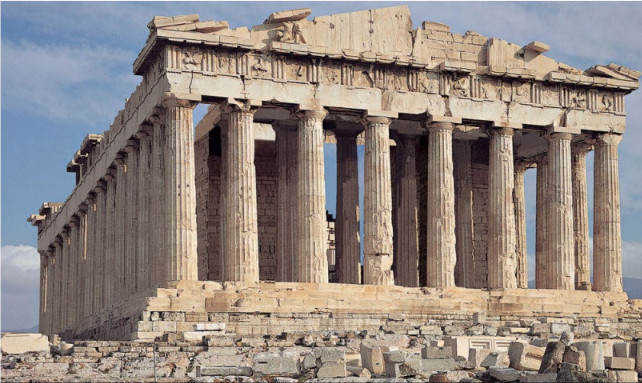
Parthenon, Architect: Iktinos, Artist: Phidias (sculptor), 447-432 BCE, Athens, pentelic marble. Rebuilt under Perikles.
A part of the Athenian Acropolis, a religious complex and center of the Panathenaic festival. Was built with careful attention to numerology (4:9) and optical refinements (curvature of stylobate, inward leaning of columns, entasis). Built according to a democratic, masculine ideal with friezes depicting the victory of order over chaos and barbarism (sack of Troy, Gigantomachy, Centauromachy, Amazonomachy)

Plan and Elevation of the Parthenon, Architects: Iktinos & Kallikrates, 447-432 BCE, Athens, pentelic marble.
Plan laid out in the cardinal directions (east on the right, rising sun). Columns placed with attention to numerology (formula = 2n + 1). Additional Adyton with four ionic columns, even though it’s a Doric temple; perhaps a claim to heritage from both mainland Greece and the western regions of Ionia.

The “Canon” or Doryphoros, Polykleitos, 440 BCE, ancient Greece, reconstruction of bronze original.
Only marble copies survive. Also known as the Treatise of Human Proportions, in accordance with the Classic ideal of the male nude: “Man is the measure of all things.” Important: contrapposto and chiastic composition for balance and interest in naturalism
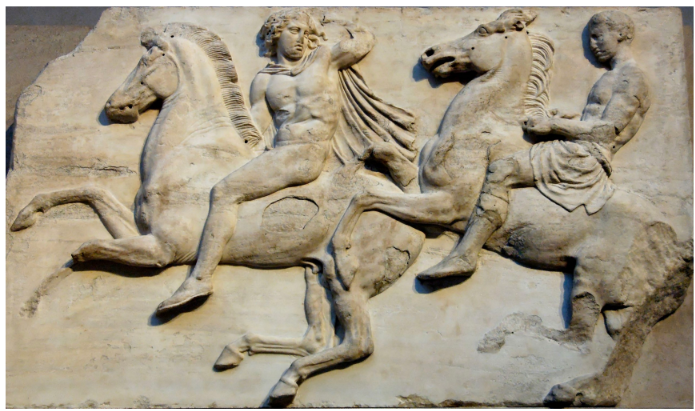
Cavalry (Riders) from The Parthenon Frieze (Ionic), Artist: Phidias, 447-432 BCE, Athens, pentelic marble.
Part of the ionic frieze on the wall around the naos (interior), lodged between interior columns and cella walls. Part of the Panathenaia. Low relief, no interest in likenesses/portraiture (democratic ideal)
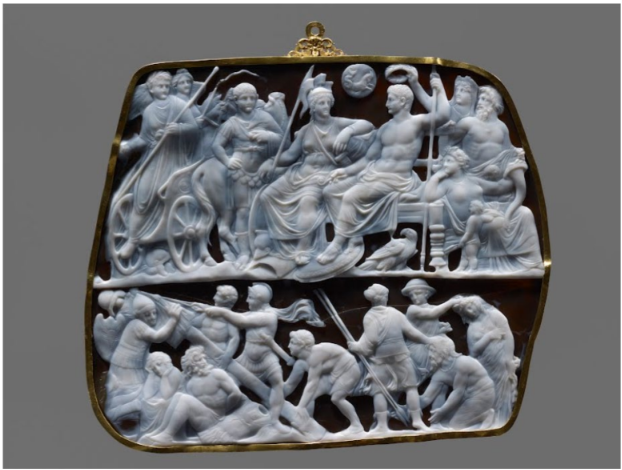
Gemma Augustea, Dioscurides, 9-15 CE, Rome (Augustan Court), sardonyx.
Shows the Roman interest in recognizable portraiture. A cameo: private commissions that circulated within the imperial family as gifts. Two distinct registers that show clear hierarchy
upper - Augustus and the gods, clear balance, larger, deification of Augustus and the Julio-Claudian dynasty
lower - Romans and defeated barbarians, dynamism, diverging from center
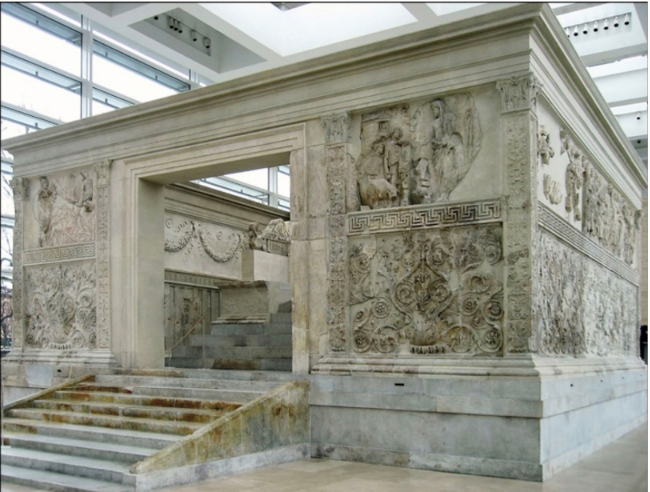
Ara Pacis Augustae (Altar to Augustan Peace), unknown artist, 13-9 BCE, Rome, carrara marble. Commissioned by Augustus.
Pax Romana, a peace through conquest. Shows several mythological scenes, as well as the imperial procession (portraiture, Augustus does not stand out). Evocation of Panathenaic procession, golden age of Periclean Athens.
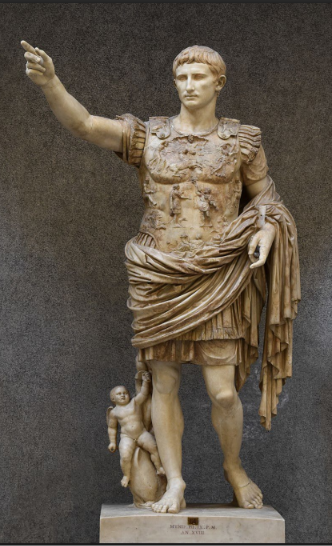
Augustus Prima Porta, unknown artist, 1st century CE, Rome, marble copy of bronze original (ca. 20 BCE).
Augustus’s classicizing portraiture (signature crab-claw curls), an ornate breastplate with a cosmic message (dawn of a new age on Rome), the orator pose (wisdom and the republic), Cupid riding a dolphin shows divine lineage.

Pantheon, began under Augustus, completed 126 CE under Hadrian, Roman concrete, brick, and stone (travertine, granite, imported marble, etc.)
A temple and monumental public architecture, featuring a large open interior, dome, and oculus. The dome as a symbol of grandeur, architectural achievement. Oculus as a symbol of the link between heavenly and earthly realms.

The Great Mosque of Damascus, built under Caliph ‘Abd al-Walid (Umayyad Dynasty), 716-705 CE, old city of Damascus, Syria
Covered in mosaics commissioned from the Byzantines, none showing human figures (religious taboo in Islamicate art), multiple ideas as paradise, garden, a bride (Ibn Jubayr). Both brings people in for religious worship and pronounces the power of the Islamic caliphate (architecture for a new religion and power)

Plan of the Great Mosque of Damascus, commissioned by Calip ‘Abd al-Walid, 716-705 CE
Has features specific to Islamicate relgious architecture: qibla wall (facing Mecca for prayer), mihrab, minbar (pulpit for preacher). An enclosed space with an open interior (community of congregants), as opposed to a open exterior and enclosed interior like the Parthenon.

Dome of the Rock, 690s, Jerusalem. Patron: Calip ‘Abd al-Malik
First monument constructed by the Umayyads, considered to be the first major work of Islamic art, third-most holy site in Islam. Octagonal in shape, and below the rocky outcrop is an underground room fashioned from a natural cave. Sacred space, commemorative structure, but not a mosque. Association between the rock and Muhammad’s acension to the heavens during his mir’aj. Also a victory symbol over the Byzantines.
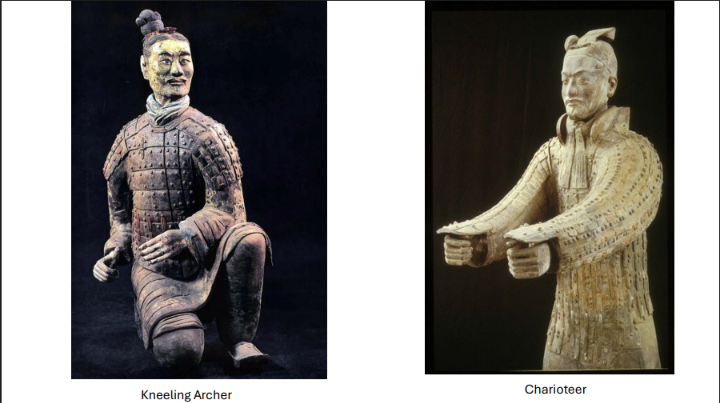
The Xi’an Terracotta Warriors, late 200s BCE, Xi’an, terracotta. Created under the orders of Qin Shihuangdi.
Made using a combo of casting (assembly line) + modelling and carving for individualization. Originally painted and held weapons. Realism not for viewing, but for the soldiers themselves to come alive in the afterlife. Part of the greater burial complex of Qin Shihuangdi, a monument stemming from an intricate worldview and imperial power (analogue world, continuation of imperial rule)

The Hours of Jeanne d’Evreux, Queen of France, Jean Pucelle, ca. 1324-28. Pages of The Betrayal of Christ & The Annunciation.
New and Old Testament, left and right. Made for 14yo Jeanne, queen and 3rd wife of Charles IV, conveying a message to her about reflection during prayer and giving birth to an exceptional male child (monkey, blind man’s bluff, Fido the dog - loyalty, faith)
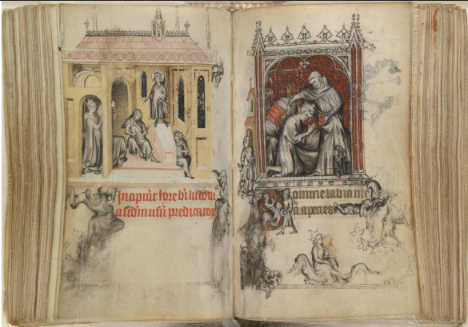
The Hours of Jeanne d’Evreux, Queen of France, Jean Pucelle, ca. 1324-28. Pages of Jeanne at St. Denis & Louis and his Confessor.
Louis XIV as a model Christian king buried at St. Denis (micro-architecture connected to Louis himself and a message of kingship), the idea of charity and submission to religious authority. Telling Jeanne to be faithful, conduct herself like previous royalty and she will be the mother of the future king.

School of Athens, Raphael, 1510-11. In Stanza della Segnatura, Vatican Palace.
Shows an intimate connection between Renaissance intellectuals and thinkers they admired from the Classical past (Leonardo-Plato, Bramante-Euclid, Michelangelo-Heraclitus, Raphael-Apelles
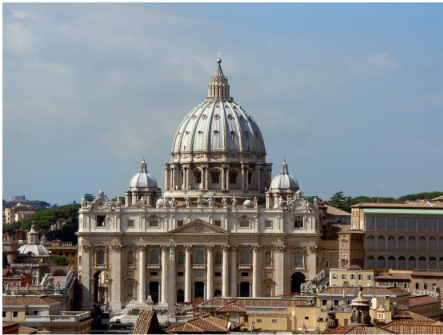
St. Peter’s Basilica, Dome: Michelangelo (construction began 1547), Facade: Carlo Maderno (construction began 1608), Rome, Italy. First commissioned under Pope Julius II.
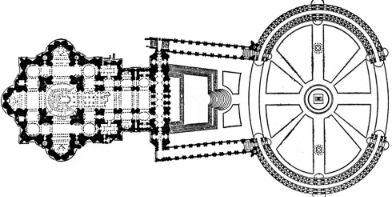
Plan of St. Peter’s Basilica, including courtyard designed by Gian Lorenzo Bernini

Baldacchino above St. Peter’s alter and tomb, combined Berinini, Borromoni, Carlo Maderno, Pope Urban VIII, 1627-31, cast bronze.

David, Bernini, 1623-24, Galleria Borghese, Rome, marble.

David, Michelangelo, 1501-04, originally located in Palazzo della Signoria, Florence, carrara marble. Originally commissioned by the Opera del Duomo.

Impression, Sunrise, Claude Monet, 1872, oil on canvas, France.

Haystacks at the End of Summer, Morning Effect, Claude Monet, 1891, oil on canvas, France

On the Balcony, Berthe Morisot, 1872, oil on canvas, France
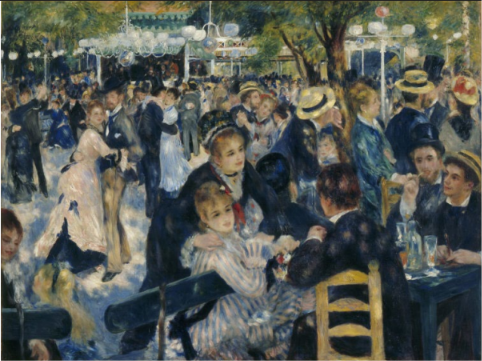
Ball at the Moulin de la Galette, Auguste Renoir, 1876, oil on canvas, Montmartre.

Les Demoiselles d’Avignon, Pablo Picasso, 1907, oil on canvas, France.

Guitar and Wine Glass, Pablo Picasso, 1912, cut-and-pasted newspaper, printed sheet music, laid and wove papers, oil, and charcoal on printed wallpaper mounted on paperboard.
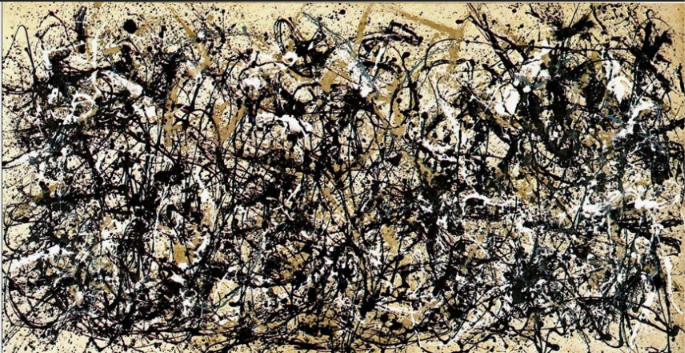
Autumn Rhythm (Number 30), Jackson Pollock, 1950, oil-modified alkyd resin (enamel paint) on canvas), the MET, NYC.
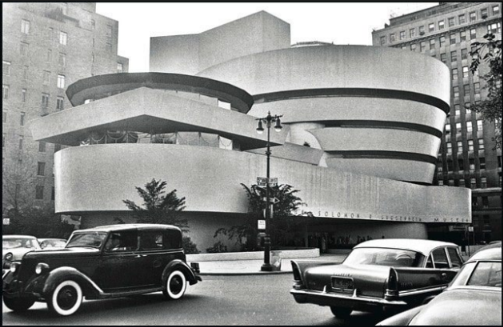
The Guggenheim Museum, Frank Lloyd Wright, 1957, steel, glass, reinforced concrete, New York.
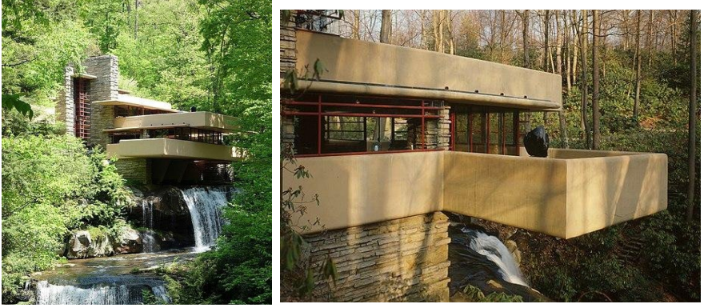
Falling Water, Frank Lloyd Wright, 1935-39, steel, glass, stone bricks, reinforced concrete, Pennsylvania.