Lecture 8: Economics of Discrimination~ Theory
 Call Kai
 Learn
 Practice Test
 Spaced Repetition
 Match
 Flashcards
 Knowt Play
1/28

There's no tags or description
Looks like no tags are added yet.
29 Terms
TOPIC 1) discrimination in Labor Markets (Taste Based)
Labor Market Discrimination
Two qualified individuals are treated differently solely because of gender, age, race, disability, etc.
They receive different wages in competitive markets, or are differentially included/excluded in hiring and promotion or other employment-related decisions.
In this context, “identical workers” means workers who have the same productivity
Discrimination vs. prejudice
discrimination- behavioral attitudes
prejudice- attitudes
Earning Equations Approach
Yi = outcome (income, earnings, or wage) of person i
Xi = vector of all productivity related to characteristics i (independent of Y and of discrimination- exogenous)
Zi = 0,1 (1 if you belong to the minority group)
ei= random error term
Assume X fully captures productive characteristics, and beta (B) are their “returns” in the labor market.
Alpha (a) represents the estimated effects of belonging to a minority group on one’s earnings (a<0 = discrimination, a>0 reverse discrimination).

Flaw within this model
1) Productivity may directly depend on Z- customers may be willing to pay more for a female actress or male athlete, is this a legitimate component of productivity?
2) B (production technology) may not truly be exogenous- technology may be designed to cater towards meaning identical technology could increase mens productivity mens productivity more relative to women’s.
3) X may also be endogenous- pre market discrimination could reduce X for members of the minority group (ex: schooling).
TOPIC 2: Beckers Employer Discrimination Model
Assumptions of the Model (5)
1) Competitive production and labor markets
2) employees are all equal (MPf = MPM ).
3) Employers maximize their utility (sum of profits + momentary value of employing members of particular groups.
4) d= taste parameters of the firm: "coefficient of discrimination” no discrimination (d=0), discrimination (d=+)
5) The discriminating employer acts as though there is disutility in hiring a female or minority worker, represented by wf + d. (d is not an actual cause but an implied disutility from hiring a minority).
SUBTOPIC A: Employment decision of a firm that does not discriminate
Declining because of diminishing marginal returns. Since capital is fixed, the more labor you add the less output increases unless you also add additional units of capital.

SUBTOPIC B: Employment decision of a discriminatory firm
What utility function are these firms attempting to maximize

Labor Demand

Graphical depiction of discriminatory firm
employers discriminate to varying degrees: a distribution of parameter di :
if enough employers w/ low di (willing to hire minorities) have a small or no wage gap.
The model predicts firms will have a segregated workforce- each firm only hires one group of workers.

Profits of discriminatory versus not discriminatory firms graphically
a firm that is discriminatory has negative profit so they exit the industry in the LR.
discriminatory firms can only stay open if the company is a monopsonist (monopoly over labor market), a monopoly, or an oligopoly because in this case the firm has large enough market power and does not face competition of firms hiring minority workers.
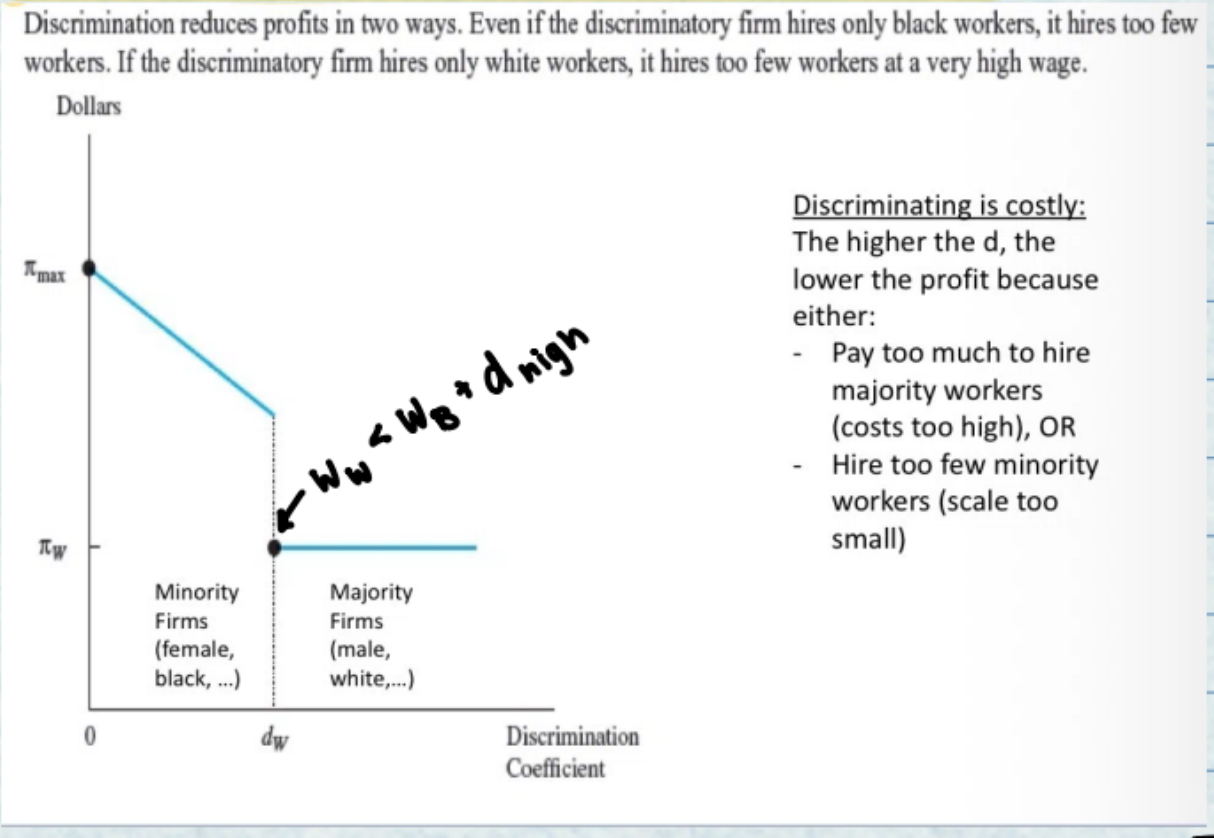
Key takeaways from the analysis of discriminatory firms (3)
1) Wage diffrentials wf < wm : arise if fraction of discriminating employers is large enough that demand for f workers when wages are equal across men and women are less than their supply. If there are enough non-discriminatory firms, discrimination is competed away.
2) Minority workers do not work for discriminating employers: if % of prejudice employers are large enough then some f group members will work for d>0 employers. THis implies that wf < wm (strength of prejudice at the margin determines wage gap.
3) Discriminators bare the cost: With free entry and exit these employers may be competed out of business. discriminating workers either hire too few workers, or pay their workers too much (in case of a monopoly or oligopoly or monopsony) to be efficient.
TOPIC 3: Employee Discrimination
employee discrimination
The firm does not experience a disutility from minority workers, but other employees do
Wage premium
Since employees from the majority firm dislike working with the minority, they feel that wm - d is occurring and require wage premium “d” to compensate.
How can paying the wage premium be avoided?
hiring only m or f group depending on whoever labor is cheaper. This, in turn, does not affect the firms profitability. However, this only works if the majority and minority are substitutable. In the case where they are compliments, segregation is not possible so firms profits are down.
TOPIC 4: Customer Discrimination
Customer Discrimination
Customers are prejudiced and have a taste for the majority.
They feel as though price charged by the majority worker is P, and that price that can be charged by the minority workers should be P’= P - d where d represents the discrimination coefficient.
How does this impact firms and how can they work around this?
The disutility customers when dealing with a minority worker makes the minority worker less productive (lower MRP).
Note, because this disutility arises upon interaction, a work around is to keep minority workers in minimal visibility roles.
Implications of both employee and customer-based discrimination (3)
1) wage differentials (minority workers earn less for identical productivity)
2) preferential hiring (minority workers of identical productivity are less likely to be hired).
3)competition will reduce discrimination (if we are dealing with employer discrimination).
TOPIC 5: Statistical Discrimination
What is statistical discrimination and what is it caused by?
Employees use observable characteristics to make inferences about another (relevant) attribute that is difficult to observe.
This arises from incomplete information (asymmetric information), uncertainty, & risk aversion by employers.
Model of statical discrimination (what is the chain of logic)
Worker applies for a job, and the employer sees..
Gender of applicant X= {m,f} or some other “signal” n of quit probability
The employer then applies the group data or assumption that applies to the gender group the applicants are a part of to individual applicants
Version 1: differences in means

Version 2: Equal mean different variance

Why care about statistical discrimination?
Statistical discrimination can’t be competed away, feedback effect (self reinforcing)
Does not reflect underlying preference (not motivated by bias or distaste “fair” in the sense that it treats individuals with the same “expected productivity” the same way.
Implicit discrimination
Idea adopted by economists (Bertrand et. al. 2005). Discriminators aspire to (and believe in) a non-discriminatory self-image, yet discriminate in certain situations due to implicit attitudes (and unconscious mental associations). Stress and time pressure are conduice ot implicit mental processes, which can be measured by the Implicit Association Test (IAT).