Basic concepts of the immune system
 Call Kai
 Learn
 Practice Test
 Spaced Repetition
 Match
 Flashcards
 Knowt Play
1/67

There's no tags or description
Looks like no tags are added yet.
Name | Mastery | Learn | Test | Matching | Spaced | Call with Kai | Chat |
|---|
No analytics yet
Send a link to your students to track their progress
68 Terms
What is immunology?
The study of the molecules ,cells, organs and systems responsible for recognition and disposal of foreign material
Other factors of immunology
-How the body components respond and interact
.
the desirable and undesirable consequences of immune interactions
.
The ways in which the immune system can be advantageously manipulated to protect against or treat diseases
Serology
The study and diagnostic examination of blood serum and other body fluids that can be used for detection of disease and monitoring of therapy through serological laboratory testing
.
Blood test done to identify the existence of antibodies and/or antigens associated with a microorganism
What does the immune system rely on
-Hematopoietic (bone marrow where immune cells are born)
.
-Vasculature (blood cells that transport immune cells)
.
-Lymphatic (lymph nodes, vessels and organs where immune response are coordinated)
classification of the 3 lines of defenses for immunity

What is innate immunity?
A nonspecific defense system that responds to foreign substances and includes structural defenses, inflammatory processes antimicrobial proteins and phagocytes
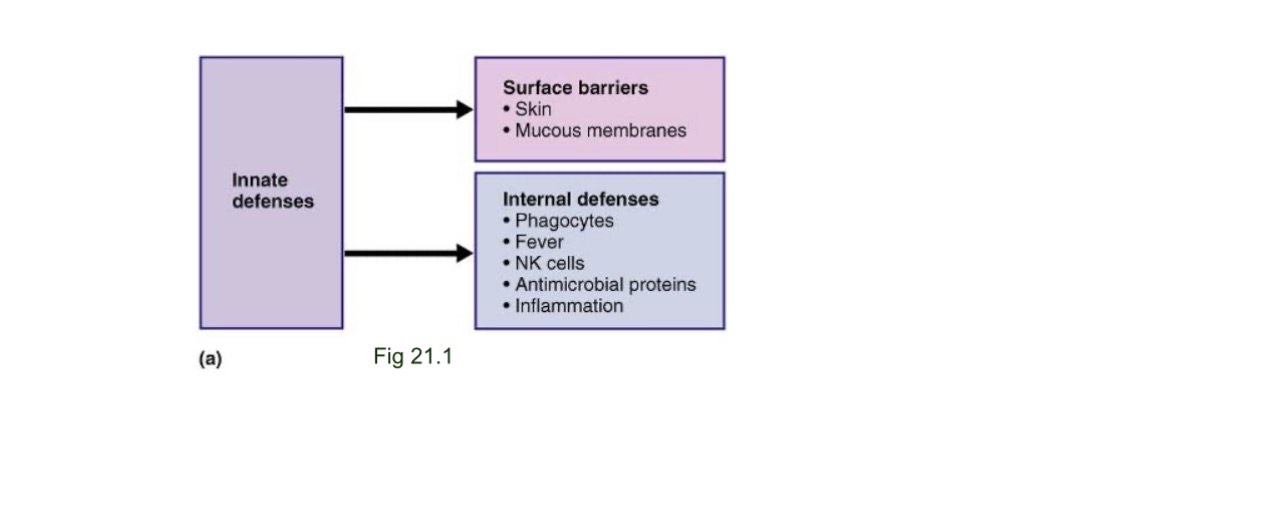
A specific defense system that responds to specific foreign substances and has the ability to remember antigens
.
Evolved mechanism allowing the body to recognize, remember and respond to a specific stimulus (an antigen)

Innate vs. Adaptive Immune System

Antigens
-immunogen
.
-molecules that have the ability to initiate adaptive immune responses e.g. components of pathogenic organism
Antibody
Immunoglobulin
.
Large Y-shape protein produced by plasma cells that is used by the immune system to identify and neutralize antigens
Primary lymphoid organs
Lymphoid organs where the lymphocytes differentiate and mature from stem cells
.
ie:- Thymus (site of T cell development)
.- and fetal liver and postnatal bone marrow (site of B cell development)
What are the main secondary lymphoid organs and tissues?
-Lymph nodes
.
- spleen
.
-mucosa-associated lymphoid tissue (found in association with mucosal surfaces) MALT
Function of spleen and why people without a spleen are more susceptible to some pathogens
responds to blood-borne antigens ; The spleen helps protect against pathogens that reach the bloodstream
What is the function of lymph nodes?
They protect the body from antigens that come from the skin or internal surfaces and are transported through lymphatic vessels
B lymphocytes ,T lymphocytes and natural killer cells
What are lymphoid cells?
Multipotent , hematopoietic progenitor cells that give rise to :
B lymphocytes ,T lymphocytes and natural killer cells
Helper T cells, cytotoxic T cells and regulatory T cells
Hematopoiesis
the process of blood cell formation
Summarize hematopoiesis
-Blood cells are derived from the pluripotent stem cell
.
--The PPSC eventually gives rise to multipotential hematopoietic stem/progenitor cells that develop along one of two major pathways: myeloid progenitors or lymphoid progenitors
.
-pluripotent stem cell gives rise to colony forming units

Myeloid progenitor gives rise to
-Granulocytes
Neutrophils
Eosinophils
Basophils
.
-Erythroblasts → red blood cells
.
-Megakaryocytes → platelets
.
Monocytes → macrophages after entering tissues
Lymphoid progenitor gives rise to
-B lymphocytes
.
-T lymphocytes
.
-NK (natural killer) cells
Three pathways of Hematopoiesis
-(Erythropoiesis)The formation of red blood cells
.
-(Leukopoiesis)The formation of white blood cells
.
-(Thrombopoiesis)The formation of platelets
Further classification of (Leukopoiesis)
-(Granulopoiesis)Formation of neutrophils, eosinophils and basophils
.
-(Lymphopoiesis)Formation of B cells and T cells
What are neutrophils and function ?
The most abundant type of circulating phagocyte that rapidly leaves the bloodstream during infection and kills microorganisms
.
Release cytokines and chemokines that prolong inflammation
What do primary neutrophil granules contain?
Cationic proteins, defensins, proteolytic enzymes ,lysozyme and myeloperoxidase used to kill bacteria
What are eosinophils?
-Granulocytes that play a crucial role in killing parasites and have a limited ability to participate in phagocytosis and regulate other immune cell functions
.
-Homeostatic regulator of inflammation suppresses inflammatory reaction to prevent excessive spread of inflammation
How do eosinophils help kill parasites?
Their granules contain toxic
.
Cell’s receptors interact with larval stages pf some parasites and damage them through oxidative mechanisms
.
-granules also damage antibody coated parasites
It is a polypeptide that interacts with eosinophils and causes them to grow and differentiate
Description of Basophils and function
Bi-lobed obscured nucleus in which chromatin filaments connecting them are not visible
.
-Release histamine and heparin contributing to inflammatory response to fight invading organisms
What receptors can Basophils bind to
IgE, IgG, complement, and histamine
What do basophil granules contain?
Heparin, chondroitin sulfate, peroxidase, platelet-activating factor and other substances
What do monocytes become after entering tissues and egs ?
Tissue-specific macrophages:
Osteoclasts
.
microglia cells
.
histiocytes
.
Kupffer cells

What are macrophages and importance ?
Highly specialized cells that remove dying or dead cells cellular debris and foreign materials
.
important in chronic inflammation, as the early stages of inflammation are dominated by neutrophil granulocytes, which are ingested by macrophages at the end of their lifespan
Two types of macrophages
-Wandering cells:
specialized macrophages ie : pulmonary alveolar macrophages / dust phagocytes function as the first line of defense against inhaled foreign particles / bacteria
.
-Fixed cells:
line the endothelium of capillaries and sinuses of organs such as bone marrow and spleen
.
In strategic locations such as the lungs ,liver ,neural tissue, bone, spleen and connective tissue
Explain how immunocontent cells are developed (bk)
