Psychology Chapter 5: Consciousness, Sleep & Psychoactive Drugs
 Call Kai
 Learn
 Practice Test
 Spaced Repetition
 Match
 Flashcards
 Knowt Play
1/21

There's no tags or description
Looks like no tags are added yet.
22 Terms
What are psychoactive drugs?
Substances that change mental processes, such as conscious awareness, mood, and perception.
Name three common examples of psychoactive drugs.
Caffeine, Tobacco, Alcohol.
What is the role of neurotransmitters in psychoactive drugs?
Most psychoactive drugs enhance or inhibit a particular neurotransmitter's effect.

Define consciousness.
Awareness of self and environment.
What is an Altered State of Consciousness (ASC)?
A temporary state of consciousness that is not the ordinary waking state, occurring during sleep, drug use, meditation, or hypnosis.
How do altered states of consciousness transpire?
Through changes in brain activation and integration of several parts of the brain.
Who likened consciousness to a stream?
William James.
What is inattentional blindness?
A phenomenon where a person fails to notice a fully visible but unexpected object because attention was engaged on another task.
What is sleep?
A periodic, natural loss of consciousness.
What are circadian rhythms?
Regular patterns of bodily functions that occur over a 24-hour period.
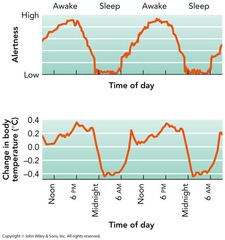
What is the Adaptation/Protection Theory of sleep?
Sleep evolved to conserve energy and protect from predators.
What does the Repair/Restoration Theory suggest about sleep?
Sleep allows organisms to repair or recuperate from depleting daily activities.
What is the correlation between deep sleep and physical development?
Deep sleep (stage 3) is correlated with physical development.
What is REM sleep characterized by?
Rapid eye movements, irregular breathing, high-frequency brain waves, paralysis of large muscles, and often dreaming.

What are hypnagogic hallucinations?
Vivid sensory phenomena that occur during the transition from wakefulness to sleep.
What are some sources of disruption to circadian rhythms?
Puberty, rotating shift work schedules, jet lag, sleep deprivation.
What are some negative outcomes of sleep deprivation?
Reduced cognitive performance, irritability, mood changes, increased cortisol levels, and higher risk of physical illness.
What are dreams?
Unfolding sequences of thoughts, perceptions, images, and emotions that typically occur during REM sleep.
What are the three views that explain why we dream?
Psychoanalytic, Biological, Cognitive.
What is meditation?
A group of techniques designed to focus attention, block out distractions, and produce an altered state of consciousness.
How does meditation affect the nervous system?
It quiets the sympathetic nervous system and activates the parasympathetic nervous system.
What characterizes hypnosis?
Deep relaxation, trance-like state, heightened suggestibility, and intense focus.