Bone Fixation, Coaptation, Fractures, Luxation Exam 2
 Call Kai
 Learn
Learn Practice Test
 Spaced Repetition
 Match
Match Flashcards
 Knowt Play
1/104

There's no tags or description
Looks like no tags are added yet.
Name | Mastery | Learn | Test | Matching | Spaced | Call with Kai | Chat |
|---|
No analytics yet
Send a link to your students to track their progress
105 Terms
What is a cancellous screw?
-wide pitch
-large thread height
-small diameter
-fully or partially threaded
-increased strength in trabecular bone

What is a cortical screw?
-small pitch
-small thread height
-large diameter
-fully threaded
-increased strength in cortical bone

What is a locking screw?
-threads in the screw head
-used with locking plates
-small pitch
-small thread height
-large core diameter
-fully threaded
-increased cortical bone strength

What are locking plates?
-both screw heads and plate holes have threads
-screw locks in at 90 degrees
-helpful if concerns about quality of bone
-don't rely on plate contact for stability

What are non-locking plates?
-no threads on plate or screw head
-screw compresses plate to bone
-friction between bone and plate provides stability
-plate needs to be perfectly contoured to bone
-helpful if needing to angle screws of place in compression

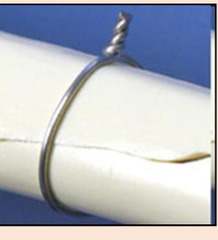
What is orthopedic wire?
-stainless steel
-little bending strength
-tensile strength related to diameter of wire
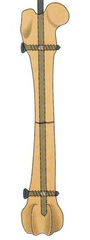
What are interlocking nails?
-intermedullary rod with holes with bolts placed through both sides
-resists bending
-resists rotation
-resists tension
-resists compression
How are screws used?
-hold plate to bone
-hold fracture segments together
-serve as object to which something can be attached
Why would a screw be placed "lag"?
-to draw bones closer together to compress the fracture line
-perpendicular to fracture line
-only engages the trans-cortex

What are the functions of bone plates?
-compression
-neutralization
-bridging
What are the benefits of compression plates?
-load sharing
-lower risk of implant failure
T or F: neutralization plates provide compression
False
T or F: fractures are reconstructed with bridging plates and there is load sharing
False
When is the only time you can use cerclage wire?
-must be anatomically reconstuctible
-long oblique or spiral fracture
What is a wire tension band?
converts distractive forces into compressive forces
When are intergragmentary wires used?
jaw fractures
What are k-wires and pins?
-pin w/ tension wire band
-positional
-antirotational
What are cross pins ideal for?
-physeal or metaphyseal fracture in young animals
-doesn't provide sufficient stability to diaphysis
What force do intramedullary pins counteract?
bending

T or F: intramedullary pins are commonly used as the sole treatment
False
What are the traits of intramedullary pins?
-axial placement
-3 points of fixation
-large diameter
Why should you not place a intramedullary pin or nail in the radius?
it is impossible to place it in the radius without interfering with the elbow or radiocarpal joint
What are the complications of internal fixation?
-implant failure
-infection
-delayed union
-non-union
-malunion
What is an external skelton fixator?
apparatus composed of multiple transcutaneous, transcortical fixation pins/wire which are incorporated into an extracorporeal frame
What is a linear external skeleton fixator?
transcutaneous pins attached to smooth linear connecting bars via connecting clamps

What kind of pins are used for linear ESF?
threaded fixation pins
What is a circular skeleton fixation?
-smooth fixation pins
-small transcutaneous wires
-wire fixation bolts
-rings connected by threaded rods
T or F: circular and linear ESF can be used together
True
What are the advantages of ESF?
-preserves blood supply
-supports concurrent wound care
-easy implant removal
-versatile implant placement
-lower initial expense
What are the disadvantages of ESF?
-can restrict muscle function
-pin tracts prone to infection
-limited proximal application
-radiographic obscuring
-requires ongoing maintenance
-owner compliance is critical
-hidden costs
What are the main indications for ESF?
-open/infected fractures
-comminuted fractures
-small patients and bones
-financial constraints
-tendon or ligament injuries
-joint fusion
-limited bone stock
When should a circular ESF be used, proximal or distal extremity?
distal
Where should hybrid ESF be placed?
proximally
What is the post-operative management for an ESF?
-protect with bumper bandage
-clean tracts daily
-activity restriction
-frequent recheck appointments
What are the complications associated with ESF?
-pin tract inflammation
-pin loosening
-delayed/nonunion/malunion
-iatrogenic fracture
-soft tissue morbidity
T or F: internal fixation is preferred if possible
True
Why is external coaptation contradicted for the definitive treatment of distal radius and ulna fractures in toy breed dogs?
-poor blood supply
-poor healing potential
-80% develop malalignment or malunion if coaptated
What are the cardinal rules of external coaptation for extra-articular injuries?
must immobilize the joint above and below
What are the cardinal rules of external coaptation for articular injuries?
must immobilize the bones above and below the joint
What are the advantages of temporarily immobilizing musculoskeletal injuries?
-non-invasive
-lower expense
What are the disadvantages of temporarily immobilizing musculoskeletal injuries?
-hidden cost
-time
-constant monitoring
-limits limb function
-instability may extend healing
-can lead to permanent dysfunction
-soft tissue complications can be severe
What is a robert jones bandage?
provides transient support of injuries distal to elbow/stifle
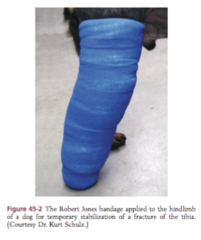
What is a modified robert jones bandage?
soft padded bandage that protects surgical incisions, provides compression, and does not provide stability

When should a splint be used?
-provides support of injuries distal to elbow/stifle
-can be used definitively or along with surgery
What is a bivalve cast?
-similar to a splint
-more stability
-higher risk of pressure sores

What is a spica splint?
-used to immobilize elbow or shoulder
-most commonly after closed reduction of lateral elbow or shoulder luxation

What is a Ehmer sling?
-prevents weight bearing and maintains hip position following closed reduction of craniodorsal hip luxation
-prone to slipping and skin irritation

What is a velpeau sling?
used to prevent thoracic limb weight bearing after scapular fracture or shoulder luxation
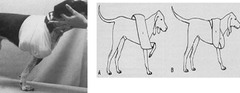
What are hobbles?
used to prevent splaying of limbs, medial shoulder instability, or caudoventral hip luxation
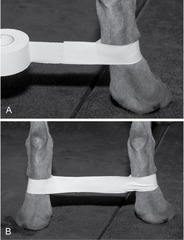
What are the complications associated with coaptation?
-bandage too loose or tight
-inappropriate bandage length resulting in tourniquet
-loss of joint mobility
-mal or nonunion
-joint laxity/angular limb deformity
How to properly bandage monitor?
-keep clean, dry, and intact
-monitor twice a day for swelling
-bandage every 1-2 weeks if no wounds
-if any concerns, bandage must be changed the same day
What is an articular fracture?
fracture involving the articular cartilage and subchondral bone
When can fracture diagnoses occur?
-stable
-sedated
-collimated
-orthogonal views
T or F: stress views can be helpful to visualize ligment injuries
True
What is more sensitive, an x-ray or CT?
CT
What are the goals of fracture management?
-complete healing
-return to funciton
What are the three treatment options for joint fractures?
-fracture repair
-salvage
-conservation/amputation
Which method of joint fracture treatment is ideal?
fracture repair
What are the salvage options?
-joint replacement
-joint fusion
-joint resection
What are the fundamental principles of joint fracture treatment?
must achieve anatomic reduction and rigid internal fixation to promote primary bone healing, return to function, and mitigate DJD
What are the complications that can occur from joint fractures?
-post traumatic osteoarthritis
-infection
-implant failure
-delayed union/malunion/non-union
-reduced ROM and function
How can you minimize the risk of OA with joint fractures?
-limit iatrogenic trauma
-perform surgery early (within 3 days)
-adhere to reduction and fixation
-physical therapy
How is a luxation described?
position of the distal bone in relation to the proximal bone
T or F: luxation typically involves joint capsule rupture and ligament disruption
True
What is the presentation of a luxation?
-acute onset
-trauma history
-non-weight bearing
How to treat luxations?
-restore normal anatomic relationship
-provide stability
-preserve joint ROM
What is the preferred treatment of luxations?
closed reduction or open reduction and stabilization
What are the salvage options for luxations?
-joint replacement
-arthrodesis
-excision arthroplasty
Which type of shoulder luxation is more common, medial or lateral?
medial
When is a lateral shoulder luxation more likely?
large breed dogs
What type of bandaging can be used for shoulder luxation?
-velpeau sling
-hobbles
-spica splint
Are medial or lateral elbow luxations more common?
lateral
What kind of bandage is used for elbow luxation?
spica splint maintaining elbow in extension
Anetebrachiocarpal luxations are usually due to what?
major trauma
T or F: antebrachiocarpal luxations are often less severe in cats bc only medial collateral is affected
True
T or F: closed reduction and stabilization are often successful with anthebrachiocarpal luxations
True
What is the treatment of choice in cats with antebrachiocarpal luxation?
open reduction and stabilization
What is the treatment of choice in dogs with antebrachiocarpal luxation?
pancarpal arthrodesis
What direction do sacroiliac luxations and hip luxations typically occur?
craniodorsal
What is the most common treatment for sacroiliac luxation?
open reduction and stabilization, sometimes surgery
How to diagnose hip luxation?
thumb test and palpation
What are the treatments of hip luxation?
-closed reduction and coaptation
-open reduction and stabilization
-THR
-FHO
What are the treatments for stifle luxation?
-open reduction and stabilization
-arthrodesis
What are the treatments for a tarsocrural and digit luxation?
-closed reduction and coaptation
-open reduction and stabilization
-arthrodesis
Closed reduction is the first line of treatment for what?
-shoulders
-hips
-elbows
-digits
T or F: open reduction and stabilization is reasonable for all joints
True
T or F: joint replacement is reasonable for hip luxations
True
Arthrodesis is resonable for what?
-carpus and tarsus
-OK for shoulders, elbows, and stifle
When is excision reasonable?
-hips
-OK for shoulders
What does it mean to evaluate for SCRAPIE?
swelling, crepitus, ROM, alignment, pain, instability, effusion
What should be included in the neurological evaluation during orthopedic exam?
-peripheral nerve injury
-spinal cord injury
-TBI
How are fractures classified?
-age
-etiology
-contamination
-configuration
-location
-bone
-displacement
What is the cardinal rule of coaptation?
must immobilize joints proximal and distal to the fracture
How does the fracture assessment score work?
higher risk=lower score
What are the clinical considerations using the FAS system?
-client and patient compliance
-patient pain tolerance
What are the biological considerations using the FAS system?
-age
-soft tissue
-energy
-overall health
What are the mechanical considerations using the FAS system?
-stability
-compression
-amount of limbs affected
-kind of animal
-weight
T or F: sometimes it is worth sacrificing biological factor to obtain a stronger fixation and vice versa
True
What is the "gold standard" of bone grafts?
Autogenous cancellous bone grafts, typically from the proximal humerus
If the FAS score is low, a _____ fixation is needed
stronger, rigid