3.2, 3.3, 3.5 Eukaryotic Cells
 Call Kai
 Learn
Learn Practice Test
 Spaced Repetition
 Match
Match Flashcards
 Knowt Play
1/48

Earn XP
Description and Tags
Spec point 3.2: "Know the ultrastructure of eukaryotic cells, including nucleus, nucleolus, ribosomes, rough and smooth endoplasmic reticulum, mitochondria, centrioles, lysosomes, and Golgi apparatus"
Name | Mastery | Learn | Test | Matching | Spaced | Call with Kai | Chat |
|---|
No analytics yet
Send a link to your students to track their progress
49 Terms
What does ultrastructure mean?
The internal structure of cells
What type of microscope is needed to view the ultrastructure of cells?
electron microscope
Eukaryotic cells have a ____ complex ultrastructure than prokaryotic cells
more
Key differences between eukaryotic and prokaryotic cells
Prokaryotic cells are:
- smaller
- lack membrane bound organelles
- have smaller ribosomes
- no nucleus
- cell wall contains glycoprotein murein whereas eukaryotic plant cell walls are made of cellulose
Which types of cells are eukaryotic?
Plant cells, animal cells
Key differences between animal and plant cells include
animal cells contain centrioles and some have microvilli while plant cells do not
plant cell have a cellulose cell wall, large permanent vacuoles and chloroplasts while animal cells do not
What are microvilli (present in some animal cells?
folded regions of the cell surface membrane that increase cell surface area for absorption
e.g. in the small intestine
What parts of the ultrastructure of an animal cell do you need to know?
nucleus, ribosomes, mitochondria, cell/plasma membrane, centrioles, vesicles, lysosome, rough endoplasmic reticulum, smooth endoplasmic reticulum, golgi apparatus
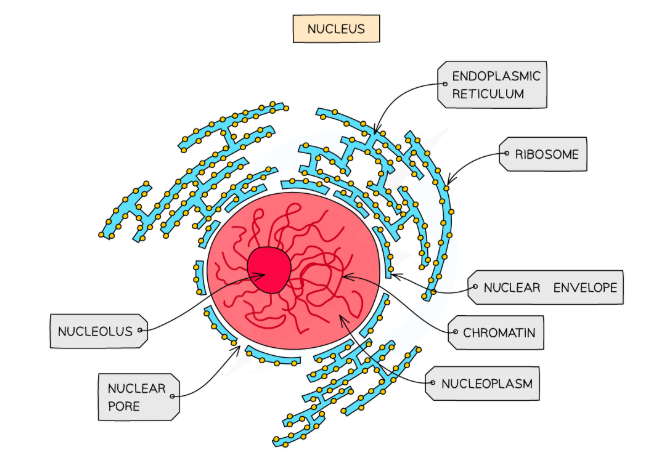
Features of a nucleus
nuclear envelope
nucleolus
chromatin
nuclear pore
Features of the nucleus: What is the nuclear envelope?
a double membrane which separates the nucleus from the cytoplasm
it contains many pores
Features of the nucleus: Why are nuclear pores important?
They are important channels which allow mRNA and ribosomes to travel out of the nucleus, as well as allowing enzymes and signalling molecules to travel in
Features of the nucleus: What is chromatin?
Linear DNA and proteins- this is the material from which chromosomes are made
Features of the nucleus: What is the nucleolus
a dense region which is the site of ribosome production
What is the nucleus surrounded by?
The endoplasmic reticulumD
Function of nucleus
control cell activities
Diagram of nucleus
Function of the cell surface/plasmid membrane
controls the exchange of materials between the internal cell environment and the external environment
The cell surface membrane is described as being _________ _________, meaning that…
partially permeable
some substances can pass through the membrane while others cannot
The cell surface membrane is formed from a…
phospholid bilayer spanning a diameter of around 10nm
Function of mitochondria
site of aerobic respiration
responsible for producing ATP, the primary energy currency of the cell
What type of membrane does mitochondria have?
a double membrane
The inner membrane of the mitochondria is folded to form structures called…
cristae
Diagram of mitochondria

Where are ribosomes found?
they can be found as free organelles in ALL cells or as part of the rough endoplasmic reticulum in EUKARYOTIC cells
Are ribosomes surrounded by a membrane?
no
Ribosomes are composed of…
RNA and proteins
Difference between ribosomes in eukaryotic vs prokaryotic cells
ribosomes are larger in eukaryotic cells (80s) and smaller in prokaryotic cells (70s)
Function of ribosomes
site of translation
where proteins are made
Two types of endoplasmic reticulum
rough (RER)
smooth (SER)
Both the SER and RER are formed from…
folds of membrane formed as an extension of the outer membrane of the nuclear envelope
The surface of the RER is covered in…
ribosomes
What is the role of the RER?
to process proteins made on the ribosomes
Function of SER
involved in the production, processing and storage of lipids, carbohydrates and steroids
Diagram of endoplasmic reticulum

What is the golgi apparatus made of?
flattened sacs of membrane
Role of the golgi apparatus
modify proteins and lipids before packaging them into golgi vesicles
vesicles are often seen at the edges of the sacs, these then transport the proteins and lipids to their required destination
Diagram of golgi apparatus

What are lysosomes?
specialist forms of vesicle which contain hydrolytic (digestive) enzymes
Role of lysosomes
to break down waste materials such as worn out organelles
Lysosomes are used extensively by cells of…
the immune system and in programmed cell death, known as apoptosis
Structure of lysosome
no clear internal structure
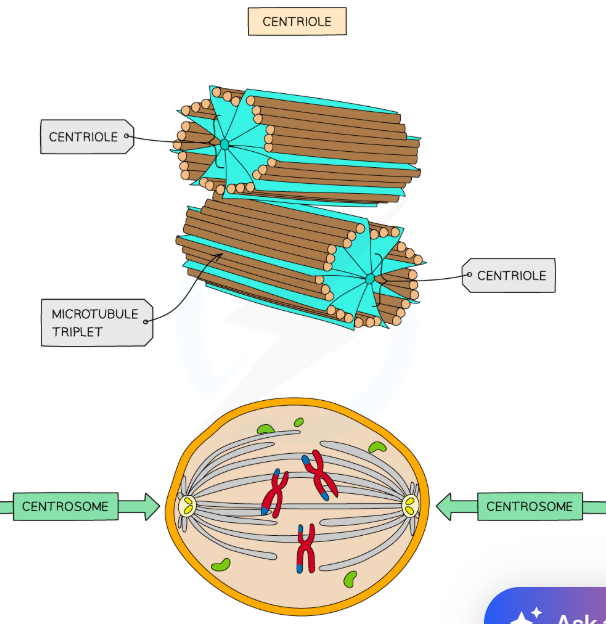
Centrioles are made of…
hollow fibres known as microtubules
Microtubules are…
filaments of protein that can be used to move substances around inside a cell, as well as to support the shape of a cell from the inside
Two centrioles at right angles to each other form a…
centrosome
What does a centrosome do?
organise the spindle fibres during cell division
Are centrioles found in plants and fungi?
no
Diagram of centriole/centrosome
Which organelles are involved in the production and secretion of proteins?
nucleus
transcription of DNA code
ribosomes
produce proteins in the process of translation
RER
where proteins are synthesised and transported to golgi apparatus
golgi apparatus
modifies, packages and sorts proteins
sends repackaged proteins to final destination, either via transport vesicles or by incorporating them into the plasma membrane

identify the organelles in this EM image
