MICROM 410 Exam 1
 Call Kai
 Learn
 Practice Test
 Spaced Repetition
 Match
 Flashcards
 Knowt Play
1/16

There's no tags or description
Looks like no tags are added yet.
17 Terms
What is a microbe?
a living organism that is too small to be seen with the naked eye
Prokaryotes: bacteria and archaea
Eukaryotes: algae, fungi, and protozoa
Viruses are acellular and lack many hallmarks of living organisms
What are the defining features of a Eukaryote?
Possess a membrane-bound nucleus
Possess membrane-bound organelles
Possess cytoskeletal elements such as microtubules and microfilaments
Typically much larger than prokaryotes
What is the 16s rRNA gene?
found in all cells (18S in eukaryotes)
Performs the same function in all organisms, so selection pressures should be similar for all during evolution
Not expected to be subject to horizontal gene transfer
Both highly conserved and highly variable regions within the sequence
What are Conserved Regions of rRNA?
sequence divergence within conserved regions can be used to distinguish between distantly-related organisms
What are Variable Regions of rRNA?
sequence divergence within variable regions can be used to distinguish between different genera and/or species of organisms
What are Eukaryotic Signature Proteins?
Gene products found exclusively in Eukaryotes and entirely absent from Prokaryotes
Cytoskeletal elements (actin, tubulin)
Nuclear pore complex proteins
Membrane sorting and trafficking proteins
Archea contain homologs of many of these genes
What are the characteristics of all living organisms?
Chromosome material: Double-stranded DNA
RNA transcription: Common ancestral RNA polymerase
Translation: Nearly universal genetic code; shared ancestral rRNAs and elongation factors
Protein: Common ancestral functional domains
Prokaryotes (+Archea): Genome Structure and Metabolic Diversity
Cell volume: very small (typically)
DNA chromosome: circular
DNA organization: Nucleoid
Gene organization: Multigene operons
Eukarya Genome Structure and Metabolic Diversity
Cell volume: large
DNA chromosome: linear
DNA organization: Nucleus with membrane
Gene organization: Single genes
Bacteria: Transcription and Translation
Intron splicing: introns are rare
RNA polymerase: Bacterial homologs
Transcription factors: Bacterial homologs
Ribosome sensitivity (antibiotics): Sensitive
Translation initiatior: Formylmethionine
Archea + Eurkarya: Transcription and Translation
Intron Splicing: Introns are common
RNA polymerase: Eurkaryotic homologs
Transcription factors: Eukaryotic homologs
Ribosome sensitivity: Resistant
Translation initiator: Methionine
Bacteria + Eukaryotes: Characteristics
Methanogenesis: No
Thermophilic growth: Up to 95C/80C
Photosynthesis: Many species
Light absorption by chlorophylls: Yes
Membrane lipids: Ester-linked fatty acids
Pathogens infection animals or plants: yes
Archaea: Characteristics
Methanogenesis: Yes
Thermophilic growth: Up to 120C
Photosynthesis: only haloarchaea
Light absorption by chlorophylls: No
Membrane lipids: Ether-linked isoprenoids
Pathogens infection animals or plants: None
What is the endosymbiotic theory?
Evidence for the symbiotic origins of mitochondria and plastids:
Same size as bacteria
Multiply autonomously by binary fission
Have double membrane envelope structure
Have bacteria-like (70S) ribosomes
Contain circular DNA genomes
Bacterial genes found in nuclear genome of Eukaryotic cells
Mitochondria and plastids monophyletic with bacteria
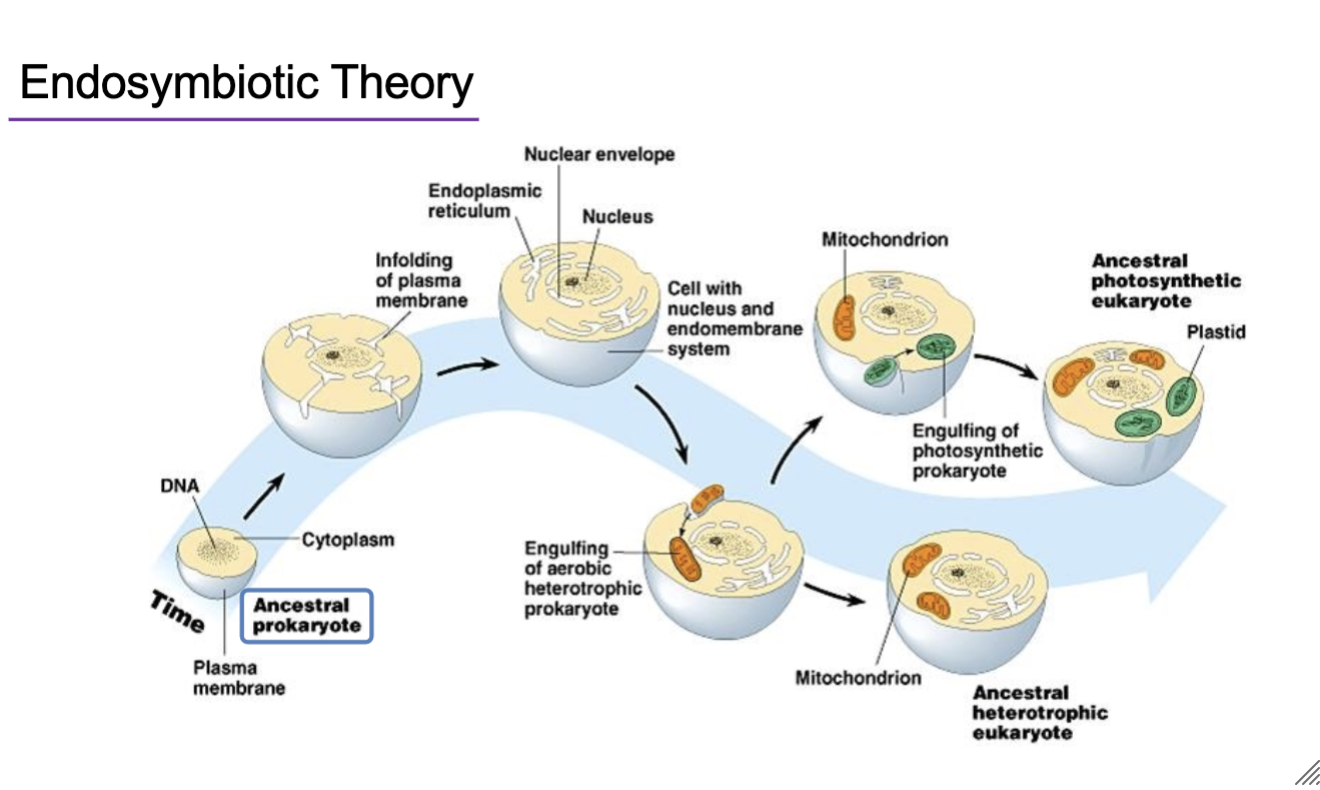
How does an organism transition from endosymbiont to organelle?
Reduced genome size with significant gene transfer to the host nucleus
Significant loss of metabolic versatility
High numbers of proteins imported from the host
Horizontal gene transfer can confuse genetic inheritance
How is the bacterial cytosol organized?
Genome highly condensed into the nucleoid
Have a single, circular chromosome of double-stranded DNA
High degree of internal organization and structure
Invaginations of cytoplasmic membrane
What are subcellular structures in bacterial cytosol?
Carboxysomes
Gas vesicles
Inclusion bodies
Magnetosomes
