Topic 3: Earth's Systems Flashcards
 Call Kai
 Learn
Learn Practice Test
 Spaced Repetition
 Match
Match Flashcards
1/27

Earn XP
Description and Tags
Vocabulary flashcards covering Earth's four spheres, their sub-layers, processes, and interactions based on Topic 3.
Name | Mastery | Learn | Test | Matching | Spaced | Call with Kai | Chat |
|---|
No analytics yet
Send a link to your students to track their progress
28 Terms
The Earth system that includes rocks, soil, and sediments, extending from Earth's surface to its very center.
Geosphere
The Earth system that includes all living things, including humans, located in the air, in water, and on land.
Biosphere
The Earth system that includes all the water on, under, or above Earth's surface.
Hydrosphere
The layer of mixed gases surrounding Earth, primarily made up of nitrogen and oxygen.
Atmosphere
The outer, rocky part of Earth made up of the crust and the rigid outer part of the mantle. It is part of the geosphere.
Lithosphere
A collection of parts that work together to carry out processes.
System
When systems or parts depend on one another to function.
Interdependent
The process by which greenhouse gases in the atmosphere trap heat leaving Earth's surface, warming the atmosphere, land, and water.
Greenhouse Effect
Precipitation that contains high levels of pollutants absorbed from the air, which can harm soil, water, and living organisms.
Acid Rain
A large, swirling tropical storm with high-speed winds and rain, formed when abundant water vapor enters the air from evaporating warm ocean water.
Hurricane
The solid innermost layer of Earth's geosphere, measuring 1,220km in thickness.
Inner Core
The liquid layer of Earth's geosphere located beneath the mantle.
Outer Core
The layer of Earth's geosphere between the crust and outer core. This layer makes up about 84% of Earth's total volume.
Mantle
The outermost layer of Earth's geosphere, ranging from 1km to 100km in thickness.
Crust
Name some types of animals that you would find in the hydrosphere.
whales, jellyfish, sharks, fish, shrimp
Name some types of animals you’d find in the geosphere.
insects, snails, earthworms, slugs
Name some types of animals you’d find in the biosphere.
deer, robin, fox, butterfly, dog
True or False?
Earth’s biosphere includes the living things in the air, in the water, and on land.
True
True or False:
Air, water and sun are nonliving, so they are part of the geosphere.
False
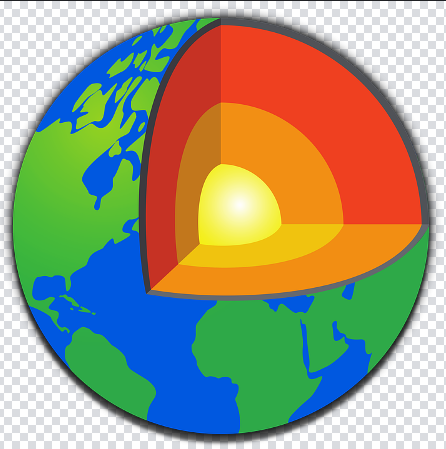
Which layer of the Earth is solid and represented in yellow in the picture?
Inner Core
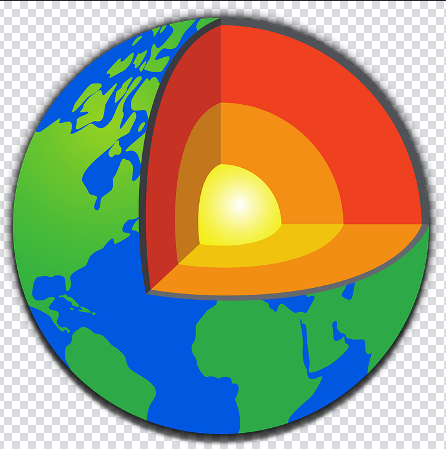
Which layer of the earth is liquid and is represented in the picture in light orange?
Outer Core

Which layer of the Earth is the outermost layer and is the thinnest of the layers?
Crust

Which layer of the earth is the largest layer and is represented in dark orange in the picture?
Mantle

Why do we call the warming of Earth’s atmosphere, land and water the Greenhouse Effect?
Our atmosphere works like the glass on a greenhouse built for plants. In a greenhouse, sunlight enters through the glass and the glass holds most of the heat from the sunlight inside the greenhouse. This represents how the temperature of our atmosphere warms as a result of the amount of greenhouse gases found in the atmosphere.
What are some examples of the hydrosphere and atmosphere interacting?
rain, snow, hurricane, tropical storms, humidity
What are some ways the biosphere interacts with other spheres?
Animals take in gases to breathe (atmosphere), plants need the nutrients and support for their roots from the soil (geosphere), animals and plants need water to survive (hydrosphere)
Describe how the atmosphere affects the geosphere.
Over time, erosion from wind and weathering from chemicals in the atmosphere wear away rock. Low moisture levels and heat from the atmosphere can dry the soil and cause drought.
True or false?
The Earth’s atmosphere absorbs almost none of the sun’s UV rays.
False