oct 13th intro to lipids and lipid derivatives, and their cellular functions
 Call Kai
 Learn
 Practice Test
 Spaced Repetition
 Match
 Flashcards
 Knowt Play
1/18

There's no tags or description
Looks like no tags are added yet.
19 Terms
lipids perform several essential functions in the body

Lipids are poorly soluble in water.
Fatty acids are the building blocks of triacylglycerols and phospholipids, and they can be oxidized to produce energy.
Triacylglycerols are predominantly nonpolar, so they pack into fat droplets with little water; this makes them the body’s main energy store.
Phospholipids have a polar head and nonpolar tails, so they form the bilayer of cell membranes.
Cholesterol is a rigid ring structure that sits within membranes and is the precursor for steroid hormones and bile acids.
why don’t lipids mix well with water?

Water molecules form hydrogen bonds with one another.
The hydrocarbon regions of lipids are nonpolar and cannot form hydrogen bonds with water, so in water they cluster together, reducing their exposure to water.
This is the hydrophobic effect; it does not require any special attraction between lipid molecules.
An amphipathic molecule contains both polar and nonpolar regions.
In a phospholipid, the polar head interacts with water while the nonpolar tails avoid it.
This is why triacylglycerols, which are almost entirely nonpolar, form droplets, while phospholipids form bilayers with their heads facing water and their tails directed inward.
what is a fatty acid?

A fatty acid has a hydrocarbon chain with a carboxyl group (–COOH) at one end.
At physiological pH (7.4), the carboxyl group is predominantly ionized (–COO⁻) and polar, while the hydrocarbon chain is nonpolar.
Fatty acids are therefore amphipathic, although long hydrocarbon chains make them poorly soluble in water.
Saturated fatty acids have no carbon–carbon double bonds; unsaturated fatty acids have one or more.
Fatty acid notation gives the number of carbons followed by the number of double bonds. Palmitic acid (16:0) has 16 carbons and no double bonds. Oleic acid (18:1) has 18 carbons and one cis double bond, which bends the chain.
How does fatty acid structure affect membranes?

Saturated fatty acid chains are relatively straight, allowing them to pack closely and form more van der Waals contacts with neighboring chains.
A cis double bond introduces a bend that disrupts tight packing and reduces these contacts.
As a result, membranes containing more cis-unsaturated fatty acid chains are generally more fluid than membranes containing more saturated chains, under comparable conditions.
Membrane fluidity allows lipids and many membrane proteins to move within the membrane, supporting normal membrane function.
Which fatty acids must come from food?

Humans cannot synthesize linoleic acid or α-linolenic acid because we lack the enzymes needed to introduce double bonds at the required positions.
Omega numbering identifies the position of the first double bond counting from the methyl end of the fatty acid chain.
Linoleic acid can be converted to arachidonic acid, a precursor of signaling molecules involved in inflammation and platelet activity.
α-Linolenic acid can be converted to eicosapentaenoic acid (EPA) and docosahexaenoic acid (DHA), but this conversion is limited.
Fish and marine oils provide EPA and DHA directly.
Patients receiving parenteral nutrition without a lipid source can develop essential fatty acid deficiency within weeks. IV lipid emulsions help prevent it.
How does the body store energy as fat?
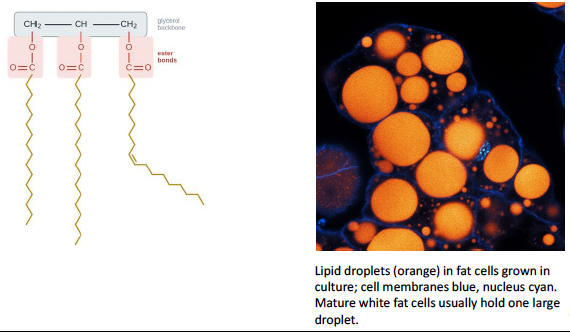
A triacylglycerol (TAG) consists of one glycerol molecule joined to three fatty acids by ester bonds.
TAGs are predominantly nonpolar and are stored in lipid droplets, mainly in adipose tissue.
Fat provides approximately 9 kcal/g, compared with 4 kcal/g for carbohydrate.
Fatty acids are highly reduced, so their oxidation releases substantial energy.
TAGs are also stored with very little water, making them efficient long-term energy stores.
Lipases break ester bonds in TAGs. In the intestine, lipases digest dietary TAGs into fatty acids and monoacylglycerols for absorption.
Orlistat, a weight-loss drug, inhibits gastrointestinal lipases and reduces fat absorption.
During fasting, lipases in adipose tissue release fatty acids and glycerol.
Fatty acids can be oxidized to produce ATP, while glycerol can be used by the liver for gluconeogenesis.
Why can the body store more energy in 1 kg of fat than in 1 kg of stored glycogen?
Fat contains more energy per gram and is stored with much less water than glycogen.
How do phospholipids form cell membranes?
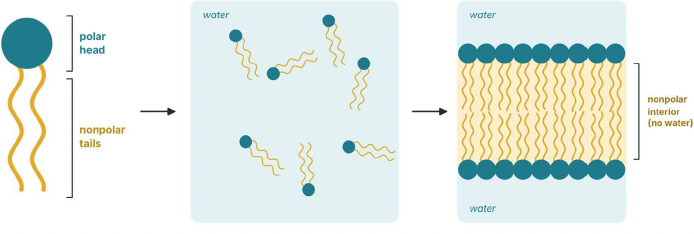
Phospholipids are amphipathic molecules with polar heads and nonpolar tails. Most membrane phospholipids contain a glycerol backbone, two fatty acid chains, and a phosphate-containing head group. In water, phospholipids can spontaneously form a bilayer. Their polar heads face water on both sides, while their nonpolar tails point inward, away from water. This arrangement reduces contact between the nonpolar tails and water.
The phospholipid bilayer forms the basic structure of cell membranes. Membrane proteins perform functions such as transport and signaling.
What other lipids are found in cell membranes?

Cell membranes contain several types of lipids. Glycerophospholipids have a glycerol backbone, two fatty acid chains, and a phosphate-containing head group.
Sphingomyelin is also a phospholipid, but its backbone is sphingosine rather than glycerol. Sphingosine provides one hydrocarbon chain, while a fatty acid provides the other. Sphingomyelin is particularly abundant in the myelin sheath that insulates nerve fibers.
Cholesterol is not a phospholipid. It has four fused rings and a small polar hydroxyl (–OH) group. In membranes, the hydroxyl group lies near the polar phospholipid heads, while the rigid rings sit among the hydrocarbon tails. By affecting how tightly the tails pack, cholesterol helps regulate membrane fluidity.
How do lipids organize membranes and anchor proteins?
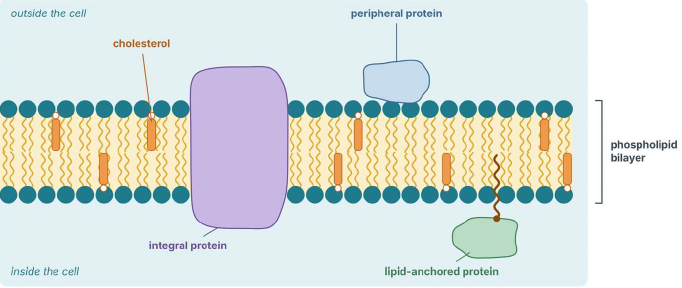
Cell membranes contain a phospholipid bilayer, cholesterol, and associated proteins. Cholesterol sits between phospholipids and helps regulate membrane properties.
Integral proteins are embedded in the bilayer, and many span it. Their nonpolar regions interact with the fatty acid tails through the hydrophobic effect.
Peripheral proteins associate with the membrane surface through noncovalent interactions, such as ionic interactions and hydrogen bonds, or by binding to other membrane proteins.
Lipid-anchored proteins have a lipid covalently attached to them. The lipid's nonpolar portion inserts into the bilayer, helping keep the protein associated with the membrane.
Membrane-associated proteins perform functions such as transport, signaling, and structural support.
A protein is attached to a membrane through a covalently linked fatty acid. What keeps it associated with the membrane?
The fatty acid's nonpolar portion inserts into the bilayer and is retained through the hydrophobic effect.
Why does the body need cholesterol?

Cholesterol is an essential component of cell membranes, where it helps regulate membrane fluidity.
Cholesterol is also the starting material for steroid hormones (including cortisol, aldosterone, estrogen, and testosterone) and bile acids, which help the intestine digest and absorb dietary fats. Humans cannot completely break down cholesterol's ring structure. Cholesterol is eliminated mainly through the intestine after conversion to bile acids or secretion into bile as cholesterol.
Vitamin D is produced in the skin from 7-dehydrocholesterol, an intermediate in the cholesterol synthesis pathway, following exposure to ultraviolet B (UVB) light.
Cholesterol is poorly soluble in water, so it travels in the blood within lipoproteins. Although cholesterol is necessary for normal function, elevated LDL cholesterol increases the risk of atherosclerotic cardiovascular disease.
How do membrane lipids produce signaling molecules?
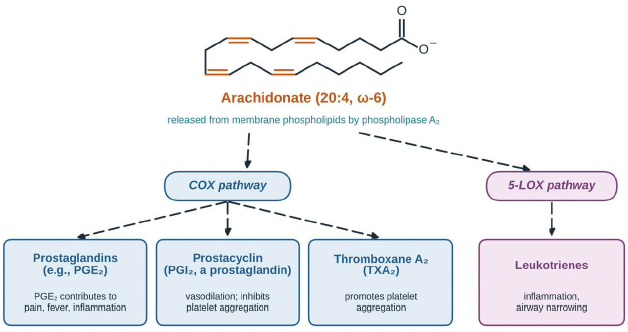
Some membrane phospholipids contain arachidonic acid, a 20-carbon polyunsaturated omega-6 fatty acid that can be synthesized from the essential fatty acid linoleic acid. When cells are stimulated, phospholipase A₂ can release arachidonic acid from membrane phospholipids.
Arachidonic acid is converted into eicosanoids, short-lived signaling molecules that generally act near the cells that produce them.
The cyclooxygenase (COX) pathway leads to the production of prostaglandins, including prostacyclin (PGI₂), and thromboxanes. These molecules participate in inflammation, pain, fever, blood vessel function, and platelet activity.
The 5-lipoxygenase (5-LOX) pathway leads to the production of leukotrienes, which contribute to inflammation and airway narrowing.
Montelukast, used in asthma, blocks the CysLT₁ leukotriene receptor.
Why does low-dose aspirin reduce platelet aggregation?

Platelets produce thromboxane A₂ (TXA₂) through the COX-1 pathway. TXA₂ promotes platelet activation and aggregation.
Aspirin irreversibly inhibits COX-1 by covalently modifying (acetylating) the enzyme, reducing TXA₂ production and platelet aggregation.
Platelets lack nuclei and cannot synthesize replacement COX-1. Aspirin's effect on an individual platelet therefore lasts for the remainder of its lifespan (approximately 7–10 days), even after aspirin has been cleared from the blood. The antiplatelet effect gradually diminishes as new platelets enter circulation.
At low doses, aspirin preferentially suppresses platelet TXA₂ production. Endothelial cells, unlike platelets, can synthesize replacement COX and restore prostacyclin (PGI₂) production. PGI₂ inhibits platelet aggregation, so its relative preservation contributes to aspirin's antiplatelet effect.
Why does aspirin's antiplatelet effect last much longer than aspirin remains in the blood?
Aspirin irreversibly inhibits platelet COX-1, and platelets cannot synthesize replacement enzyme.
Why does fat absorption matter for vitamins?

Vitamins A, D, E, and K are fat-soluble. Their intestinal absorption depends on normal fat digestion and the formation of mixed micelles with the help of bile salts. Intestinal cells repackage the absorbed lipids into chylomicrons, which enter the lymph and then the bloodstream.
Conditions that impair fat absorption can also reduce absorption of these vitamins.
Vitamin A is required for normal vision. Vitamin D helps regulate calcium and phosphate balance. Vitamin E protects cell membranes against oxidative damage. Vitamin K is needed to produce functional bloodclotting proteins.
Orlistat inhibits gastrointestinal lipases and reduces dietary fat absorption. It can also decrease absorption of fat-soluble vitamins.
Patients taking orlistat should take a multivitamin containing vitamins A, D, E, and K at least 2 hours before or after orlistat, such as at bedtime.
Warfarin inhibits recycling of vitamin K to its active reduced form, decreasing the production of functional vitamin K-dependent clotting proteins. Changes in dietary vitamin K intake can therefore affect warfarin treatment.
What must we know about lipids?
Lipid structure determines biological function
Fatty acids are building blocks and energy sources
Triacylglycerols store energy
Phospholipids and cholesterol support membrane function
Lipids also provide signaling molecules and support the absorption of fat-soluble vitamins
A cell membrane contains a greater proportion of cis-unsaturated fatty acid chains. Which change is most likely?
A. Tighter packing of phospholipid tails
B. Increased membrane fluidity
C. Decreased movement of membrane lipids
D. Increased formation of ester bonds
B
Why are triacylglycerols particularly effective for longterm energy storage?
A. They contain phosphate groups that release ATP
B. They dissolve readily in the cytosol
C. They contain highly reduced fatty acids and are stored with little water
D. They directly enter glycolysis without being broken down
C
A patient takes low-dose aspirin daily. Why does its antiplatelet effect persist after aspirin has been cleared from the blood?
A. Platelets cannot synthesize replacement COX-1 after irreversible inhibition
B. Aspirin remains bound reversibly to COX-1 for several days
C. Aspirin permanently prevents the production of new platelets
D. Thromboxane A₂ remains stored in platelets until they are removed
A
A patient taking orlistat develops reduced absorption of dietary fat. Which vitamin deficiency would most directly interfere with the production of functional blood-clotting proteins?
A. Vitamin A
B. Vitamin D
C. Vitamin E
D. Vitamin K
D
A protein is attached to a cell membrane through a covalently linked fatty acid. Which interaction most directly helps retain the protein at the membrane?
A. Hydrogen bonding between the fatty acid and water
B. Covalent bonding between the fatty acid and phospholipid head groups
C. Hydrophobic interactions between the fatty acid and membrane lipid tails
D. Ionic attraction between the fatty acid and extracellular Na⁺
C