biodegradable plastics midterm

0.0(0)
Studied by 0 people
call kaiCall Kai
learnLearn
examPractice Test
spaced repetitionSpaced Repetition
heart puzzleMatch
flashcardsFlashcards
GameKnowt Play
Card Sorting

1/19

encourage image

There's no tags or description

Looks like no tags are added yet.

20 Terms

1
New cards

What are the primary sectors driving plastic production globally?

The largest drivers of plastic production are:

•Packaging (approx. 40%) – Includes single-use bags, bottles, wrappers, and containers. This sector dominates due to its low cost and convenience.

•Building and Construction (~20%)

2
New cards

Evolution of Plastics

  • 1907: Bakelite – the first synthetic plastic

  • Post-WWII: Rapid rise in plastic production

  • 1970s–2000s: Diversification in materials and applications

  • 2010s–Now: Focus on sustainability and biodegradability


3
New cards

Environmental Impact of Plastics

•• Non-biodegradable plastics persist for hundreds of years

•• Microplastics contaminate oceans, soil, and food chains

•• Greenhouse gas emissions from production and disposal

•• Low recycling rates (~9% globally)

4
New cards

Global Plastic Production

•• Over 400 million metric tons produced annually

•• Expected to double by 2050

•• Packaging is the largest sector (approx. 40%)

•• Driven by low cost, versatility, and durability

5
New cards

Why Biodegradable Plastics?

•• Reduce long-term pollution

•• Designed to break down into natural elements

•• Derived from renewable resources

•• Increasing demand in packaging, agriculture, and medical fields

6
New cards

What is plastic?

Plastics are materials that can transition between solid and liquid (soft) states.

Plastics are made of polymers. These polymers have been compounded with modifying or stabilizing additives. Typically based on the element carbon. 

All plastics are polymers, however, not all polymers are plastics. Several natural products, like cellulose, are polymers, but they are unable to be processed like a plastic material until they are altered from their natural form.

7
New cards

Type of plastics

Property

Amorphous Structure

Semi-Crystalline Structure

Molecular Order

Random, tangled network of chains.

Highly ordered parallel crystal domains mixed with random chains.

Optical Clarity

Transparent and clear (light passes straight through).

Opaque or translucent (crystal domains scatter the light).

Melting Behavior

Softens gradually across a wide temperature range.

Sharp, specific melting point where crystals break apart.

Chemical Resistance

More sensitive to stress cracking and chemical solvents.

Highly resistant to chemicals due to tightly packed crystal walls.

Shrinkage & Warping

Low, uniform shrinkage during cooling and molding.

High, uneven shrinkage as crystals pack tightly together.

Impact Resistance

Generally tough and impact-resistant at room temperature.

Tends to be more rigid, stiff, and prone to brittle failure.


<table style="min-width: 75px;"><colgroup><col style="min-width: 25px;"><col style="min-width: 25px;"><col style="min-width: 25px;"></colgroup><tbody><tr><td colspan="1" rowspan="1" style="padding-top: 0.48pt; padding-right: 0.48pt; padding-left: 0.48pt; color: windowtext; font-weight: 400; font-style: normal; text-decoration: none; vertical-align: middle; border: 1pt solid white; background: rgb(231, 234, 237); text-align: center; height: 15.33pt; width: 79pt;"><p style="text-align: center;"><span><strong>Property</strong></span></p></td><td colspan="1" rowspan="1" style="padding-top: 0.48pt; padding-right: 0.48pt; padding-left: 0.48pt; color: windowtext; font-weight: 400; font-style: normal; text-decoration: none; vertical-align: middle; border: 1pt solid white; background: rgb(231, 234, 237); text-align: center; width: 161pt;"><p style="text-align: center;"><span><strong>Amorphous Structure</strong></span></p></td><td colspan="1" rowspan="1" style="padding-top: 0.48pt; padding-right: 0.48pt; padding-left: 0.48pt; color: windowtext; font-weight: 400; font-style: normal; text-decoration: none; vertical-align: middle; border: 1pt solid white; background: rgb(231, 234, 237); text-align: center; width: 234pt;"><p style="text-align: center;"><span><strong>Semi-Crystalline Structure</strong></span></p></td></tr><tr><td colspan="1" rowspan="1" style="padding-top: 0.48pt; padding-right: 0.48pt; padding-left: 0.48pt; color: windowtext; font-weight: 400; font-style: normal; text-decoration: none; vertical-align: middle; border: 1pt solid white; background: rgb(231, 234, 237); text-align: center; height: 37.16pt; width: 79pt;"><p style="text-align: center;"><span><strong>Molecular Order</strong></span></p></td><td colspan="1" rowspan="1" style="padding-top: 0.48pt; padding-right: 0.48pt; padding-left: 0.48pt; color: windowtext; font-weight: 400; font-style: normal; text-decoration: none; vertical-align: middle; border: 1pt solid white; background: rgb(231, 234, 237); text-align: center; width: 161pt;"><p style="text-align: center;"><span>Random, tangled network of chains.</span></p></td><td colspan="1" rowspan="1" style="padding-top: 0.48pt; padding-right: 0.48pt; padding-left: 0.48pt; color: windowtext; font-weight: 400; font-style: normal; text-decoration: none; vertical-align: middle; border: 1pt solid white; background: rgb(231, 234, 237); text-align: center; width: 234pt;"><p style="text-align: center;"><span>Highly ordered parallel crystal domains mixed with random chains.</span></p></td></tr><tr><td colspan="1" rowspan="1" style="padding-top: 0.48pt; padding-right: 0.48pt; padding-left: 0.48pt; color: windowtext; font-weight: 400; font-style: normal; text-decoration: none; vertical-align: middle; border: 1pt solid white; background: rgb(231, 234, 237); text-align: center; height: 46.33pt; width: 79pt;"><p style="text-align: center;"><span><strong>Optical Clarity</strong></span></p></td><td colspan="1" rowspan="1" style="padding-top: 0.48pt; padding-right: 0.48pt; padding-left: 0.48pt; color: windowtext; font-weight: 400; font-style: normal; text-decoration: none; vertical-align: middle; border: 1pt solid white; background: rgb(231, 234, 237); text-align: center; width: 161pt;"><p style="text-align: center;"><span>Transparent and clear (light passes straight through).</span></p></td><td colspan="1" rowspan="1" style="padding-top: 0.48pt; padding-right: 0.48pt; padding-left: 0.48pt; color: windowtext; font-weight: 400; font-style: normal; text-decoration: none; vertical-align: middle; border: 1pt solid white; background: rgb(231, 234, 237); text-align: center; width: 234pt;"><p style="text-align: center;"><span>Opaque or translucent (crystal domains scatter the light).</span></p></td></tr><tr><td colspan="1" rowspan="1" style="padding-top: 0.48pt; padding-right: 0.48pt; padding-left: 0.48pt; color: windowtext; font-weight: 400; font-style: normal; text-decoration: none; vertical-align: middle; border: 1pt solid white; background: rgb(231, 234, 237); text-align: center; height: 53.84pt; width: 79pt;"><p style="text-align: center;"><span><strong>Melting Behavior</strong></span></p></td><td colspan="1" rowspan="1" style="padding-top: 0.48pt; padding-right: 0.48pt; padding-left: 0.48pt; color: windowtext; font-weight: 400; font-style: normal; text-decoration: none; vertical-align: middle; border: 1pt solid white; background: rgb(231, 234, 237); text-align: center; width: 161pt;"><p style="text-align: center;"><span>Softens gradually across a wide temperature range.</span></p></td><td colspan="1" rowspan="1" style="padding-top: 0.48pt; padding-right: 0.48pt; padding-left: 0.48pt; color: windowtext; font-weight: 400; font-style: normal; text-decoration: none; vertical-align: middle; border: 1pt solid white; background: rgb(231, 234, 237); text-align: center; width: 234pt;"><p style="text-align: center;"><span>Sharp, specific melting point where crystals break apart.</span></p></td></tr><tr><td colspan="1" rowspan="1" style="padding-top: 0.48pt; padding-right: 0.48pt; padding-left: 0.48pt; color: windowtext; font-weight: 400; font-style: normal; text-decoration: none; vertical-align: middle; border: 1pt solid white; background: rgb(231, 234, 237); text-align: center; height: 55.5pt; width: 79pt;"><p style="text-align: center;"><span><strong>Chemical Resistance</strong></span></p></td><td colspan="1" rowspan="1" style="padding-top: 0.48pt; padding-right: 0.48pt; padding-left: 0.48pt; color: windowtext; font-weight: 400; font-style: normal; text-decoration: none; vertical-align: middle; border: 1pt solid white; background: rgb(231, 234, 237); text-align: center; width: 161pt;"><p style="text-align: center;"><span>More sensitive to stress cracking and chemical solvents.</span></p></td><td colspan="1" rowspan="1" style="padding-top: 0.48pt; padding-right: 0.48pt; padding-left: 0.48pt; color: windowtext; font-weight: 400; font-style: normal; text-decoration: none; vertical-align: middle; border: 1pt solid white; background: rgb(231, 234, 237); text-align: center; width: 234pt;"><p style="text-align: center;"><span>Highly resistant to chemicals due to tightly packed crystal walls.</span></p></td></tr><tr><td colspan="1" rowspan="1" style="padding-top: 0.48pt; padding-right: 0.48pt; padding-left: 0.48pt; color: windowtext; font-weight: 400; font-style: normal; text-decoration: none; vertical-align: middle; border: 1pt solid white; background: rgb(231, 234, 237); text-align: center; height: 46.33pt; width: 79pt;"><p style="text-align: center;"><span><strong>Shrinkage &amp; Warping</strong></span></p></td><td colspan="1" rowspan="1" style="padding-top: 0.48pt; padding-right: 0.48pt; padding-left: 0.48pt; color: windowtext; font-weight: 400; font-style: normal; text-decoration: none; vertical-align: middle; border: 1pt solid white; background: rgb(231, 234, 237); text-align: center; width: 161pt;"><p style="text-align: center;"><span>Low, uniform shrinkage during cooling and molding.</span></p></td><td colspan="1" rowspan="1" style="padding-top: 0.48pt; padding-right: 0.48pt; padding-left: 0.48pt; color: windowtext; font-weight: 400; font-style: normal; text-decoration: none; vertical-align: middle; border: 1pt solid white; background: rgb(231, 234, 237); text-align: center; width: 234pt;"><p style="text-align: center;"><span>High, uneven shrinkage as crystals pack tightly together.</span></p></td></tr><tr><td colspan="1" rowspan="1" style="padding-top: 0.48pt; padding-right: 0.48pt; padding-left: 0.48pt; color: windowtext; font-weight: 400; font-style: normal; text-decoration: none; vertical-align: middle; border: 1pt solid white; background: rgb(231, 234, 237); text-align: center; height: 55.5pt; width: 79pt;"><p style="text-align: center;"><span><strong>Impact Resistance</strong></span></p></td><td colspan="1" rowspan="1" style="padding-top: 0.48pt; padding-right: 0.48pt; padding-left: 0.48pt; color: windowtext; font-weight: 400; font-style: normal; text-decoration: none; vertical-align: middle; border: 1pt solid white; background: rgb(231, 234, 237); text-align: center; width: 161pt;"><p style="text-align: center;"><span>Generally tough and impact-resistant at room temperature.</span></p></td><td colspan="1" rowspan="1" style="padding-top: 0.48pt; padding-right: 0.48pt; padding-left: 0.48pt; color: windowtext; font-weight: 400; font-style: normal; text-decoration: none; vertical-align: middle; border: 1pt solid white; background: rgb(231, 234, 237); text-align: center; width: 234pt;"><p style="text-align: center;"><span>Tends to be more rigid, stiff, and prone to brittle failure.</span></p></td></tr></tbody></table><p></p>
8
New cards

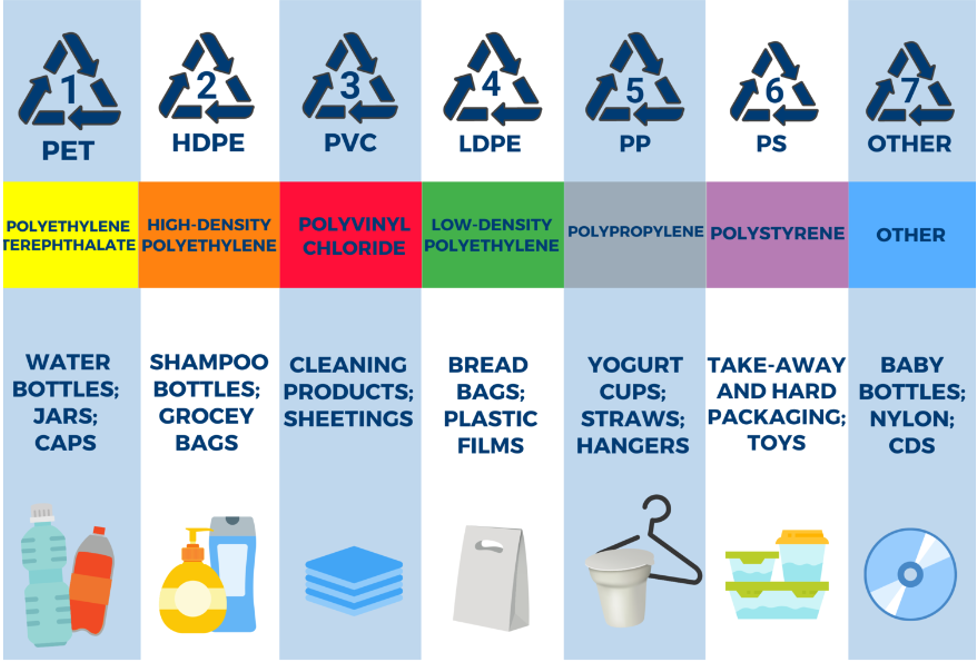
Type of plastics

knowt flashcard image
9
New cards

Plastic Items not typically recycled and the reason

#3: Rarely recycled because it contains toxic substances such as chlorine, which require specialized and costly processing.

#6: Rarely recycled because it is often contaminated with food residue, making it difficult to clean and process efficiently.

#7; Often indicates a mixture of different plastics or materials, making recycling difficult.

10
New cards

•Biobased plastics

Plastics that are made using polymers derived from biological sources, such as starch and cellulose.

11
New cards

• Bioplastics

Refers to both biobased plastics and biodegradable plastics.

(i) not all bioplastics are biodegradable

(ii) certain plastics of petrochemical origin can be labelled as bioplastic due to their biodegradable properties

12
New cards

Biodegradable

Decomposition of the material occurs by the microbial activity (biotic processes). The material is mineralized into compounds, such as CO2, CH4, H2O, NH4+, N2, and H2.

(i) not all biobased plastics are biodegradable

(ii) certain plastics of petrochemical origin can be biodegradable

13
New cards

• Compostable

A subset of biodegradable plastics that biodegrade under composting conditions, such as high humidity and oxygen at 55 ± 2 °C (industrial composting conditions) and 28 ± 2 °C (home composting conditions). 

14
New cards

Addition polymerization

forms polymers from monomers with C=C double bonds without any small molecule byproducts, growing rapidly via a chain reaction.

Examples: HDPE, PP  (often non-biodegradable)

15
New cards

Condensation polymerization

involves monomers with two functional groups reacting to form a larger molecule and eliminating a small byproduct like water, growing slowly in a step-wise process.

Example: PBS (often biodegradable)

16
New cards

Enzyme(s) need to physically contact with plastics  to degrade

Microorganisms can secrete enzymes

<p><span><strong>Microorganisms can secrete enzymes</strong></span></p>
17
New cards

Molecular Weight (MW)

The sum of atomic weights in a molecule.

18
New cards

Molarity (M)

Moles of solute per liter of solution, 1 M = 1 mole (gram of M.W.) per liter of solution)

19
New cards

Normality (N):

Gram-equivalents of solute per liter of solution.
• Relationship:  N = M × n (where n is the number of equivalents per mole).

20
New cards

Oxo Degradation

conventional plastics

(e.g. LDPE, LLDPE, HDPE, PP etc.)

are mixed with chemicals which are pro-oxidants

(e.g. inorganic catalysts containing transition metals such as manganese, cobalt, iron, etc.)

to expedite the oxidation. The inorganic catalyst present in the polymer causes the oxidation process under the UV light and/or heat, and oxygen which enables rapid conversion of polymers into smaller fragments of low molecular weight.

Oxo-degraded plastics do not fully biodegrade but instead break down into smaller fragments, including persistent microplastics