Chem 105a Experiment 3: The Copper Cycle A Series of Chemical Reactions
 Call Kai
 Learn
 Practice Test
 Spaced Repetition
 Match
 Flashcards
 Knowt Play
1/43

There's no tags or description
Looks like no tags are added yet.
44 Terms
Purpose
To perform a series of chemical reactions that transform copper through different forms and ultimately recover it as metallic copper.
Lab Objectives
Perform a series of chemical reactions.
Make qualitative observations about the properties of chemical reactants and products
Learn how to properly and safely use a Bunsen burner to heat solutions
Apply the concept of percent yield to experimental situations.
Safety Table

Which chemicals were the most dangerous to our health in this experiment?
HNO3 (nitric acid)
NaOH (sodium hydroxide)
H2SO4 (sulfuric acid)
What are the two measurements to be taken for this experiment?
The initial mass of the copper used
The final mass of the copper metal recovered
Will then be calculating percent yield
Why was it important that you record good qualitative observations for this experiment?
So that if you do not attain an acceptable yield, your possible mistakes can be recognized
Percent Yield
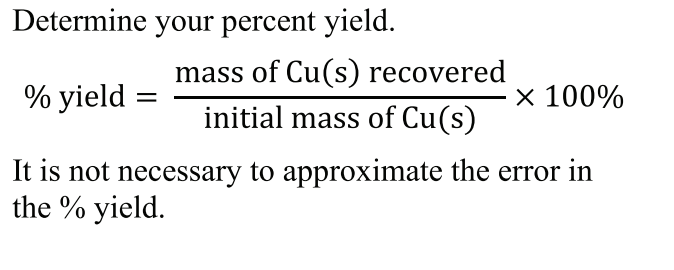
What are the steps in the copper cycle?
1. Oxidized
2. Precipitated
3. Dehydrated
4. Dissolved
5. Reduced
Oxidation
The loss of electrons (Cu (s) —> Cu2+(aq) + 2e¯)
Becomes more positive
Reduction
The gain of electrons (Cu2+(aq) + 2e¯ —> Cu (s))
Becomes more negative
In an electrochemical activity table, the elements at the top of the table...
Above = Reduce
Reduce (give electrons to) the elements below them (ex. according to this table, the reduced form of cadmium, Cd(s), will reduce the oxidized form of lead, Pb2+ to Pb(s), and nickel, Ni2+, to Ni(s) and will itself be oxidized to Cd2+)

In an electrochemical activity table, the elements at the bottom of the table...
Below = Oxidize
Oxidize (take electrons from) the elements above them (ex. according to this table, the oxidized form of lead, Pb2+, will oxidize the reduced form of nickel, Ni(s) to Ni2+, and will itself be reduced to Pb(s)
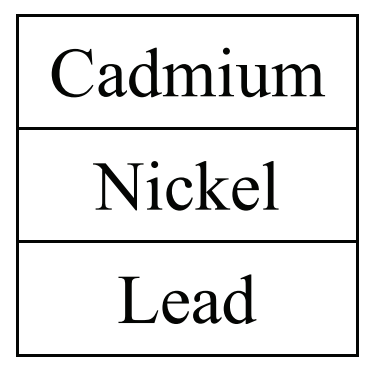
If Nickel will not reduce cadmium but it will oxidize iron, where must the oxidation reaction of nickel go on the table of electrochemical activity?
Below cadmium
Below iron
What is the oxidized form of cadmium? The reduced form?
Oxidized: Cd2+
Reduced: Cd(s)
When a solid metal is oxidized (electrons are taken away)...
It forms aqueous ions
and in turn, it another species is reduced. it is observed that the solid metal dissolves in solution as metal cations
What is another word for hydrogen ions?
An acidic solution
(ex. if zinc metal is oxidized by H+ ions, you could say than zinc metal is oxidized by an acidic solution)
Acids are used to test the quality of "gold" jewelry. Both the piece of jewelry to be tested and a sample of gold of known purity are rubbed on a flat piece of stone to transfer some of the metal onto the stone.
The acid is placed on both rubbings and the color is compared. The acid will dissolve more of the rubbing from the unknown item if it is not as pure as the known sample. Explain how this test works.
Since gold is placed low on the electrochemical activity table, it should be expected to not be oxidized by the acid (H+) or reduce the acid (H+ to hydrogen gas). therefore, the more impure metal will react with the acid.

Why is it safe to use silver vessels to hold acidic foods?
Because silver is below hydrogen on the electrochemical activity page so it will not reduce hydrogen ions to hydrogen gas

Why are gold alloys dissolved more by acid than pure gold?
Gold is at the bottom of the electrochemical activity table so it is not oxidized (dissolved) by anything. The alloys are farther up the table and are therefore easier to dissolve by hydrogen.

What is the first step in the copper cycle?
The dissolution of copper metal
Gets the copper in the solution
Looked like a bright green/teal solution
What do we use to dissolve the copper metal in step 1?
Nitric acid (HNO3)
Dissolving reaction releases reddish brown NO2 gas, so must be performed under fume hood

What is the second step of the copper cycle?
The precipitation of copper hydroxide
Transforms the copper so that it can be easily separated from the other components
What do we add to the copper in solution to form a precipitate in step 2? What did it look like when we did this?
NaOH - Used to neutralize any excess nitric acid (HNO3)
Looked like blue clumps

What is the formula for the copper after adding NaOH?
Cu(OH)2
How do we know we've added enough NaOH to the copper solution?
Litmus paper turns blue
What does the pH of the solution after the reaction in step 2 have to be in order for the reaction to continue?
Basic; pH>7
What is the third step of the copper cycle?
The dehydration of copper hydroxide
Heating the copper hydroxide formed in the previous step produces copper oxide and water
What is a dehydration reaction?
Water forms as a product
How did we dehydrate the copper precipitate Cu(OH)2(s)?
Added 75 mL of water to beaker
Put it over a bunsen burner
Soln separated into clear top layer and blue bottom
Blue bottom turned into black dust in mini explosions
Soln became fully black
Filtration
What is the formula for copper after filtering it?
CuO - copper oxide

How was the Cu(OH)2(s) separated from the solution?
Vacuum filtration
Why is it important to Rinse and clean your filtration flask after this step?
Residual sodium hydroxide will interfere with the dissolution of the copper oxide as well as the reduction of copper(II) to copper metal.
What was the fourth step of the copper cycle?
The dissolution of copper oxide
Converting the solid copper oxide to a soluble form in preparation for the final recovery
What was used to dissolved the copper oxide?
Sulfuric acid (H₂SO₄)
Then the acid was filtered out again using vacuum filtration to get the copper filtrate
What is the formula for copper after dissolving it in sulfuric acid?
CuSO4

What was the fifth step of the copper cycle?
The reduction of copper ions
Need to add a metal that will reduce copper ions to copper metal
What do we add to the copper filtrate once we have transferred it to a small beaker?
Zinc metal

Why will zinc reduce copper ions?
It is above copper in the electrochemical table
How would I determine the approx. grams of zinc to reduce a given amount of copper?
1. Convert g Cu to moles
2. Compare moles of Cu to Zn (1:1 since molar masses close enough)
3. Convert moles Zn to g
How is excess zinc dissolved in the solution?
By adding hydrochloric acid (HCl)
Why does the hydrochloric acid only dissolve the zinc and not the copper?
Since zinc is higher on the electrochemical reactivity table than hydrogen, it is oxidized (dissolved) by HCl. however, since copper is less reactive than hydrogen, it is reduced by it and remains in the solid state.
Where was the fifth step (reduction of copper ions) performed and why?
Because sulfuric acid, which is an irritant if inhaled

Possible Sources of Error
Expected % Yield is 100%
If higher: Final copper contained residual water or other material such as excess zinc, which increased its measured mass
If lower: When I had to transfer the CuO from the beaker to the funnel for filtration, or if not all of the copper was precipitated by the zinc