Microbiogy Labs 5+7 - Algae, Protozoa, Fungi
 Call Kai
 Learn
Learn Practice Test
 Spaced Repetition
 Match
Match Flashcards
 Knowt Play
1/30

Earn XP
Description and Tags
(>_<)
Name | Mastery | Learn | Test | Matching | Spaced | Call with Kai | Chat |
|---|
No analytics yet
Send a link to your students to track their progress
31 Terms
Algae Characteristics
Eukarya - Protist
Most single-celled
Photosynthetic
Aquatic

Diatoms (Algae)

Volvox (Algae)

Spirogyra (Algae)

Ceratium (Algae)
Protozoa Characteristics
“First Animal”
Eukarya - Protist
Unicellular, heterotrophic
Classified by movement
Protozoa Movement
Pseudopodia
Cilia
Flagella
Apicomplexa (nonmotile parasites)
Protozoa stages (names)
Trophozoite
Cyst
First stage protozoa
Trophozoite
Active feeding state
Second stage protozoa
Some can form cysts
Like an endospore for protozoa
Protects from harsh conditions
Call allow a parasite to live outside a host
Allows for transfer from host to host

Amoeba proteus (Protozoa)
Amorphous
Moves by pseudopods
Free-living (non-parasitic)
Freshwater organism

Entamoeba coli (Protozoa)
Non-pathogenic
Colonizes human GI tract
Cyst has 8-16 nuclei
Moves via pseudopodia

Balantidium coli (Protozoa)
Causes balantidiasis (most asymptomatic but can be diarrhea)
Fecal-oral transmission, or contaminated food/water
Cysts withstand acidic pH of stomach
Excystation occurs in GI tract
Trophozoite causes ulceration of the colon
Highly motile (ciliated) trophozoite

Giardia lamblia (Protozoa)
Flagellated
Causes giardiasis
Same life cycle as B. coli
Attaches to epithelium in duodenum via ventral sucking disks
Cysts are shed via feces
Most infections are asymptomatic
Infects a number of mammals (dogs, humans, beavers..)
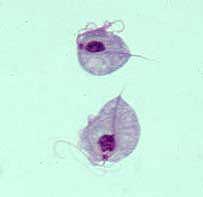
Trichomonas vaginalis (Protozoa)
Causes trichomoniasis (vulvovaginitis), curable STI found in both sexes
Most infections asymptomatic
Four anterior flagella
Trophozoite only; no cyst stage

Trypanosoma cruzi (Protozoa)
Flagellated - no cyst
Causes Chagas
Endemic throughout Latin America and South America
Insect vector - Acquired through the reduviid (kissing) bug
Infection can be lifelong, most asymptomatic
Can cause heart problems (dilated heart, arhythmia)

Plasmodium vivax (Protozoa)
Causes malaria
Insect vector
Life cycle involves insect (female Anopheles mosquito) and vertebrate tissue
Nonmotile - apicomplexa
Fungi Characteristics
Eukarya - Fungi
Nonmotile
Cell wall made from chitin (polysaccharide)
Absorptive heterotrophs (secrete enzymes, then absorb nutrients)
Saprophytes (decompose decaying matter)
Fungi divided by
Unicellular yeasts
Filamentous molds
Based on appearance
Fungi parts
Hypha (plural: hyphae)
Individual fungal filament
Mycelium
Fibrous network of hyphae
Microscope techniques for fungi
Tape mount
Slide culture
Tape mount
Lactophenol Cotton Blue (LPCB) –
Lactic acid - preserves fungal structures –
Phenol – kills any live organisms
Cotton Blue – stains chitin
Advantages –
Fast/easy to prepare
Slide lasts long time
Disadvantages
Structures may not be preserved
Slide Culture
Potato Dextrose Agar (pH 5.5 – Fungi like acidic environment)
Best grown at RT, dark, and moist
Advantages
Fungal structures preserved
Disadvantages
Takes days to grow

Saccharomyces cerevisiae (Fungi)
Common baker’s yeast
Does not form mycelium (not fuzzy)
Produces colonies that look like bacteria

Rhizopus (Fungi Mold)
“bread mold”
White or grayish cottony growth
Mycelium appears white
Sporangia (where spores are) appears black


Aspergillus (Fungi Mold)
Characterized by green-yellow or brown colonies with white edge
Conidiospores (asexually produced fungal spores)


Penicillium (Fungi Mold)
Conidiospores (asexually produced fungal spores)

Fungal spores - asexual reproduction
Offspring identical to parents
Sporangiospores
Found in Rhizopus
Conidiospores
Found in Penicillium and Aspergillus
Fungal spores - sexual reproduction
Offspring genetically different
Zygospores
Found in Rhizopus
Fusion of nuclei occurs in zygospore

Candida albicans (Fungi)
Grows as yeast and filamentous fungi
Part of gut flora
Causes candidiasis

Schizosaccharomyces (Fungi)
Look for 8 spores
Produced by meiosis