psych 3260 exam 1
 Call Kai
 Learn
Learn Practice Test
 Spaced Repetition
 Match
Match Flashcards
 Knowt Play
1/89

There's no tags or description
Looks like no tags are added yet.
Name | Mastery | Learn | Test | Matching | Spaced | Call with Kai | Chat |
|---|
No analytics yet
Send a link to your students to track their progress
90 Terms
how has the elderly population changed over human history?
life expectancy was relatively stable between 8000 BCE to 1800 CE, before rapidly increasing due to factors like sanitation, clean water, vaccines, germ theory, and modern medicine
in the modern day, we have more elderly adults and higher life expectancies than ever before
general changes associated with age
increases
life experience and wisdom
emotional regulation
vocabulary and knowledge
decreases
processing speed
working memory
sensory and motor skills
chronological age
the amount of time that has elapsed since your date of birth
objective and universal, but tells us little about a patient’s health
e.g., two 75-year-olds could be in vastly different health
biological age
measured by damage to cells, organs, and other bodily systems (e.g., telomeres, epigenetics)
a much better predictor of disease
influenced by sleep, exercise, and stress
emotional/psychological age
a person’s subjective experience of how old they are
can increase or decrease over time
affected by mood and culture
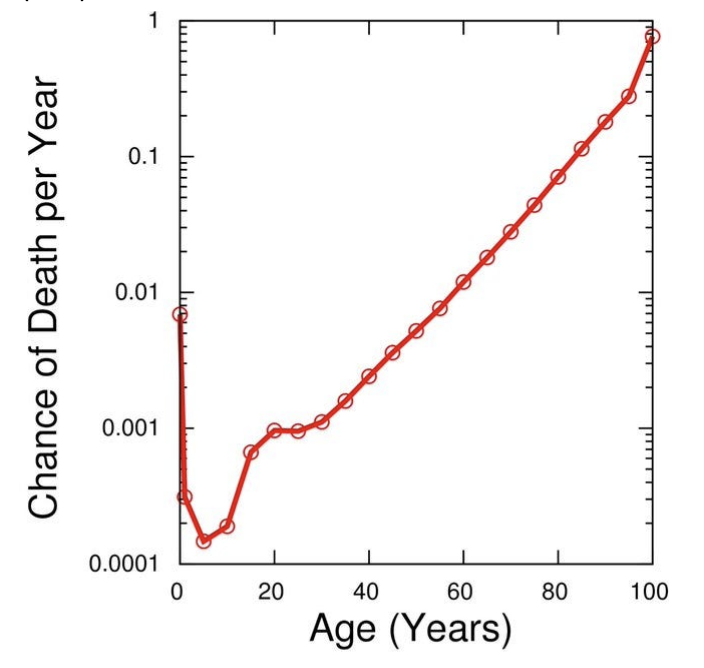
the gompertz curve
measures a person’s annual chance of dying across the human lifespan
gompertz zone = 30-90
the longevity revolution
most of the increase in human lifespan occurred after 1900
influenced by healthcare, nutrition, antibiotics, and decreases in infant mortality
how does life expectancy change with age?
“the longer you live, the longer you will live”
older people have made it past many of the major risks in life, so they tend to live longer than younger people
women tend to live longer than men
caloric restriction
significantly reducing the amount of calories you eat every day (40%) is the only proven way to increase lifespan
aging as a cause for disease
age is a proxy for many changes and effects, but it is NOT a cause of anything
aging cannot be used for random assignment, so it can only be considered a quasi-experiment (correlational)
thus, changes associated with age are “age-related”
cross-sectional studies
same test day, different lifetimes
ex: testing how 20-year-olds, 50-year-olds, and 95-year-olds use their cellphones
cohort
a group of people born in the same generation
cohort effect
differences in behaviors due to wildly different ages and lived experiences
ex: people born during WWII didn’t get their first phone until they were in their 60s, while people born in 2000 didn’t get their first phone until they were in middle school
longitudinal studies
follow the same people over time
pros = eliminates cohort effects, leaving aging as the leading contributor to potential changes
cons = some participants may drop out or die (selective attrition), changes in technology, expense, practice effects
selective attrition
the participants who leave a longitudinal study are often those doing the worst (i.e., poorest health), which biases the results of the study
practice effects
participants take the same tests again and again in a longitudinal study
can hide real decline and make people look better than they really are
how does choosing age groups skew tests?
most studies related to age psychology choose young adult groups (18-25) and older adult groups (65-95)
the 7-year span in young adults can have significant differences in experiences, abilities, and life stages
the 30-year span in older adults can have significant differences in health, life experiences, cognition, and goals
healthy-volunteer bias
the people who most need studying are the ones least likely to take part; makes aging look gentler than it is and causes the study’s average to sit above the true average
healthy → enroll and keep coming back
frail/ill → decline, can’t attend, or don’t survive
which age group is almost never included in aging studies?
individuals in nursing homes
excluded because they’re…
difficult to test
have cognitive impairments
are expensive to test
often lead to “messy” data
although researchers want to focus on “normal” aging, the elderly in nursing homes should also be part of that population
what is the relationship between biology and psychology?
biological changes influence our thoughts, emotions, and behavior
our psychological responses, habits, and environments influence our biology
what are some biological effects of aging?
wrinkling skin → makes agining visible (psychological consequences)
muscle weakness → leads to reduced independence
bone density → becomes thinner and weaker, increasing fracture risk
cardiovascular and respiratory changes → less efficient
gait speed
how fast you walk
also requires thinking
what are some effects of aging on the brain?
abilities are determined by multiple brain areas; cognitive decline leads to more effort to achieve the same tasks
shrinking hippocampus → impaired memory, increased forgetfulness, difficulty learning new information
enlarged ventricles → linked to slower thinking and reduced processing speed
loss of white matter → fewer and less efficient connecitons between brain regions
reduced neurotransmitters → affect mood, motivation, attention , and learning
prefrontal cortex inhibition →makes it harder to focus, plan, and multitask
how does aging affect memory?
episodic memory declines faster (hippocampus changes)
procedural memory doesn’t go away (basal ganglia doesn’t change)
circadian rhythm
the 24hr sleep-wake cycle
required for maintaing physiological and psychological processes
why is sleep beneficial?
sleep restores the body, consolidates memories, regulates mood and emotion, clears waste form the brain, supports immune function, and drives overall health
how does the circadian rhythm change with aging?
older adults go to sleep earlier and wake up earlier
leads to better cognitive ability in the morning
older adults have problems staying asleep, not falling asleep
insomnia
difficult falling asleep and staying asleep
leads to daytime fatigue
becomes more common as we age
daytime fatigue
impaired attention and reaction time during the day due to a lack of sleep
fragmentation and age
young adults get more continuous sleep (more restorative)
older adults get more fragmented sleep because they are more likely to wake up multiple times during the night (less restorative)
leads to less/interrupted REM sleep and more daytime fatigue
sleep apnea
a cessation of breathing during sleep, caused by blocked or collapsed airways
can happen 500+ times an hour; breathing only resumes upon waking up
effects:
additional strain on the heart (increased risk for hypertension, strokes, and heart attacks)
poor sleep quality (daytime fatigue, worsened mood)
REM interruptions
CPAP machine
continuous positive airway pressure; pumps air into the mouth during sleep to reduce interruptions caused by sleep apnea
memory consolidation
the process of stabilizing a memory after learning and storing it so it can be remembered later
strongly associated with REM sleep
sleep and neurodegenerative diseases
poor sleep quality has been linked with a higher risk of developing Alzheimer’s
during high-quality sleep, the brain clears out waste proteins (beta-amyloid plauqes and tau protein) which are associated with Alzheimer’s
effects of aging on the eyes
lens yellowing, senile miosis, vitreous foaters, macular thinning, cataracts
lens yellowing
chromophores accumulate; blues dim, contrast drops
senile miosis
pupil shrinks; -⅓ the light reaches the retina at age 80
vitreous floaters
the small shapes you see drifting across your vision (increases with age)
macular thinning
central retina thins; fine detail and reading degrade
cataracts
lens proteins that clump into a cloudy haze; glare worsens
prevalence increases with age
treatment
surgery can remove cloudy lenses and replace them with artifical intraocular lenses (IOLs)
cataracts can still return
prevention
blocking UV light
no smoking
movement and health eating
preventing lens injury
presbyopia
a decrease in lens elasticity associated with age
stiffer lens → less shape change → blurred near vision
corrective lenses and surgery can help, but aren’t permanent solutions
20/20 vision
normal visual sharpness or clarity when looking at an object or chart from 20 feet away
first number = the distance (in feet) between you and the eye chart
second number = the distance (in feet) at which an individual with healthy eyes could see the eye chart
ex: 20/40 vision indicates that what you see clearly at 20ft, someone with perfect vision could see clearly at 40ft
passing the eye test ≠ seeing well enough to drive
eye charts
used to test individual’s vision, but do not represent the real world
eye charts are bright, have high contrast, no movement
the real world can be dark, have glare, and constant motion
disability glare
scattering of light (increased glare), causing general blindness
increases with age
glare recovery
the amount of time it takes to regain sensitivity after temporary blindness
increases with age
dark adaptation
the process of vision adjusting when the lights are turned off; causes pupil dilation
cones (color) are prioritized in high-light environments
rods (black/white) are prioritized in low-live environments
increases with age
ex: after being blinded by oncoming headlights, it can take at least 30 seconds for an older adult to see well enough to drive safely
contrast sensitivity
the ability to detect differences between light and dark, even when contrast is low
as contrast decreases, the same pattern becomes harder and harder to see
declines with age
ex: sidewalk curbs disappear; glass is harder to identify
dynamic visual acuity
the ability to detect moving objects (object or observer can be moving)
decreases exponentially with age
ex: difficulty identifying a speed limit sign when driving at a high speed
glaucoma
damage to the optic nerve caused by increased pressure (poor fluid drainage), leading to peripheral vision loss and eventual blindness
vision loss if often slow and may be undetectable; vision that is lost will not return even with treatment
treatment is most effective if started early
eyes drops to decrease pressure
laser surgery to improve fluid drainage
surgery to create new drainage routes
prevention
knowing family history (highly heritable)
protecting eyes from injury
avoiding steroids
regular movement
macular degeneration
thinning and loss of the macula, leading to central vision loss
dry AMD → more common and typically slower; leads to blurring and distortion in the center of the eye
wet AMD → less common and often faster; leads to a black spot in the center of the eye
treatments exist but vision will not recover
medications and surgery can slow and stop further damage
vision and memory associations
many problems that look like they’re caused by poor memory may actually be caused by poor vision
ex: poor vision makes it harder to understand reading → leads to poor recall → may be interpreted as a memory problem
the outer ear
function = collecting sound
parts = pinna (auricle), external auditory canal
pinna (auricle)
the external ear structure; collects sound waves
grows hair with age
external auditory canal
funnels sound waves to the middle ear
contains cerumen (wax)
middle ear
function = amplifies sound
parts = tympanic membrane (eardrum), ossicles, eustachian tube
tympanic membrane
the eardrum; vibrates due to air pressure and sound waves
ossicles
three small bones in the ear (malleus = hammer, incus = anvil, stapes = stirrup); vibrate due to air pressure and sound waves
becomes denser with age
eustachian tube
drains fluid out of the ear
inner ear
function = turning sound into signals
parts = semicircular canals, cochlea, auditory nerve
cochlea
hit by the vibrating stapes to create traveling waves in cochlea fluid that bend hair cells to start action potentials in the auditory system
tonotopic organization
base of the cochlea resonates due to high frequencies
apex of the cochlea resonates due to low frequencies
auditory nerve
transmits auditory signals to the brain
hearing range
10Hz to 20,000Hz
highest frequencies (~20,000Hz) can only be heard by infants
what causes age-related hearing loss?
aging leads to a progressive loss of cochlear hair cells from the base (high frequencies) to the apex (low frequencies)
inner hair cells are more robust
outer hair cells are more likely to be damaged
hearing loss and gender
men are more likely than women to develop hearing loss
the differences in hearing ability between men and women increase with age, especially at higher frequencies
audiograms
measure hearing thresholds
preventing hearing loss
limit exposure to background noise at specific frequencies
loud sounds damage the part of the cochlea that matches the frequency of the noise
ex: continual exposure to power tools will damage the hair cells responsible for that frequency
hearing aids
devices used to amplify noises for individuals with hearing loss
often not used by older adults (social stigma + acceptance of age)
somewhat ineffective → amplify all noises, not just specific noises (masking)
cochlear implants
uses microphones that transmit sounds to electrodes in the cochlea, which send signals to the brain
very controversial among the Deaf community
interactions between hearing and cognition
as speech gets faster, the gap in understanding between younger and older adults increases with age
due to changes in processing speed
energetic masking
difficulty understanding a speaker due to background noise (e.g., music) at the same frequency
difficulties associated with masking increase with age
informational masking
difficulty understanding a speaker due to background talking at the same frequency
more difficult to understand than energetic masking
difficulties associated with masking increase with age
accented speech and understanding
difficulties with understanding distorted or accented speech increase with age
compounded with energetic & informational masking
what is the link between hearing loss and dementia?
large population studies show that older adults with hearing loss are more likely to develop dementia
hypothesis 1: there is a common cause between hearing loss and dementia
some theories, but no concrete evidence
hypothesis 2: hearing loss leads to social isolation, which leads to cognitive decline (dementia)
hearing aid use is associated with a lower risk of developing dementia
hearing loss is associated with low performance on multiple cognitive abilities (e.g., memory, processing speed, executive function)
the McGurk effect
what you see and what you hear can interact to create a new perception, indicating that visual and auditory information are combined in the brain
lip reading!
ex: visual input = “ga ga ga” and auditory input = “ba ba ba” → participants heard a new sound (“da” or “tha”)
what causes the McGurk effect?
redundancy → two looks at the same signal (auditory and visual)
complementarity → if one signal is hard to hear, the other can provide the missing information
bigger boost for younger adults, but still beneficial for older adults
how can you prevent age-related hearing loss?
avoid excessive noise
use hearing protection
keep listening levels on devices at a safe range
keep your ears clean and dry
see a healthcare professional if you notice problems (e.g., ringing, hard to hear, muffled sounds)
how long and loud can you listen to something without hearing loss?
80 dB for 40 hours/week
doorbells, loud conversations, and traffic (inside a car)
90 dB for 4 hours/week
shouted conversations, movie theaters, and motorcycles at 25ft
100 dB for 20 minutes/week
hair dryers, headphones at max volume, and sporting events
disability trajectory
small injuries that cascade into very detrimental effects
ex: older adult falls → has to go to the hospital → loses muscle during their hospital stay → now requires a walker or wheelchair → loss of independence
detrimental effects of falling
hip fractures (disability cascade)
traumatic brain injury
detrimental effects of near falls
decreased confidence in moving
avoiding activities
reduced movement → reduced mobility → increased risk of falling
not going out → social isolation
what does balance require in a psychological sense?
attention → focusing on relevant information and ignoring distractions
decisions → constantly deciding where to move, how fast to move, and how to adjust to changes in the environment
confidence → cautious movement can increase the risk of falling
willingness to move → recovering from the the fear of past falls
how is balance a sensory tripod?
balance requires
vision (information about surroundings, movement, and distance)
the vestibular system (inner-ear motion and gravity sensors)
proprioception (information about bodily movement)
vestibular system
responsible for the body’s balance; controlled by the semicircular canals
semicircular canals
rely on tiny hair cells that detect head movement and changes in position relative to gravity (vestibular system)
aging leads to a loss of vestibular hair cells (poor balance)
leads to dizziness and unsteadiness when standing up
makes adults feel less stable when turning quickly
leads to greater uncertainty in movement
proprioception
information from sensors in your muscles, joints, and feet that tell your brain where your body is and how it’s moving
decreases with age
reduced sensitivity in the feet
reduced joint-position sense
less accurate pressure information
slower detection of body sway
how can we improve balance?
strength training, balance practice, and physical activity
osteoporosis
increased porosity and fragility of the bones
increases with aging, making the bones much more fragile and more likely to break with a fall
prevention
maintain calcium when you’re young
practice weight-bearing exercise
increase Vitamin D
avoid smoking and excessive alcohol
decibels (dB) vs frequency (Hz)
decibels = measure of loudness
frequency = measure of pitch
eye miosis
unusually small or constricted pupils that fail to expand properly in dim light
pupil size decreases with age