Deck 1: Introduction and Electric Fields
 Call Kai
 Learn
 Practice Test
 Spaced Repetition
 Match
 Flashcards
 Knowt Play
1/22

There's no tags or description
Looks like no tags are added yet.
23 Terms
What is the main goal of high voltage engineering?
To guarantee that the electrical stress given by the electric field is significantly smaller than the electric breakdown strength.
Why are higher transmission voltages used when transmitting power over very long distances?
Power loss on the lines has a quadratic dependence of current. P = RI2
Why then are there upper voltage limits on power transmission?
The insulation cost increases with voltage
What methods of reducing electric field strength are used in field grading?
grading layers, insulation system geometries, electrode contours
How is electric field strength defined?
It is defined by mechanical force on a positive test charge q+
E = F/q+
What is the direction of the electric field?
The electric field always points from a region of higher potential to the region of lower potential

In an electrostatic field, positive and negative charges are the source of the electric field. How is the dielectric displacement density related to the electric field strength?
D = ε0 εr E
Where ε0 is the permittivity of vacuum and εr is the relative permittivity
The forces of the electric field can accelerate mobile charge carriers, and a drift current proportional to the field strength arises. How is current density defined?
J = σ E
σ is the electrical conductivity of an insulating material
How is potential energy Wpot defined?
A charge q, which is moved against the force F of the electric field E
φ = Wpot / q
How is electric field calculated from potential?
E = - grad φ
Define where capacitance comes from and its empirical relation.
An electrostatic field is caused by charges on an electrode surfaces
The electrode stores a distinct amount of charge at a given potential difference (voltage)
This charge storage capacity is called capacitance
C = q/V = q / Δφ
How is the whole capacitively stored energy W in the field volume calculated?
W = ½ C V2
Derive the expression for capacitance in a parallel plate capacitor.
ON IPAD
What is the electric field for two parallel-plates, concentric cylinders, and concentric spheres?
Parallel plates: E = V/x
Concentric cylinders: E = V/(x ln(R/r))
Concentric spheres: E = V/(x2(1/r - 1/R))
What are the three classifications of electric fields?
Static and stationary (steady-state) fields
Quasi-static (quasi-stationary) fields
Non-stationary fields
What is a static and stationary (steady-state) field?
Field quantities are time-invariant, do not change with time (i.e. Electric field E, magnetic curl field H, and electrical conduction field J)
There is no propagation of electromagnetic waves
What is a Quasi-static field?
Field quantities are slowly changing with time, but their coupling is very weak (i.e. Electric field E, magnetic curl field H, and electrical conduction field J)
What is a non-stationary field?
For rapidly varying fields the mutual coupling of electric and magnetic fields must not be neglected
Then the characteristics of electromagnetic wave propagation must be considered
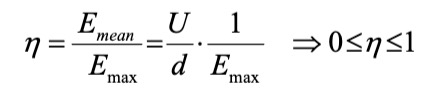
What is the degree of electric field uniformity η, and how does it relate to inception and breakdown voltage?
Uniform field: η=1 so breakdown and inception voltage are equal
Weakly non-uniform field: η < 1 breakdown and inception voltage approximately equal
Strongly non-uniform field: η << 1 breakdown voltage is higher than inception voltage
What are the two components of total current density J in an insulating material?
Jtot = Jcond + Jcap
Conduction current density: Jcond =σdc E
The field distribution depends primarily on the conductivity σ of the materials.
Capacitive current density: Jcap = ∂D/∂E
The field distribution depends primarily on the permittivity ε of the materials.
What is the fundamental difference between capacitive and resistive field distributions?
Capacitive fields are governed by permittivity ε, while resistive fields are governed by conductivity σ
What causes a transition from a capacitive to a resistive field distribution?
After applying a DC voltage, the initial field distribution is capacitive.
Over time, charges redistribute and accumulate at material interfaces, causing the field to gradually become resistive as steady state is reached.
What causes a transition from a resistive to a capacitive field distribution?
A sudden voltage change, switching operation, or polarity reversal creates a transient displacement current, making the field initially capacitive again.