c.1. hl content SIMPLE HARMONIC MOTIONNN
 Call Kai
 Learn
 Practice Test
 Spaced Repetition
 Match
 Flashcards
 Knowt Play
1/17

There's no tags or description
Looks like no tags are added yet.
18 Terms
So what is SHM aka Simple Harmonic Motion?
A type of motion in which oscillations occur where the restoring force is directly proportional to the displacement from the equilibrium position, and acts towards it.
F = -kx
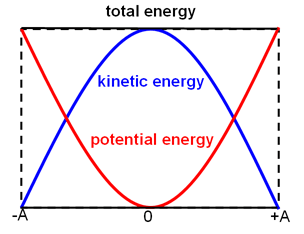
How does KE, PE and total energy change from peak displacements to middle?
TOTAL: constant
KE: big when at middle bc it’s traveling fastest
PE: big when farther away bc it’s higher up
What is “damping”?
Energy dissipates due to friction
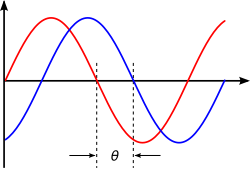
What is the phase angle? (Ø), what expressed in?
the difference between a since wave + your one.
“Fraction of an oscillation that occurs between 0 displacement and a standard sine wave that has 0 displacement at t=0”
EXPRESSED IN PI
Relationship between intensity/power/energy and amplitude?
Intensity <>< A²
But it can be interchanged like P <>< A² too
Relationship between intensity/power/energy and radius?
Intensity <>< 1 / r²
Or if ya want to be fancy and say r^ -2 that works too
If total energy and potential energy are given in the data booklet, how do you get KINETIC?
Ek = Et - Ep so
½ mw² (xo² - x²)
What’s the equation in the formula book for a STANDARD sine wave?
X = Xo sin (wt) theres no phase angle thats it
What does w (angular velocity) have to be in? What is it?
RADIANS PER SECOND
The rate of change of phase angle with respect to time
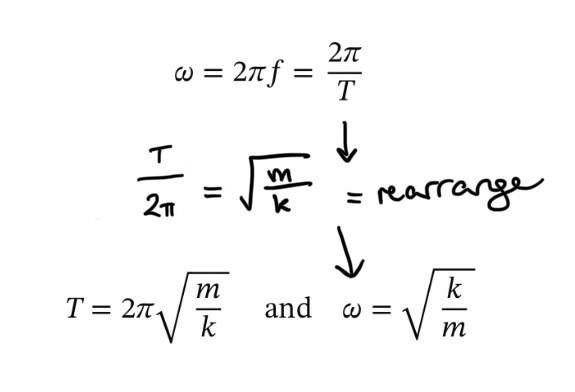
How can we relate angular velocity to the mass spring equation?
Bc it’s 2pi / T , flips it and subs for the 2pi and T part
Just know its related like that
Why is something with damping not SHM?
As it slows down, the sinusoidal wave form isn’t constant, motion isn’t constant so not IDEAL SHM
Explain the energy changes as a spring goes from UP to down
TOP: most stretched (or compressed), EPE the greatest KE = 0
MOVING TOWARDS: EPE decreases from its maximum value, stored energy converted into KE so speeds up
Kinetic energy increases to a MAXIMUM (while total mechanical energy remains constant)
No energy loss bc its ideal so mechanical energy constant
So you have 2 values for the phase angle from the CAST circle, how to find which one?
If it says “wave is traveling negative direction” go to the v=xowcos(angle) equation and make sure v<0, that would mean cos(angle) has to be negative, so the right value is the one that satisfies that :3
How is max velocity related to amplitude and angular frequency?
vmax = wxo

How to find the change in phase angle from 2 times?
It’s = 2pi x 🔺t/T
(so if the main wave was 80 T and your’s is 10 seconds differences its 10/80)

“Compare the energies” what do u do?
Get both then find ratio so u can say: ‘A is 4 times B etc.’
What can the diffraction grating equation be rearranged to get? my =dsin0
m = d/Y WHEN ANGLE IS 90 DEGREES

What does m=< d/Y mean?
The largest possible order (as a whole number tho)