physics midterm
 Call Kai
 Learn
 Practice Test
 Spaced Repetition
 Match
 Flashcards
 Knowt Play
1/26

There's no tags or description
Looks like no tags are added yet.
27 Terms
mass varies linearly with volume (T/F)
true
the quantity z varies linearly with x and inversely with the square of y. if i triple x and double y, what happens to z
-increases
-decreases
-remains the same
-not enough info
decreases
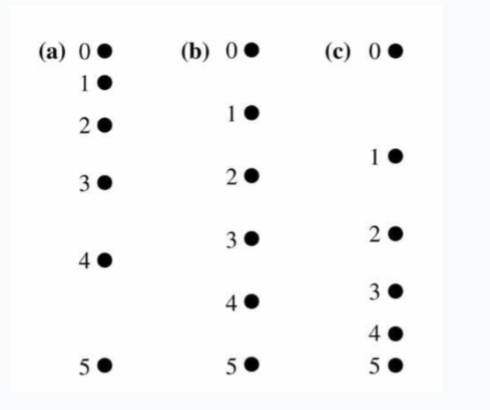
which dust settling at constant speed, which is a ball dropped, and which is a mars explorer coming down for a landing
ball, dust, rocket
A particle (can/cannot) have zero average velocity and nonzero average speed measured over the same interval. A particle (can/cannot) have nonzero average velocity and zero average speed.
can…can not
A particle is moving to the left and speeding up. which was does the acceleration point
to the left
at one instant, a particle is traveling due northeast at 10m/s. at a later time, it is traveling due south at 2 m/s. what of the following best describes its average acceleration
-northeast-ish at more than 10 m/s2
-northeast-ish at less than 10 m/s2
-southwest-ish at more than 10 m/s2
-southwest-ish at less than 10 m/s2
southwest-ish at more than 10 m/s²
A particle is moving in the positive direction at 6 m/s. its acceleration is -22 m/s²
how long does it take to stop?
-8 sec
-3 sec
-2 sec
-will not stop
3 seconds
twelve fleas sit on the hour marks of an analog clock. what is the sum of all their vector positions
-up, towards the 12 position
-to the right, towards the 3 position
-to the left, towards the 9 position
-the vector sum is zero
-there is not enough information
there is not enough info
consider the motion x=t². you calculate the avg velocity between 0 and 1.0s and the instantaneous velocity at 1.0s. which is bigger?
-instantaneous
-average
-the same
instantaneous
uniform motion is (sometimes/always/never) one dimensional
always
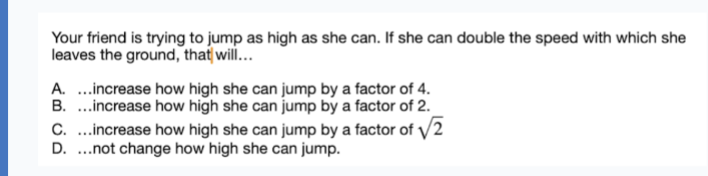
A
If Vincent is going 30 mph in his car and puts his brakes on as hard as he can, his stopping distance is 357 feet. What is his stopping distance at 45 mph
803 ft
In the position equation of kinematics, the v on the right side of the equation has a subscript of
1
A particle undergoes 1D constant-a motion. Its initial velocity is positive, and its acceleration is negative. Is its velocity always decreasing? is its speed always decreasing?
yes…no
A particle undergoes motion described by the graph shown. The average velocity of this particle between Time 1 and Time 2 is (positive/negative/zero). Its average speed during this interval is (positive/zero/negative).
zero, positive
A projectile is launches at speed v0 and angle theta. increasing which quantity(ies) will increase its range.
V0
(Vx)0
(Vy)o
theta
1, 2, 3

might not agree… always agree… always…
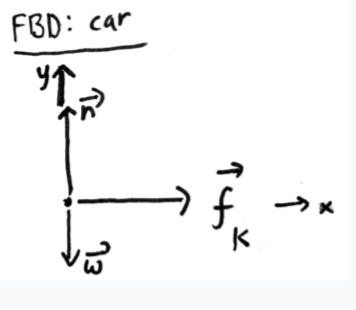
A car is traveling at constant speed on a level road. what is wrong with a FBD shown
-the normal force is too long
-the friction force is too long
-a force is missing
-all of the above
all of the above
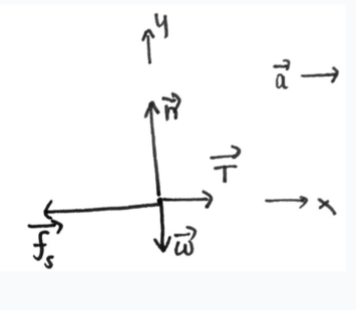
A child is towing a sled with a horizontal rope. the sled is speeding up. which are true of this FBD
the normal is too long
the friction force is too long
the tension force is too short
the friction force is the wrong king
none of the above
all of the above
all of the above
exert force F on Object A and measure its resulting acceleration. what force do I have to exert on Object B to give it 3 times the acceleration of A? the mass is 1/5 the mass of A
60% of F
Michael is putting out a flag. the flagpole makes an angle theta with the wall. what is the x-component of the force due to the wall on the poll
Fp sin(theta)
two masses M sit at (a,0) and (-a,0). what is the direction of the force they exert on m, located at (0,b)
-+x
—x
-+y
—y
-no net force
the -y direction
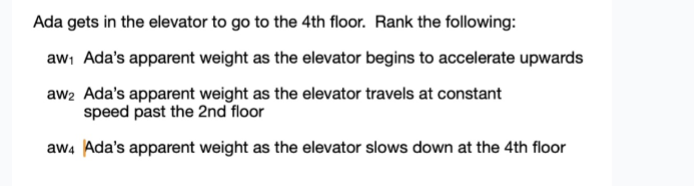
aw1> aw2> aw4

mg/k

a block is given a shove up an inclined plane, and as it is moving it is slowing down. is anything wrong with this fbd
normal force has wrong magnitutde
normal force has wrong direction
friction force has wrong mag
friction force has wrong direction
type of friction is wrong
doesn’t include the pushing force
it is correct
it is correct
kinetic friction can sometimes point in the same direction as an object’s velocity (t/f)
true
drink sitting on table, its FBD has its weight and normal force, which cancel.
are w and n an action-reaction pair
w and n are not an action-reaction pair