Drug properties & optimzation II 03 (2/3)
 Call Kai
 Learn
 Practice Test
 Spaced Repetition
 Match
 Flashcards
 Knowt Play
1/29

There's no tags or description
Looks like no tags are added yet.
30 Terms
Lipophilicity importance in drugs
- D's should be
1. Sufficiently hydrophilic to dissolve in biolo fluids
2. Have sufficient lipophilicity to cross memb's when passive diffusion is required
- Appropriate balance deps on the drug, formulation & route of administration.

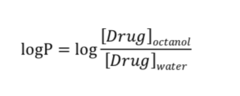
LogP (measurements of lipophilicity)
- Logarithm of the octanol/water partition coefficient for neutral form of a compound
- Not pH-dep
- Higher LogP: more lipophilic
- Lower LogP: more hydrophilic
- Formula →
LogP: rationale for Rule of 5
- LogP describes a neutral compound's preference for octanol vs. water
- High LogP = greater lipophilicity, but excessive may ↓ aq solubility & limit oral absorption
- Effective oral D's require a balance, not max. lipophilicity
Advantages of LogP
- Well-established measure of lipophilicity
- Useful for comparing molecular structures
- Included in Rule of Five
Limitations of LogP
- Describes the neutral species
- Doesn't directly capture pH-dep ionization
- May not rep. the distribution of ionizable D's under physiolo conditions
LogD (measurements of lipophilicity)
- Distribution btwn octanol & water at a specified pH (7.4)
- Accounts for a compound's non+ionized forms
- pH-dep, unlike LogP
- An intermediate LogD preferred, but no universal optimum

LogD suggested range
1 < Log D7.4 < 3 for many orally administered small-molecule D's, but not a universal requirement
Advantages of LogD
- Accounts for ionization at a specified pH
- Relevant for ionizable D's
- Can study lipophilicity under physiolo relevant conditions
Limitations of LogD
- Deps on pH
- Values measured at diff pH conditions can't be directly compared w/o considering ionization
2 common ways to measure LogP and LogD
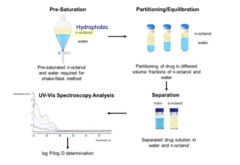
1. Shake-flask (solution method)
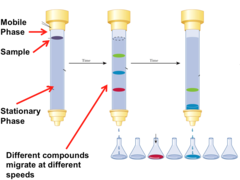
2. HPLC (High-Performance Liquid Chromatography)
Shake-flask (solution method)
1. Mix drug w octanol & water
2. Allow system to reach equilibrium
3. Measure concen's in both phases
4. Calculate partition or distribution coefficient
HPLC (High-Performance Liquid Chromatography)
- Inject sample into a specialized HPLC column calibrated w compounds of known Log P
- Retention time ↑ w lipophilicity; use this correlation to estimate Log P
Low LogD_7.4
- Relatively high water solubility
- Low lipid bilayer permeability
- Low oral absorption
- Pic on desktop

High LogD_7.4
- Low water solubility
- Higher lipid bilayer permeability = poor oral absorption
- Pic on desktop

Very high LogD7.4
- Highly lipophilic D, very low water solubility
- Increased memb permeability to a point, then can get trapped in hydrophobic core of lipid bilayer = poor oral absorption
- Pic on desktop

Drug permeability
- How readily a D crosses a biolo barrier
- Passive permeability is influenced by lipophilicity, ionization, molecular size, H-bonding capacity
- Solu+permeability r distinct, but both influence oral absorption
Caco-2 Assay (permeability methods)
- Uses layer of cultured human intestinal-like epithelial cells btwn Buffer 1 and 2
- Can reflect passive & transporter-mediated transport
- More complex, costly & time-consuming

PAMPA (Parallel Artificial Membrane Permeability Assay) - permeability methods
- Uses an artificial lipid memb btwn Buffer 1 and 2
- Measures mainly passive permeability
- Simple, rapid and suitable for early screening
Assay methods
1. Place D in Buffer 1 (donor compartment)
2. Allow D to cross memb/cell layer
3. Measure D concen. in Buffer 2 (receiver compartment) over time
4. Compare how readily diff D's cross barrier
Biopharmaceutics Classification System (BCS)
- Classifies D substances based on aq solubility and intestinal permeability
- 4 classes (I-IV)
- Class 1 and 3 immediate-release prods can qualify for BCS-based biowaivers

4 classes of BCS
- Class I: favourable for oral absorp
- Class II: dissolution/solubility can limit absorp
- Class III: permeability can limit absorp.
- Class IV: many oral-delivery challenges

Metabolic stability
D's resistance to enzymatic transformation
Phase I of drug metabolism
- Oxidation, reduction and hydrolysis
- May introduce or expose functional groups
- Cytochrome P450

Cytochrome P450 (Phase I metabolism)
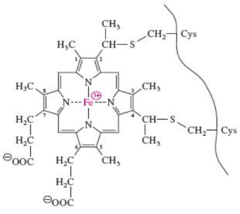
- Cytochrome P450 (CYP) enzymes catalyze many oxidation rxn's
- Contain a heme group w an iron (Fe) center
- Use O₂ and e- supplied by NADPH
- Found in liver & tissues
- Can introduce polar groups like -OH
Catalytic cycle of Cytochrome P450
1. Starts with Fe(III) then undergoes many redox rxn's and addition of O₂
2. Fe=O (most reactive iron species) is formed which oxidizes the substrate, then is converted into Fe-O-H via RH
3. ROH is removed and Fe re-enters cycle
- Pic on desktop

Determining electron richness
- EDG's can ↑ e- density in parts of a molecule & EWG's can ↓ e- density
- Resonance structures help visualize e- distribution
- E- distribution can affect susceptibility to oxidation

Phase II of drug metabolism
- Conjugation rxn's that attach chem groups to D's or metabolites
- Conjugation ↑ polarity & facilitates elimination
- Common rxn's: sulfation, acetylation

Common measurements of metabolic and plasma stability
1. Liver microsomal stability
2. Plasma stability
Liver microsomal stability (measurement of m&p stability)
- Uses subcellular memb preparations from liver tissue
- Assesses metabolism by enzymes present in microsomes, including CYP enzymes
- Can measure D disappearance half-life (T₁/₂)

Plasma stability (measurement of m&p stability)
- Measures how long a compound remains chemically or enzymatically intact in plasma
- Expressed as (T₁/₂)
