biology module 9
 Call Kai
 Learn
 Practice Test
 Spaced Repetition
 Match
 Flashcards
 Knowt Play
1/50

There's no tags or description
Looks like no tags are added yet.
51 Terms
kinase
enzyme; phosphorylates a protein
takes place in: nucleus, cytoplasm, mitochondria, cell membrane
phosphatase
enzyme; dephosphorylates a protein
takes place in: nucleus, cytoplasm, mitochondria, cell membrane
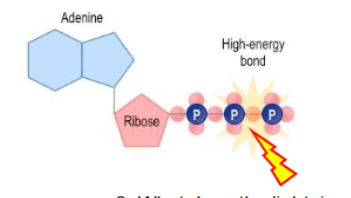
what molecule is this
ATP

cellular respiration
cells convert chemical energy (food) into ATP
requires glucose + enzymes + molecular “shuttles” (NADH) + a chemical “pull” (oxygen)

cellular respiration is a series of
redox reactions

redox reactions
oxidation-reduction reactions or chemical reactions that involve transferring of electrons between two species
NADH
electron carrier
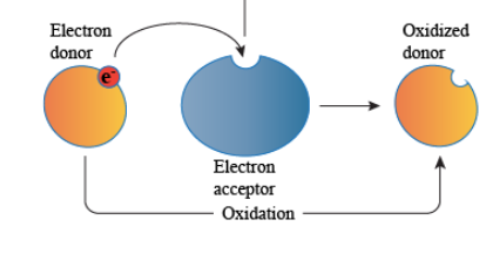
oxidation
substance loses electrons; becomes oxidized

reduction
substance gains electrons; positive charge amt becomes reduced
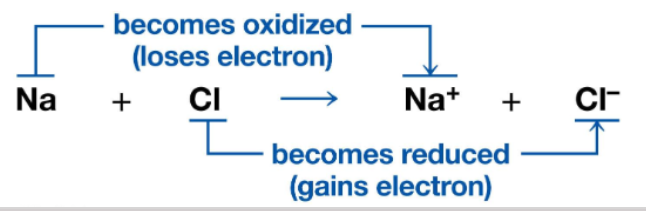
reducing agent
electron donor; reduces electron acceptor

oxidizing agent
electron acceptor; oxidizes electron donor

fermentation
chemical process; molecules like glucose are broken down anaerobically
produces energy + regenerates NAD+ for glycolysis + produces lactate/ethanol

substrate phosphorlyation
donation of phosphate group from a substrate to ADP
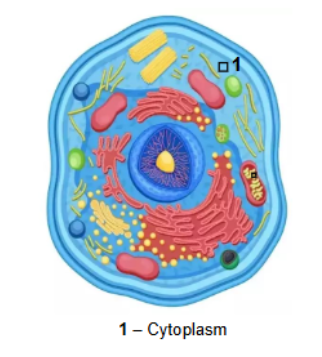
2 goals of glycolysis + location
break down glucose
produce energy
cytoplasm (outside mitochondria)

without glycolysis
neurodegeneration + enzyme deficiency + cancer
cells malfunction or die
glucose to glucose 6-phosphate
1st step of glycolysis (energy investment phase)
hexokinase phosphorylates glucose
glucose 6-phosphate to fructose 6-phosphate
2nd step of glycolysis (energy investment phase)
phosphogluco-isomerase rearranges the sugar to be split evenly
fructose 6-phosphate to fructose 1, 6-bisphosphate
3rd step of glycolysis (energy investment phase)
phospho-fructokinase phosphorylates fructose 6-phosphate
fructose 1, 6-bisphosphate split in half into G3P + DHAP
4th step of glycolysis (energy investment phase)
aldolase splits glucose (6C) in half (into 2 3C molecules)
DHAP to G3P
5th step of glycolysis (energy investment phase)
isomerase converts DHAP to G3P
G3P to 1, 3-bisphospho-glycerate
6th step of glycolysis (energy payoff phase)
triose phosphate dehydrogenase collects electrons via (2) NAD+ carriers
2 NADH & 2 H+
1, 3-bisphospho-glycerate to 3-Phospho-glycerate
7th step of glycolysis (energy payoff phase)
phospho-glycerokinase mediates 1st substrate level phosphorylation
1 ADP to 1 ATP
3-Phospho-glycerate to 2-Phospho-glycerate
8th step of glycolysis (energy payoff phase)
phospho-glycero-mutase rearranges the molecule
2-Phospho-glycerate to PEP
9th step of glycolysis (energy payoff phase)
enolase rearranges molecule + releases water as a waste-by-product
PEP to pyruvate
10th step of glycolysis (energy payoff phase) [END OF GLYCOLYSIS]
pyruvate kinase mediates 2nd substrate level phosphorlyation
1 ADP to 1 ATP
[END] = 2 PYRUVATE + 2 NADH + 2 ATP
products produced per glucose molecule
2 ATP 2 PYRUVATE 2 NADH
pyruvate oxidation goals + location
make acetyl-CoA
produce energy carrier
mitochondrial matrix
decarboxylation
1st step of pyruvate oxidation
carboxl group removed; forms CO2
oxidation
2nd step of pyruvate oxidation
NAD+ gets reduced to NADH
mediated by pyruvate dehydrogenase complex
Coenzyme A attachment
3rd step of pyruvate oxidation [END]
coenzyme A attached to acetate; forms acetyl CoA
products of pyruvate oxidation
2 Acetyl-CoA , 2 NADH + H+ , 2 CO2
kreb’s cycle goal + location
oxidize acetyl-CoA
produce energy
mitochondrial matrix
electron transport chain goal + location
creates proton gradient
produces energy
mitochondrial membrane

fill in blanks
filled dih

products of kreb’s cycle
oxaloacetate, 4 CO2, 2 ATP, 6 NADH + H+ , 2 FADH2
products of electron transport chain
30-32 ATP, Protons, NAD+, FAD
anaerobic respiration
done by some species of microorganisms that use non-oxygen electronegative molecules; also form an ETC
fermentation
does not use ETC; another form of substrate-level phosphorlyation; occurs in absence of oxygen
consists of glycolysis + reactions that regenerate NAD+ for glycolysis

types of fermentation
alcoholic + lactic acid fermentation

alcoholic fermentation
pyruvate converted to ethanol
CO2 released from pyruvate (forms acetaldehyde)
acetaldehyde reduced by NADH to ethanol

lactic acid fermentation
pyruvate converted to lactate without producing CO2
fermentation by bacteria used in food (cheese, yogurt, chocolate, etc)
obligate anaerobes
use fermentation or anaerobic respiration and cannot survive in presence of O2
facultative anaerobes
yeast + many bacteria use cellular respiration in presence of O2 or fermentation when O2 is absent
citrate formation
1st step of Kreb’s Cycle
Acetyl-CoA (2C) joins oxaloacetate (4C) to form citrate (6C)
catalyzed by citrate synthase
Isomerization
2nd step of Kreb’s cycle
citrate (6C) converted to isocitrate (6C)
by aconitase
first oxidation + decarboxylation
3rd step of Kreb’s cycle
isocitrate (6C) oxidized to α-ketoglutarate (5C)
reduced NAD+ to NADH and CO2 released
by isocitrate dehydrogenase
second oxidation + decarboxylation
4th step of Kreb’s cycle
α-ketoglutarate (5C) oxidized to succinyl-CoA (4C)
reduced NAD+ to NADH and CO2 released
by α-ketoglutarate dehydrogenase
substrate-level phosphorylation
5th step of Kreb’s cycle
succinyl-CoA (4C) converted to succinate (4C)
produces (1) ATP
by succinyl-CoA synthetase
oxidation of succinate
6th step of Kreb’s cycle
succinate (4C) oxidzed to fumarate (4C)
reduces FAD to FADH2
by succinate dehydrogenase
hydration
7th step of Kreb’s cycle
fumarate (4C) converted to malate (4C) by addition of water
catalyzed by fumarase
regeneration of oxaloacetate
8th step of Kreb’s cycle [END]
malate (4C) oxidized to oxaloacetate (4C)
reduces final NAD+ to NADH
by malate dehydrogenase
[cycle occurs one more time, doubling products]