(6A) NSAIDs: Salicylates, Fenamates, Oxicams & COX-2 Inhibitors
 Call Kai
 Learn
Learn Practice Test
 Spaced Repetition
 Match
Match Flashcards
 Knowt Play
1/20

There's no tags or description
Looks like no tags are added yet.
Name | Mastery | Learn | Test | Matching | Spaced | Call with Kai | Chat |
|---|
No analytics yet
Send a link to your students to track their progress
21 Terms
What we talk about in NSAIDS?
Salicylates
Fenamates
Oxicams
COX-2 Inhibitors
Arylalkanoic Acids
Give me basic over structure
Salicylate → 1 ring + COOH
Fenamate → 2 rings + COOH + N between rings
Oxicam → 2 aromatic groups + ENOL, no COOH
Celecoxib → 3 rings + sulfonamide
Arylalkanoic → COOH–α-carbon–aryl; then look at the individual drug
Give me the Salicylates?
Salicylic Acid
Aspirin
Salicylic Acid
Salicylic acid may appear in formulations and skin-care products.
It is not the major oral anti-inflammatory agent being focused on here.
Focus on aspirin/acetylsalicylic acid
At physiological pH, what is aspirin’s ionization?
At physiological pH (after being absorbed), aspirin has a high ionized fraction (overwhelmingly in the negatively charged formed)
professor estimated approximately 10,000:1 ionized : unionized (I/U)
Aspirin Mechanism
Serine –OH attacks the carbonyl of aspirin's acetoxy group
→ acetyl group transfers to serine
→ serine becomes acetylated
salicylate anion is released
→ COX activity is inhibited.
→ COX-1 fully inhibited
→ COX-2 becomes very sluggish.
What is the difference between Aspirin and Naproxen?
Aspirin = irreversible
It acetylates COX serine.
That is why its effect lasts.
Naproxen = reversible
It only inhibits COX while it is bound; when it falls off, COX can work again.
Patient takes low-dose aspirin (81mg) + naproxen. What should they do?
Take aspirin first
let aspirin acetylate COX
then take naproxen about 30–60 minutes later.
If aspirin and naproxen are present together:
Naproxen can competitively occupy the site → interfere with aspirin getting in and producing irreversible acetylation.
What do platelets use COX-1 for?
To produce TXA₂, which promotes platelet aggregation/clumping.
Why aspirin's platelet effect lasts so long
Low-dose aspirin: COX-1 irreversibly inhibited → TXA₂ synthesis ↓
Platelets:
Have no nucleus
therefore no DNA blueprint to make new COX-1
platelet must ultimately be replaced
Aspirin
duration?
about 4–6 hours.
Metabolism and Duration relationship
Fast metabolism → short duration
Slow metabolism → longer duration
Aspirin
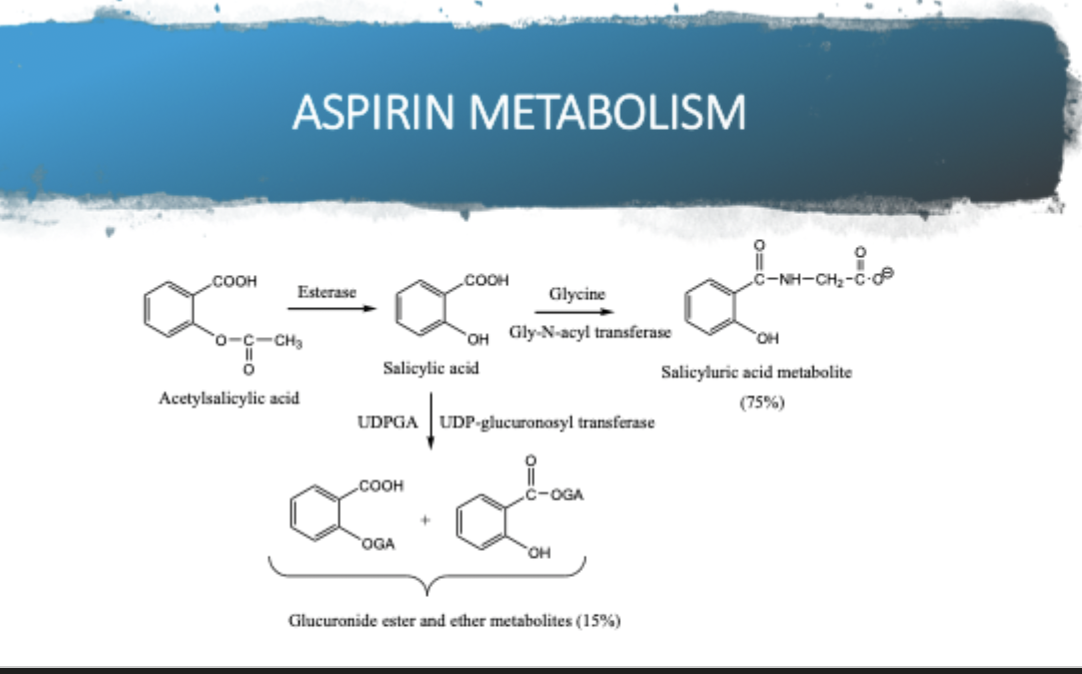
Metabolism
Aspirin → esterase → salicylic acid → Phase II metabolism
salicylic acid has much less anti-inflammatory activity
Then salicylic acid can undergo Phase II pathways::
Glycine conjugation at the carboxylic acid = major pathway
Glucuronidation at the carboxylic acid and/or phenol OH = minor pathways
Aspirin In-Vitro Decomposition
Aspirin contains an ester that can auto-hydrolyze during storage.
Aspirin In-Vitro Decomposition
Professor's practical signs:
Moisture / water → vinegar smell → discard
degraded aspirin has less anti-inflammatory/pain-relief activity
Light → discoloration → quinone formation → decomposition
What are the 2 types of Fenamates?
Mefenamic Acid
Meclofenamate
Who more potent: Fenamates or aspirin/naproxen?
Fenamates shown > aspirin/naproxen in potency.
Fenamates have 2 separate aromatic rings + conjugation → greater potency.
The nitrogen between the rings helps maintain that conjugation.
Which is more potent?

Meclofenamate > mefenamic acid
WHY is meclofenamate more potent?
Chlorines (Cl) do two important things:
Cl → lipophilicity ↑ → better distribution
AND
bulky ortho Cl groups → rings twist / become non-coplanar → better COX binding → potency ↑
Cl affects…
Cl affects POTENCY, not duration.