Guest Lecture - Temporal Lobe Amnesia
 Call Kai
 Learn
 Practice Test
 Spaced Repetition
 Match
 Flashcards
 Knowt Play
1/14

There's no tags or description
Looks like no tags are added yet.
15 Terms
Who was patient JM?
63 year old carpet fitter
Woke in the night unable to recall that his brother had recently died
He's in distress and wondering why the living room is full of flowers
Wife tells him and he keeps forgetting
Repetitive questioning
Lasting about 45 minutes (amnesia lasting 45 mins)
Recurrent "memory attacks": 20 times over 2 years
Normal MRI (no issues with language or motor functioning)
EEG epileptiform activity over the temporal lobes
What is Transient Epileptic Amnesia (TEA)?
Recurrent, witnessed episodes of transient amnesia
Other cognitive functions intact
Evidence of epilepsy (one or more)
Epileptiform abnormalities on EEG
Other clinical features of epilepsy (automatisms, olfactory hallucinations, etc.)
Response to anticonvulsant/epileptic medication
What are the clinical features of TEA?
Age of onset: ~62 years (mainly older adults)
Frequency of amnesic episodes: 13 per year
Duration: ~30 minutes
On waking: 74% (some attacks)
Olfactory hallucinations: 42% (more frequent than TLE)
Good response to AEDs: 88% (88% of people stop having these attacks upon medication)
Ongoing memory problems: 76%
What occurred to patient JM when he received the AED?
AEDs stopped the amnesic episodes
But persistent memory problems
Forgot he had replaced his friend's carpet a few weeks earlier
No memory of watching movies with his son
Memory of his wedding, gone
These are NOT during amnesic attacks

what does this graph display for memory retention in TEA patients?
These patients are not holding onto their memories normally
Overtime they show accelerated forgetting
Accelerated Long-Term Forgetting
We know it has something to do with the temporal lobes
Why might accelerated long term forgetting be related to the temporal lobes?
Bilateral epileptiform abnormalities over the temporal lobes often observed in TEA
We also see evidence of ALF in "classic" in TLE!
hippocampus is abnormally active

What is the life of a memory? What are the stages? What stage does amnesia affect?
encoding → consolidation → retrieval → reconsolidation back to encoding
amnesia affects the encoding
Which stage is involved in accelerated long term forgetting? Give evidence for encoding, consolidation, retrieval.
encoding:
maybe not because when you carefully match patients and controls on learning you still get ALF
consolidation: maybe?
retrieval:
giving patients retrieval support does not help them retrieve (the memory is not there and they can not retrieve)
Is ALF a disorder of the hippocampus?
there is subtle hippocampal atrophy in TEA (8% volume reduction)
… but not related to ALF
therefore hippocampal anatomy does not tell us much

What is the connection between the hippocampus and associative memory? How does this relate to the task shown?
Associative memory: were both words seen together?
Item memory: were both words previously seen?
Hippocampus is highly activated during associative recognition!
also:
Old-old = targets associative memory and more hippocampus-dependent
Old-new = less hippocampal-dependent

What did the study find for controls vs. TLE patients and associative memory and hippocampus dysfunction?
No evidence for hippocampal dysfunction -> TLE forgetting at same rate as controls
Not what was expected!
What is system consolidation during sleep and wakefulness? What interaction is important for this?
Reactivation happens during wakeful rest and sleep
Periods where brain is idling or sleeping
Hippocampus is reactivating memories during this and its part of its role in reconsolidation
Hippocampal-neocortical interaction is important for this
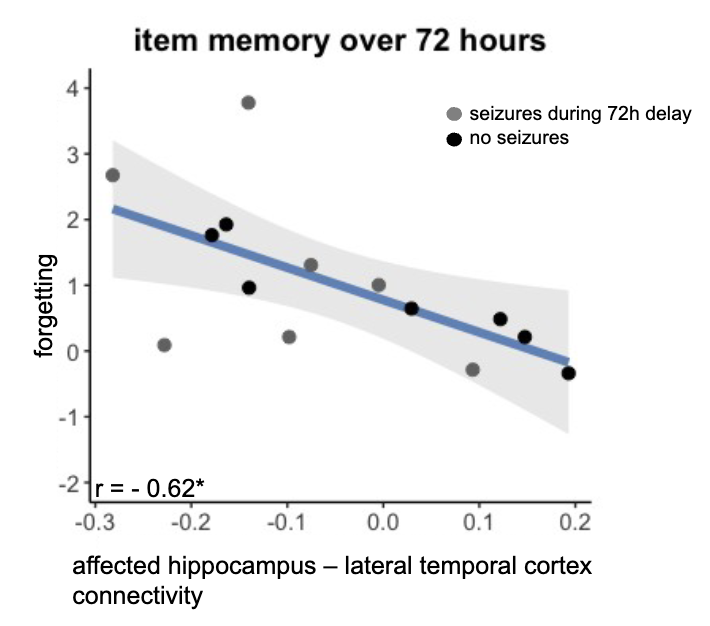
How does connection between temporal cortex and hippocampus influence accelerated forgetting?
The more disconnection between temporal cortex and hippocampus -> more evidence for accelerated forgetting
How does Slow Wave Sleep (SWS) contribute to systems consolidation?
in healthy brain → more SWS is good for memory
in TLE → an increase in the number of epileptic spikes during SWS + spread of that activity
Why? Maybe because the brain is highly synchronized and the seizure can simply spread more easily
While hippocampus is reconsolidated, neocortex is primed for plasticity

What conclusion can we draw for accelerated long term forgetting and SWS?
Epileptic spikes might be throwing hippocampus out of sync and that is failing to strengthens these memories so they just get lost over time
a consolidation disorder
seizures are not involved but spikes are
TLE patients have more SWS = more forgetting
