PSYCH 1X03: INSTRUMENTAL CONDITIONING
 Call Kai
 Learn
 Practice Test
 Spaced Repetition
 Match
 Flashcards
 Knowt Play
1/28

There's no tags or description
Looks like no tags are added yet.
29 Terms
Instrumental Conditioning
explicit training to learn the contingency between voluntary behaviours and their consequences
The Law of Effect
Behaviours with positive consequences = stamped in (performed more frequently)
Behaviours with negative consequences = stamped out (performed less frequently)
Leads to refinement
What is a reinforcer and what are types
Reinforcer: any stimulus that is presented after a response that impacts the frequency that the response is performed
Positive reinforcer:a rewarding or pleasant stimulus (ex: dessert, praise)
Negative reinforcer: unpleasant or aversive stimulus (ex: discipline)
What are the 4 types of instrumental conditioning
Reward Training: Presentation of a positive reinforcer, increases response/behaviour (ex: you do homework, get given $10, more likely to do homework)
Punishment Training: Presentation of a negative reinforcer, decreases response/behaviour (ex: you hit your sister, your mom scolds you, less likely to hit ur sis next time)
Omission Training: Removal of a positive reinforcer, decreases behaviour (ex: Billy watches TV and hits his sister, his mom takes away the TV, Billy less likely to hit his sis)
Escape Training: Removal of a negative reinforcer, increases behaviour (ex: shock on one side of cage, rat runs away from it to safe side, is now safe, more likely to stay on the safe side)
How can you ensure that instrumental conditioning learning takes place faster
Presentation of the consequence right after the behaviour/response
What is autoshaping and how does it occur + give examples
Learning without direct guidance for simple behaviours
Subject engages in random behaviours and applies the Law of Effect: stamps in behaviours with positive consequences, stamps out behaviours with negative consequences
Eventually you form an association (contingency)
Examples: Pigeon placed in a cage with a keyhole, when it pecks at the keyhole, it gets a seed. Eventually learns contingency between pecking and receiving food; Thorndike’s cat and puzzle box
What is shaping by approximation and how does it occur
Learning guided by someone else for complex behaviours; breaking down the behaviour into small approximations leading up to the target behaviour
Reinforcement based on progress/improvement (the closer you get to the desired behaviour) —> criteria for reinforcement becomes stricter after each approximation
Example: BF Skinner’s Ping Pong Pigeons
What is chaining and how does it occur
Technique used to learn a sequence of behaviours (if a task requires multiple steps, you would use this type of learning)
Every step is reinforced with the opportunity to complete the next step; reinforcement occurs as long as steps are in correct order
Ex: brushing your teeth (take toothbrush, put toothpaste, wet it, brush teeth, rinse brush, rinse mouth, put back toohrbsuh), washing your hands properly
Explain major differences between shaping by successive approximation and chaining
Shaping is reinforced through completing the successive approximations and criteria is very strict
Chaining is reinforced through completing the steps in the correct order
Shaping is about taking a final behaviour and breaking it down into small approximations that eventually reaches the target behaviour (ex: saying mama)
Chaining is about taking a task that requires multiple steps and going through each step in order, building up to the end of the process (ex: brushing teeth)
Acquisition
Learning the contingency between a response and its consequence
Discriminative Stimulus (SD/S+)
Stimulus which signals that a contingency relationship between a response/behaviour and a reinforcement = valid
S-delta (S-)
Stimulus which signals that a contingency relationship between a response/behaviour and a reinforcement = not valid
Example of the S+ and S-
Child knows that when she eats veggies at her parents house, she will receive dessert, but if she eats veggies at her grandparents’ house, she will not be reinforced
S+ = parents home
S- = grandparents home
What is generalization + example
When stimuli similar to the DS elicit the response
Pigeon pecks when the green light is on because it will receive food. Will also peck at lights with similar frequencies
How can the S- affect the generalization gradient of the DS
Original experiment:
Pecking in green light (SD) = food
Blue and yellow light = moderate pecking
New experiment:
Pecking in green light (SD) = food
Pecking in red light (S-delta) = no food
Blue light = pecking remains moderate
Yellow light = reduced pecking
→ Because the yellow light is the intermediate between the SD and S-delta
Continuous reinforcement
A reinforcer follows every correct response made by the individual.
What schedule of reinforcement is usually seen in the real world
Partial reinforcement
What is partial reinforcement and how is the broad category further divided
Partial reinforcement: Reinforcement is given after a few responses
Divided into either ratio or interval schedules
Ratio = after a given # of times
Interval = after a given amt of time
Further divided into fixed or variable schedules
Fixed = after exact # of times / amt of time
Variable = after an avg # of times / amt of time
What are the 4 schedules of reinforcement with examples
Fixed Ratio: After a exact # of responses, reinforcement occurs (FR-10: after 10 responses, reinforcement occurs)
Fixed Interval: After an exact # of time has passed, reinforcement occurs (FI-1: after 1 minute, reinforcement occurs)
Variable Ratio: After an avg # of responses, reinforcement occurs (VR-8: after an avg of 8 responses, reinforcement occurs)
Variable Interval: After an avg amt of time has passed, reinforcement occurs (VR-5: after an avg of 5 minutes has passed, reinforcement occurs)
Fixed Ratio: graph (response rate) + issues
Graph → Pause and Run Pattern: Following reinforcement, a participant will pause with inactivity before beginning the next run of responding.
Issues: A schedule that is too stingy will lead to ratio strain, and the subject will stop responding; A lack of motivation leads to procrastinating behaviour in a Fixed Ratio schedule
Variable Ratio: graph (response rate)
Graph: Diagonal line with no pauses between
Support very constant and high response rates
Fixed Interval: graph (response rate)
Graph: has a characteristic scallop pattern
Ex: A course with weekly quizzes
Study response rate peaks before a quiz, and drops significantly after a quiz
Variable Interval: graph (response rate)
Graph: straight line on the cumulative record
Ex: A course with pop quizzes
Study behaviour would continue at a steady rate to ensure preparedness for the pop quiz
VI schedule that delivers more frequent reinforcement will support higher response rates
If you were in a class that administered pop classes extremely frequently, you would likely be studying at a higher rate than if you were in a class that administered pop quizzes only a few times during the semester
Extinction
stopping of a desired behaviour once reinforcement is no longer given
What types of schedules of reinforcement should you use if you want to avoid extinction? (continuous vs partial; variable vs fixed)
Behaviours learned from partial reinforcement are most robust (resistant to extinction) than those trained on a continuous reinforcement schedule
Variable schedules are more resistant to extinction than fixed schedules since individuals have fewer expectations about when reinforcement is coming

What type of schedule of reinforcement is this
Fixed Ratio

What type of schedule of reinforcement is this
Variable Ratio
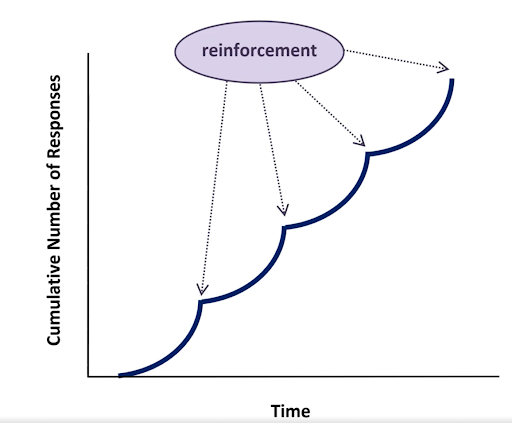
What type of schedule of reinforcement is this
Fixed Interval

What type of schedule of reinforcement is this?
Variable Interval