Bio-targets III 02
 Call Kai
 Learn
 Practice Test
 Spaced Repetition
 Match
 Flashcards
 Knowt Play
1/27

There's no tags or description
Looks like no tags are added yet.
28 Terms
Michaelis-Menten kinetics (enzyme function)

Velocity for Michaelis-Menten kinetics
V = dP/dt = Vₘₐₓ[S] / Kₘ + [S]

Rearranging equation gives linear relationship
Lineweaver-Burk plot
1/V = ( Km / Vₘₐₓ[S] ) / (1/Vₘₐₓ)

Vₘₐₓ
Maximum rxn velocity

Kₘ
Substrate concentration [S] at 1/2 Vₘₐₓ

K_d
- Equilibrium dissociation constant for binding (kr/kf)
- Lower Kd = tighter binding
k꜀ₐₜ
- Turnover rate
- How quickly bound substrate is converted to product

k꜀ₐₜ / Kₘ
- Catalytic efficiency
- Higher = more efficient enzyme-substrate rxn
- Can be used to compare diff substrates
Competitive inhibition (CI)
- Inhibitor competes w substrate for active site
- Prevents substrate binding while inhibitor is bound
↳ ↑ing substrate concen. can overcome inhibition
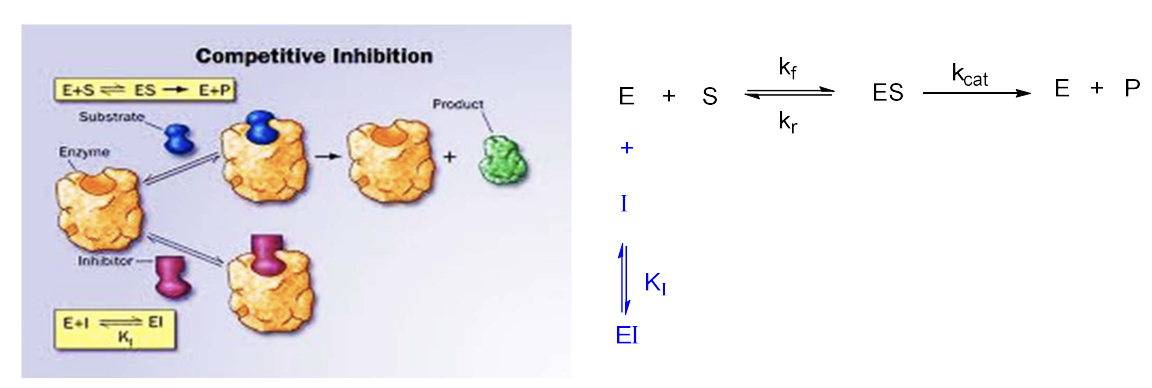
Effect of CI on enzyme kinetics
- Vₘₐₓ unchanged → 1/Vₘₐₓ unchanged
- Apparent Kₘ ↑ → -1/Kₘ approaches 0
- Lineweaver-Burk slope ↑

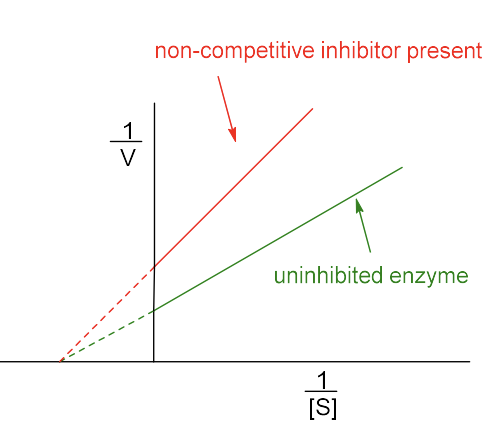
Noncompetitive inhibitor (NI)
Inhibitor binds at a site diff from active site
Substrate can still bind
Inhibitor binding ↓ catalytic activity by altering enzyme function
Inhibitor can bind E or ES

Effect of NI on enzyme kinetics
- Vₘₐₓ ↓ → 1/Vₘₐₓ ↑
- Kₘ unchanged → -1/Kₘ unchanged
- Lineweaver-Burk slope ↑
Uncompetitive inhibition (UI)
- Inhibitor binds only to ES complex
- Forms an inactive ESI complex
- Inhibitor binding ↓/prevents prod formation
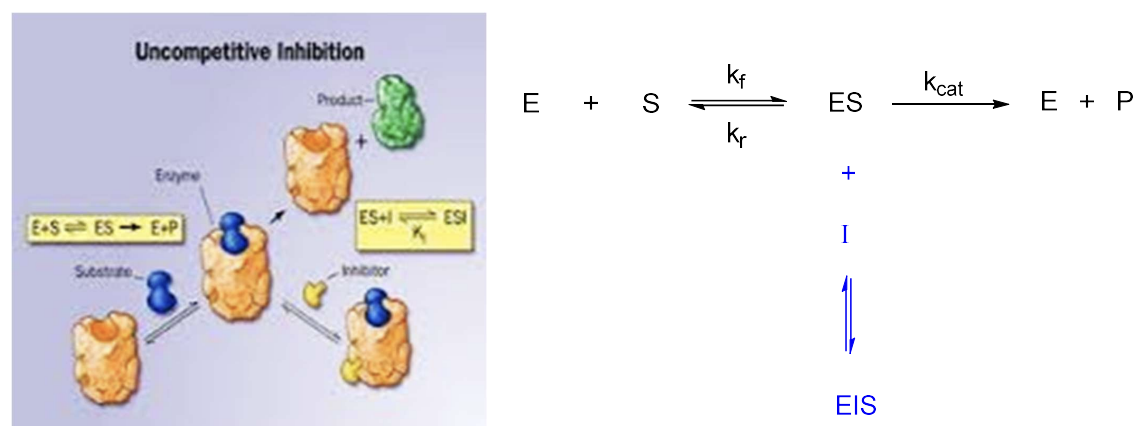
Effect of UI on enzyme kinetics
- Vₘₐₓ ↓ → 1/Vₘₐₓ ↑
- Kₘ ↓ → -1/Kₘ becomes more -ve
- Lineweaver-Burk lines r parallel

Irreversible inhibitors
- Prod long-lasting inhibition
- Form a covalent bond w enzyme
- Modifies residues important for enzyme function
- Some r mech-based ("suicide") inhibitors
- Ex: Penicillin

Receptors
- Respond to ligand binding
- Ligands bind to specific sites on receptors
- Binding can change receptor confor. & activity

Chemical messaging via binding
Ligand binding changes receptor's shape, allowing an intracellular signal protein to bind

Chemical messaging via catalysis
Ligand binding changes receptor's shape, activating or regulating catalytic activity
Resulting rxn helps transmit the signal

Agonists
Bind to receptors & activate them
Many bind at same site as natural messenger
Some receptor ligands bind at other sites (allosteric sites)
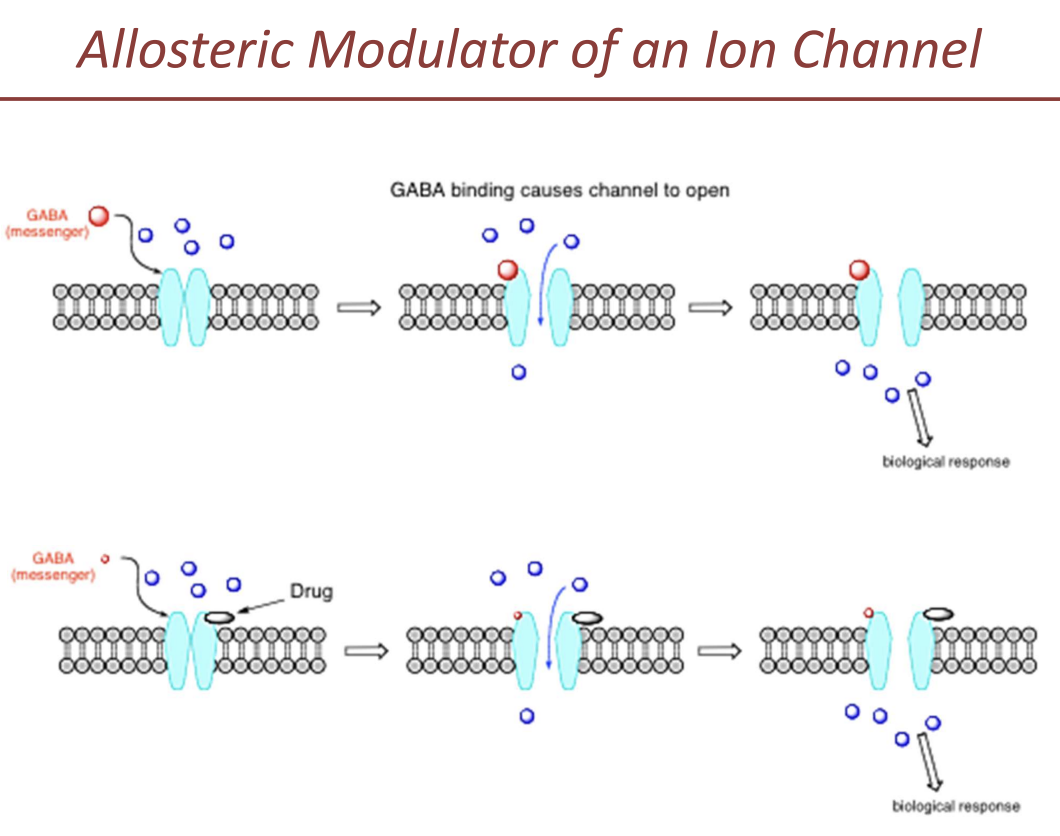
Allosteric modulators, ex: Benzodiazepines
Ex: Asthma drugs

Asthma drugs are adrenaline agonists
Adrenaline receptors in lungs stimulate bronchial opening when activated
Bind to active site of the noradrenaline receptor

Benzodiazepines are allosteric modulators
GABA is the natural messenger, which binds to & activates receptor
GABA binding opens ion channel
Benzodiazepines bind at a diff site & enhance the effect of GABA
Antagonists
Bind to receptor but don't activate them
Reduce or prevent activation by an agonist
Bind at same site as natural messenger or allosteric sites
Ex: Cimetidine (Tagamet)

Cimetidine (Tagamet) is a receptor antagonist
Histamine is the natural messenger
Activates receptor & promotes stomach acid secretion
Cimetidine binds to receptor but doesn’t activate it
Blocking histamine signaling reduces stomach acid secretion

Antagonists can bind at allosteric sites
Bind at a site diff from normal messenger
↓ receptor’s response to messenger
Don’t directly compete for same binding site

Partial agonists
- Bind to & activate receptor
- Prod a smaller max. response & have ↓er efficacy than a full agonist
- Can ↓ effect of a full agonist when both r present (competition)
- Ex: Buprenorphine

Buprenorphine is a partial agonist of opioid receptor
Binds strongly to μ-opioid receptors
Used in treatment of opioid use disorder
Inverse agonists (IA)
Receptor shows some activity even in absence of messenger
IA’s reduce "background activity" that some receptors have
Prod an effect oppo to an agonist
Agonist: ↑ receptor activity, Inverse agonist: ↓ receptor activity

Effects of receptor ligands on biolo activity (graph)
