4- ISOMERISM
 Call Kai
 Learn
Learn Practice Test
 Spaced Repetition
 Match
Match Flashcards
 Knowt Play
1/139

Earn XP
Description and Tags
Proverbs 16:3
Name | Mastery | Learn | Test | Matching | Spaced | Call with Kai | Chat |
|---|
No analytics yet
Send a link to your students to track their progress
140 Terms
b. Isomers
Existence of 2 or more compounds with same formula but different structures
a. Resonance
b. Isomers
c. Allotropes
d. Polymorphs
c. Structural / constitutional isomerism
Type of isomerism based on order of bonding
a. Stereoisomerism
b. Conformational isomerism
c. Structural / constitutional isomerism
d. Optical isomerism
d. Stereoisomerism
Type of isomerism based on spatial orientation
a. Constitutional isomerism
b. Functional isomerism
c. Skeletal isomerism
d. Stereoisomerism
c. Skeletal /Chain isomers
Constitutional isomers with different connectivity due to branching
a. Positional isomers
b. Functional isomers
c. Skeletal /Chain isomers
d. Conformational isomers
d. Positional isomers
Constitutional isomers that differ in the position of a locant
a. Skeletal isomers
b. Functional isomers
c. Configurational isomers
d. Positional isomers
b. Functional isomers
Constitutional isomers that differ in the actual functional group
a. Positional isomers
b. Functional isomers
c. Skeletal isomers
d. Optical isomers
d. Configurational isomers
Stereoisomers that differ in configuration involving 3D difference / asymmetry
a. Geometric isomers
b. Conformational isomers
c. Positional isomers
d. Configurational isomers
b. Geometric isomers
Stereoisomers that differ in conformation involving 2D difference
a. Optical isomers
b. Geometric isomers
c. Enantiomers
d. Diastereomers
c. Enantiomers
Configurational isomers that are mirror images of each other
a. Diastereomers
b. Geometric isomers
c. Enantiomers
d. Conformational isomers
d. Diastereomers
Configurational isomers that are NOT mirror images of each other
a. Enantiomers
b. Conformational isomers
c. Geometric isomers
d. Diastereomers
c. Optical isomerism
Subtype of configurational isomerism that involves 3D difference / asymmetry
a. Geometric isomerism
b. Conformational isomerism
c. Optical isomerism
d. Positional isomerism
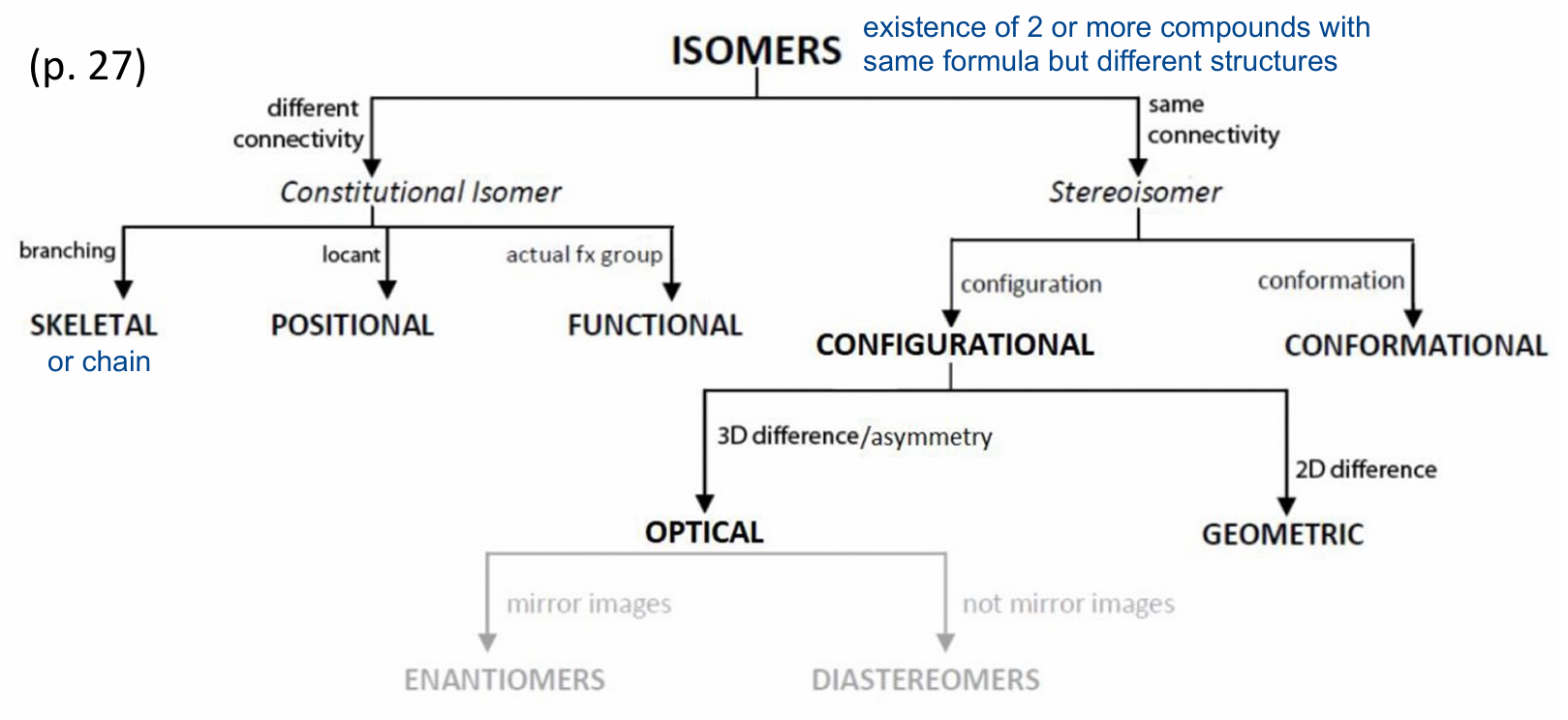
Different types of isomers [Diagram]
c. Chain isomers / Skeletal isomers
[CONSTITUTIONAL ISOMERS]
Type of constitutional isomer that usually occurs in alkanes due to branching
a. Positional isomers
b. Functional isomers
c. Chain isomers / Skeletal isomers
d. Optical isomers
a. alkanes (CnH2n+2)
[CONSTITUTIONAL ISOMERS: Chain Isomers]
Chain isomers / Skeletal isomers are usually seen in
a. alkanes
b. alkene
c. alkyne
d. Branching
[CONSTITUTIONAL ISOMERS: Chain Isomers]
The cause of chain isomerism in alkanes
a. Different functional groups
b. Different locant positions
c. Different spatial orientation
d. Branching
c. n-butane or normal butane
[CONSTITUTIONAL ISOMERS: Chain Isomers]
The IUPAC name of CH₃CH₂CH₂CH₃, a chain isomer of C₄H₁₀
a. Isobutane
b. 2-methylpropane
c. n-butane
d. Neopentane
d. 2-methylpropane or isobutane
[CONSTITUTIONAL ISOMERS: Chain Isomers]
The IUPAC name of the branched chain isomer of C₄H₁₀ with a methyl group on carbon 2
a. n-butane
b. Neopentane
c. n-propane
d. 2-methylpropane
c. C₄H₁₀
[CONSTITUTIONAL ISOMERS: Chain Isomers]
The molecular formula shared by both n-butane and isobutane, demonstrating chain isomerism
a. C₃H₈
b. C₅H₁₂
c. C₄H₁₀
d. C₄H₈
c. Positional isomers
[CONSTITUTIONAL ISOMERS]
Type of constitutional isomer that differs in the location of a substituent or multiple bond
a. Chain isomers
b. Functional isomers
c. Positional isomers
d. Optical isomers
b. alkene (CnH2n)
[CONSTITUTIONAL ISOMERS: Position Isomers]
Positional Isomers are usually seen in ______
a. alkanes
b. alkene
c. alkyne
b. 1-butene
[CONSTITUTIONAL ISOMERS: Position Isomers]
The IUPAC name of CH₃CH₂CH=CH₂, a positional isomer of C₄H₈
a. 2-butene
b. 1-butene
c. 1-butyne
d. 2-butyne
d. 2-butene
[CONSTITUTIONAL ISOMERS: Position Isomers]
The IUPAC name of CH₃CH=CHCH₃, a positional isomer of C₄H₈
a. 1-butene
b. 2-butyne
c. 1-butyne
d. 2-butene
c. C₄H₈
[CONSTITUTIONAL ISOMERS: Position Isomers]
The molecular formula shared by both 1-butene and 2-butene, demonstrating positional isomerism
a. C₄H₁₀
b. C₃H₆
c. C₄H₈
d. C₅H₁₀
b. Alkyl halide (R-X)
[CONSTITUTIONAL ISOMERS: Position Isomers]
The general classification of C₃H₇Br used as an example of positional isomerism
a. Alcohol (R-OH)
b. Alkyl halide (R-X)
c. Aldehyde (R-CHO)
d. Carboxylic acid (R-COOH)
d. 1-bromopropane
[CONSTITUTIONAL ISOMERS: Position Isomers]
The IUPAC name of CH₃CH₂CH₂Br, a positional isomer of C₃H₇Br
a. 2-bromopropane
b. 1-bromobutane
c. 2-bromobutane
d. 1-bromopropane
c. 2-bromopropane
[CONSTITUTIONAL ISOMERS: Position Isomers]
The IUPAC name of CH₃CHBrCH₃, a positional isomer of C₃H₇Br
a. 1-bromopropane
b. 2-bromobutane
c. 2-bromopropane
d. 1-bromobutane
d. C₃H₇Br
[CONSTITUTIONAL ISOMERS: Position Isomers]
The molecular formula shared by both 1-bromopropane and 2-bromopropane, demonstrating positional isomerism
a. C₄H₉Br
b. C₂H₅Br
c. C₃H₅Br
d. C₃H₇Br
d. Different location of substituent or multiple bond
[CONSTITUTIONAL ISOMERS: Position Isomers]
The structural basis that distinguishes positional isomers from each other
a. Different molecular formula
b. Different functional groups
c. Different degree of branching
d. Different location of substituent or multiple bond
d. C₆H₆Cl₂ (disubstituted benzenes)
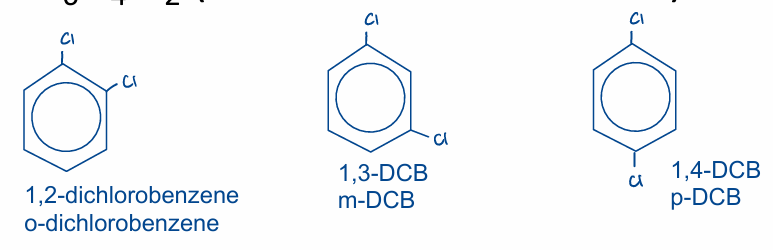
[CONSTITUTIONAL ISOMERS: Position Isomers]
The molecular formula of disubstituted benzenes used as an example of positional isomers
a. C₆H₅Cl
b. C₆H₄Cl₂
c. C₆H₃Cl₃
d. C₆H₆Cl₂
d. o-
[CONSTITUTIONAL ISOMERS: Position Isomers]
The common prefix notation for 1,2-dichlorobenzene
a. m-
b. p-
c. n-
d. o-
c. m-
[CONSTITUTIONAL ISOMERS: Position Isomers]
The common prefix notation for 1,3-dichlorobenzene
a. o-
b. p-
c. m-
d. n-
d. p-
[CONSTITUTIONAL ISOMERS: Position Isomers]
The common prefix notation for 1,4-dichlorobenzene
a. m-
b. o-
c. n-
d. p-
1. m-DCB
p-DCB
3. o-DCB
[CONSTITUTIONAL ISOMERS: Position Isomers]
The abbreviations of the following:
1. 1,3-dichlorobenzene
2. 1,4-dichlorobenzene
3. 1,2-dichlorobenzene
d. Functional isomers
[CONSTITUTIONAL ISOMERS]
Type of constitutional isomer that differs in the functional group present
a. Chain isomers
b. Positional isomers
c. Conformational isomers
d. Functional isomers
c. C₂H₆O
[CONSTITUTIONAL ISOMERS: Functional]
The molecular formula shared by ethanol and dimethyl ether, demonstrating functional isomerism
a. C₃H₈O
b. C₂H₄O
c. C₂H₆O
d. C₂H₅O
c. Alcohols and ethers
[CONSTITUTIONAL ISOMERS: Functional]
The functional groups that are functional isomers of each other under the molecular formula C₂H₆O
a. Aldehydes and ketones
b. Carboxylic acids and esters
c. Alcohols and ethers
d. Alcohols and aldehydes
d. C₃H₆O
[CONSTITUTIONAL ISOMERS: Functional]
The molecular formula shared by propanal and propanone, demonstrating functional isomerism
a. C₃H₆O₂
b. C₂H₄O
c. C₄H₈O
d. C₃H₆O
c. Aldehydes and ketones
[CONSTITUTIONAL ISOMERS: Functional]
The functional groups that are functional isomers of each other under the molecular formula C₃H₆O
a. Alcohols and ethers
b. Carboxylic acids and esters
c. Aldehydes and ketones
d. Alcohols and ketones
b. Acetone
[CONSTITUTIONAL ISOMERS: Functional]
The common name of propanone (CH₃COCH₃)
a. Propanal
b. Acetone
c. Acetic acid
d. Acetaldehyde
d. C₃H₆O₂
[CONSTITUTIONAL ISOMERS: Functional]
The molecular formula shared by propanoic acid and methyl acetate, demonstrating functional isomerism
a. C₃H₆O
b. C₂H₄O₂
c. C₄H₈O₂
d. C₃H₆O₂
c. Carboxylic acids and esters
[CONSTITUTIONAL ISOMERS: Functional]
The functional groups that are functional isomers of each other under the molecular formula C₃H₆O₂
a. Aldehydes and ketones
b. Alcohols and ethers
c. Carboxylic acids and esters
d. Alcohols and carboxylic acids
a. dimethyl ether
“OH and ethers are functional isomers of each other”
[CONSTITUTIONAL ISOMERS: Functional]
Functional isomer of ethanol
a. dimethyl ether
b. propanone or acetone
c. methylethanoate aka methyl acetate
b. propanone or acetone
“aldehyde and ketone are functional isomers of each other”
[CONSTITUTIONAL ISOMERS: Functional]
Functional isomer of propanal
a. dimethyl ether
b. propanone or acetone
c. methylethanoate aka methyl acetate
c. methylethanoate aka methyl acetate
“carboxylic acids and esters are functional isomers of each other”
[CONSTITUTIONAL ISOMERS: Functional]
Functional isomer of propanoic acid
a. dimethyl ether
b. propanone or acetone
c. methylethanoate aka methyl acetate
c. Geometric isomers
[STEREOISOMERS]
Type of stereoisomer that occurs in double bonds or cyclic compounds
a. Optical isomers
b. Conformational isomers
c. Geometric isomers
d. Chain isomers
c. Geometric isomers
[STEREOISOMERS]
Type of stereoisomer that occurs in Cis/Trans
a. Optical isomers
b. Conformational isomers
c. Geometric isomers
d. Chain isomers
d. Cis/Trans notation
[STEREOISOMERS: Geometric]
The notation system used for equally disubstituted alkenes in geometric isomerism
a. R/S notation
b. D/L notation
c. α/β notation
d. Cis/Trans notation
c. Cis
[STEREOISOMERS: Geometric]
The geometric isomer where substituents are on the same side of the double bond
a. Trans
b. Anti
c. Cis
d. Syn
d. Trans
[STEREOISOMERS: Geometric]
The geometric isomer where substituents are on opposite sides of the double bond
a. Cis
b. Syn
c. Anti
d. Trans
d. Cis isomer
[STEREOISOMERS: Geometric]
The geometric isomer that is less stable due to steric hindrance
a. Trans isomer
b. Anti isomer
c. Syn isomer
d. Cis isomer
d. Trans isomer
[STEREOISOMERS: Geometric]
The more stable geometric isomer between cis and trans
a. Cis isomer
b. Syn isomer
c. Anti isomer
d. Trans isomer
d. Cis isomer
cis (asymetrical) >trans (symmetrical)
[STEREOISOMERS: Geometric]
The more polar geometric isomer between cis and trans
a. Anti isomer
b. Trans isomer
c. Syn isomer
d. Cis isomer
c. Cis is asymmetrical
[STEREOISOMERS: Geometric]
The reason cis isomer is more polar than trans isomer
a. Cis is symmetrical
b. Trans has more branching
c. Cis is asymmetrical
d. Trans has steric hindrance
d. Trans isomer
[STEREOISOMERS: Geometric]
The geometric isomer with higher melting point
a. Cis isomer
b. Syn isomer
c. Anti isomer
d. Trans isomer
c. Cis isomer
more polar= more energy requires to break them apar
[STEREOISOMERS: Geometric]
The geometric isomer with higher boiling point
a. Trans isomer
b. Anti isomer
c. Cis isomer
d. Syn isomer

[STEREOISOMERS: Geometric]
Label cis/ trans

c. Geometric isomers
[STEREOISOMERS]
Type of stereoisomer that occurs in E/Z isomers
a. Optical isomers
b. Conformational isomers
c. Geometric isomers
d. Chain isomers
d. E/Z notation
[STEREOISOMERS: Geometric]
The notation system used for tri- or tetrasubstituted alkenes in geometric isomerism
a. Cis/Trans notation
b. R/S notation
c. D/L notation
d. E/Z notation
c. Tri/tetrasubstituted alkenes
[STEREOISOMERS: Geometric]
The type of substituted alkenes where E/Z notation is applied
a. Monosubstituted alkenes
b. Equally disubstituted alkenes
c. Tri/tetrasubstituted alkenes
d. Unsubstituted alkenes
Entgegen
[STEREOISOMERS: Geometric]
The German word from which "E" in E/Z notation is derived, meaning opposite
Zusammen
[STEREOISOMERS: Geometric]
The German word from which "Z" in E/Z notation is derived, meaning together
d. Opposite
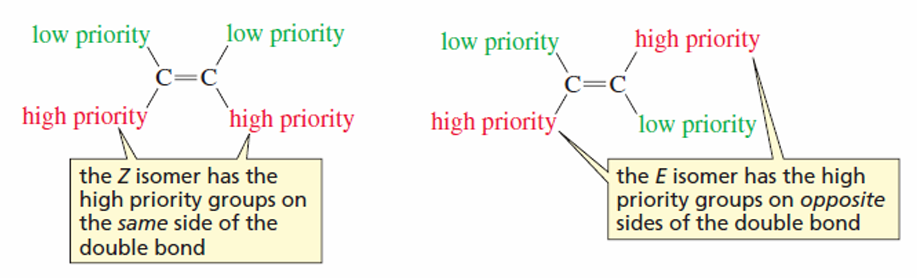
[STEREOISOMERS: Geometric]
The English meaning of "Entgegen" used in E/Z isomer notation
a. Together
b. Similar
c. Adjacent
d. Opposite
b. Together
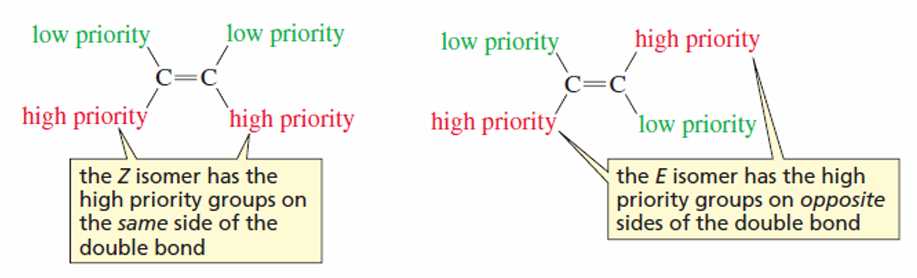
[STEREOISOMERS: Geometric]
The English meaning of "Zusammen" used in E/Z isomer notation
a. Opposite
b. Together
c. Adjacent
d. Similar
c. Atomic mas
divide first into two sides
heavier substituent gets higher priority
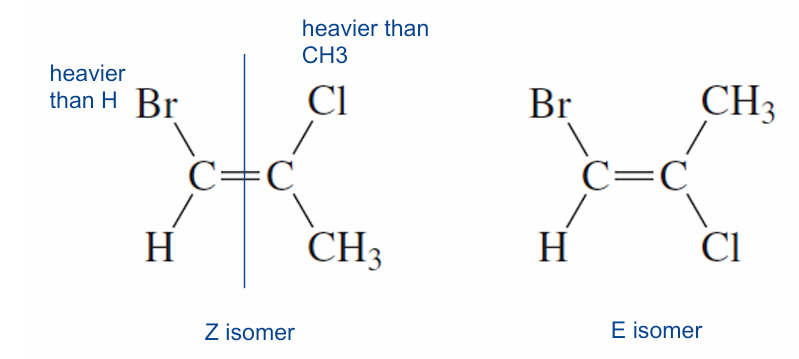
[STEREOISOMERS: Geometric]
The basis for assigning priority in E/Z notation system
a. Alphabetical order of substituents
b. Number of hydrogen atoms attached
c. Atomic mass
d. Length of carbon chain
b. Cahn-Ingold-Prelog sequence
[STEREOISOMERS: Geometric]
The sequence rule used for prioritizing substituents in E/Z isomer designation
a. Markovnikov sequence
b. Cahn-Ingold-Prelog sequence
c. Aufbau sequence
d. Zaitsev sequence
c. Higher atomic number
[STEREOISOMERS: Geometric]
The basis for assigning higher priority in the Cahn-Ingold-Prelog sequence
a. Higher electronegativity
b. Higher metallic reactivity
c. Higher atomic number
d. Higher molecular weight
c. Br > Cl > S > P

[STEREOISOMERS: Geometric]
The correct order of priority from highest to lowest among Br, Cl, S, and P
a. Cl > Br > P > S
b. S > P > Cl > Br
c. Br > Cl > S > P
d. P > S > Br > Cl
c. ¹H, because it has lower atomic mass
[STEREOISOMERS: Geometric]
In CIP priority ranking, which has lower priority between ²H and ¹H
a. ²H and ¹H have equal priority
b. ²H, because it has fewer neutrons
c. ¹H, because it has lower atomic mass
d. ²H, because it has higher atomic number
c. Draw an imaginary line between the vinylic carbons
1) Draw an imaginary line between the vinylic (C=C) carbons
2) Assign the higher CIP priority per vinylic carbon
3) Assign the letter based on the higher priorities:
Z = same side
E = opposite site
[STEREOISOMERS: Geometric]
The first step in determining E/Z designation of an alkene
a. Assign R/S configuration
b. Identify the molecular formula
c. Draw an imaginary line between the vinylic carbons
d. Count the number of substituents
b. Assign the higher CIP priority per vinylic carbon
1) Draw an imaginary line between the vinylic (C=C) carbons
2) Assign the higher CIP priority per vinylic carbon
3) Assign the letter based on the higher priorities:
Z = same side
E = opposite site
[STEREOISOMERS: Geometric]
The second step in determining E/Z designation of an alkene
a. Draw an imaginary line between vinylic carbons
b. Assign the higher CIP priority per vinylic carbon
c. Assign the letter based on higher priorities
d. Count the number of carbon substituents
d. Assign the letter based on the higher priorities
1) Draw an imaginary line between the vinylic (C=C) carbons
2) Assign the higher CIP priority per vinylic carbon
3) Assign the letter based on the higher priorities:
Z = same side
E = opposite site
[STEREOISOMERS: Geometric]
The third step in determining E/Z designation based on higher priorities where Z equals same side
a. Assign molecular formula
b. Count substituents on each carbon
c. Draw the imaginary line between carbons
d. Assign the letter based on the higher priorities
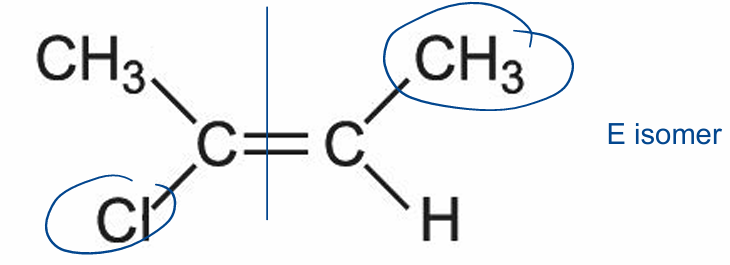
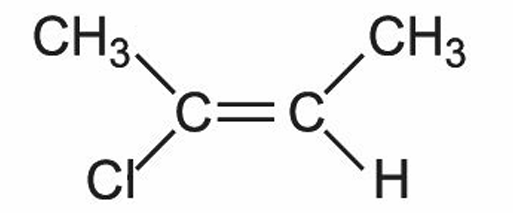
[STEREOISOMERS: Geometric]
E or Z isomer?
c. Conformational isomers
[STEREOISOMERS]
Type of stereoisomer that arises from different ways atoms flex and bend
a. Geometric isomers
b. Optical isomers
c. Conformational isomers
d. Positional isomers
c. Conformational isomers
[STEREOISOMERS]
Are stereoisomers of the same compound with temporary spatial differences = no descriptors needed
a. Geometric isomers
b. Optical isomers
c. Conformational isomers
d. Positional isomers
d. Rotation along a single bond
Rotation along a single bond: aliphatic or acyclic compounds
Ring flipping: cyclic compounds
[STEREOISOMERS: Conformational]
The first cause of conformational isomerism in aliphatic or acyclic compounds
a. Ring flipping
b. Double bond rotation
c. Branching
d. Rotation along a single bond
c. Ring flipping
Rotation along a single bond: aliphatic or acyclic compounds
Ring flipping: cyclic compounds
[STEREOISOMERS: Conformational]
The cause of conformational isomerism in cyclic compounds
a. Rotation along a single bond
b. Branching
c. Ring flipping
d. Double bond restriction
d. Ethane
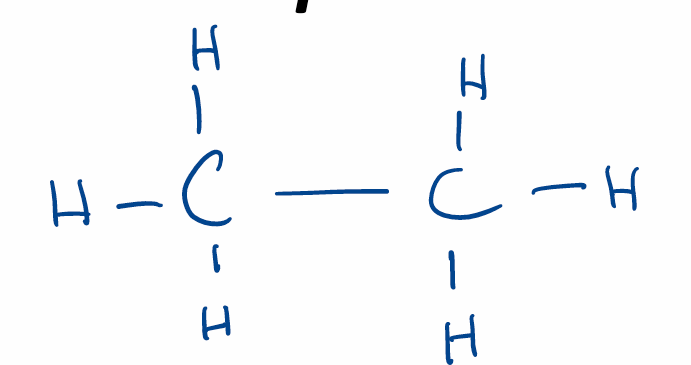
[STEREOISOMERS: Conformational]
The classic aliphatic compound used as an example for conformational isomerism
a. Methane
b. Propane
c. Butane
d. Ethane
d. 3
a. Saw Horse Formula
b. Perspective Formula
c. Newman Projection Formula
[STEREOISOMERS: Conformational]
The total number of graphical representations used for conformational isomers of aliphatic compounds
a. 4
b. 2
c. 5
d. 3
c. Perspective formula
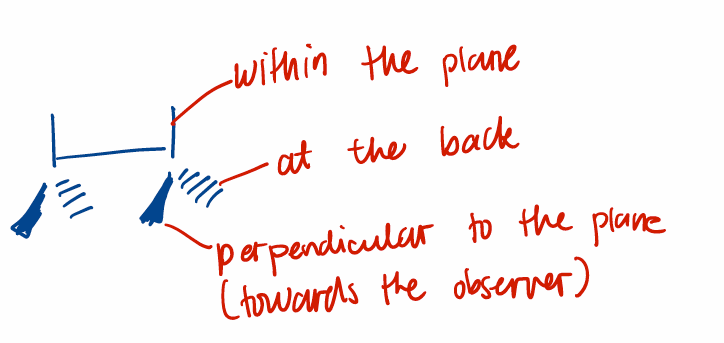
[STEREOISOMERS: Conformational]
The graphical representation of conformational isomers also known as the dash and wedge formula
a. Sawhorse formula
b. Newman projection formula
c. Perspective formula
d. Fischer projection formula
d. Newman projection formula
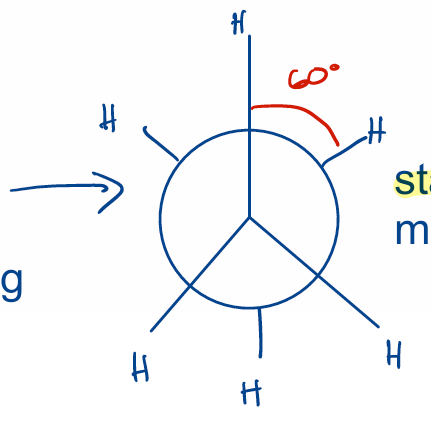
[STEREOISOMERS: Conformational]
The graphical representation that uses a front and back carbon view to show dihedral angles in conformational isomers
a. Sawhorse formula
b. Perspective formula
c. Fischer projection
d. Newman projection formula
d. Sawhorse formula
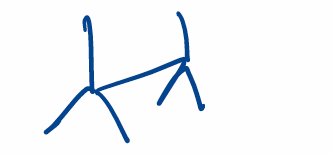
[STEREOISOMERS: Conformational]
The graphical representation of conformational isomers that resembles a sawhorse structure
a. Newman projection formula
b. Fischer projection
c. Perspective formula
d. Sawhorse formula
d. Eclipsed position
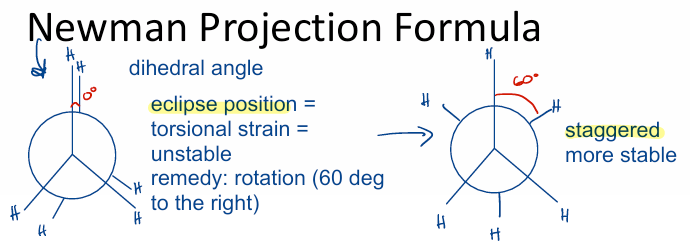
[STEREOISOMERS: Conformational]
The conformational position where atoms are directly aligned, creating torsional strain
a. Staggered position
b. Anti position
c. Gauche position
d. Eclipsed position
c. Rotation of 60 degrees to the right
[STEREOISOMERS: Conformational]
The remedy to convert an eclipsed conformation to a staggered conformation
a. Ring flipping
b. Rotation of 90 degrees to the right
c. Rotation of 60 degrees to the right
d. Rotation of 180 degrees to the right
d. Staggered position
[STEREOISOMERS: Conformational]
The more stable conformational position of ethane
a. Eclipsed position
b. Gauche position
c. Anti position
d. Staggered position
d. Dihedral angle
[STEREOISOMERS: Conformational]
The angle used to describe the spatial relationship between substituents in Newman projection
a. Bond angle
b. Torsional angle
c. Valence angle
d. Dihedral angle
b. Newman projection formula
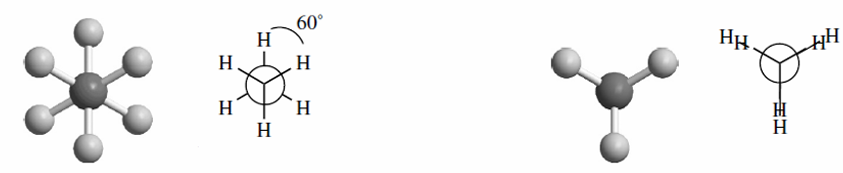
[STEREOISOMERS: Conformational]
Conformations around rotating bonds (rotamers) are represented using:
a. Sawhorse formula
b. Newman projection formula
c. Perspective formula
d. Fischer projection formula
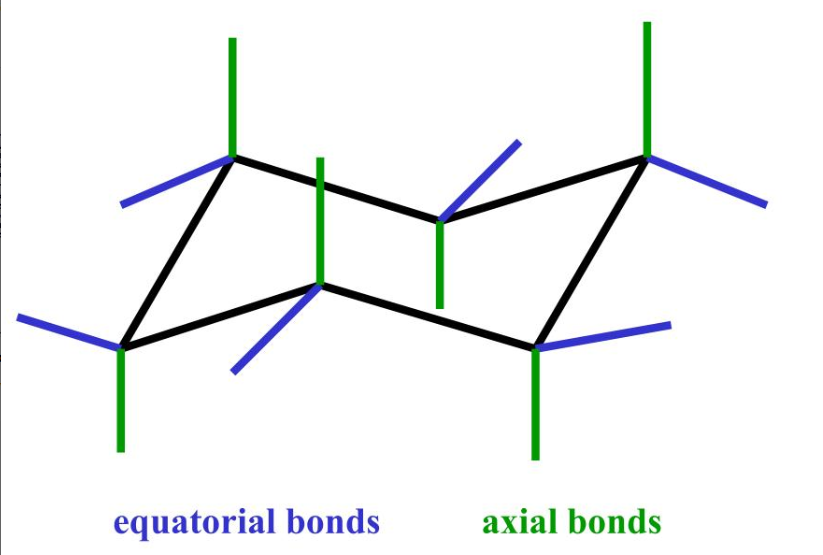
[STEREOISOMERS: Conformational]
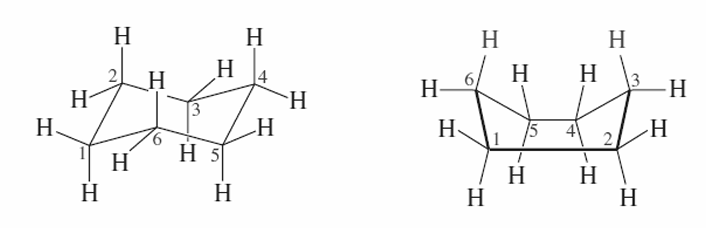
Label the type of bonds seen in chair isomer of cyclohexane
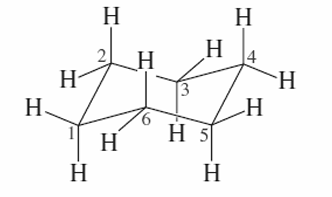
Chair isomer= less steric = more stable
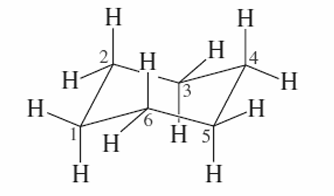
[STEREOISOMERS: Conformational]
More stable form of cyclohexane? chair or boat isomer
stability: anticonformer >gauche >e2 >e1
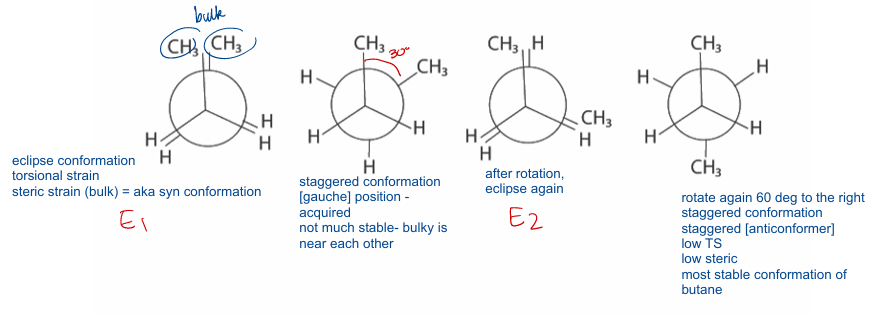
[STEREOISOMERS: Conformational]
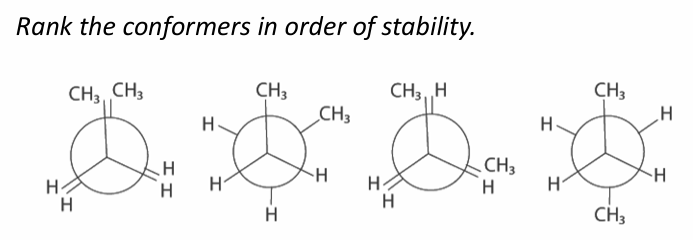
d. CH₃CH₂CH₂CH₃
[STEREOISOMERS: Conformational]
The molecular formula of butane used as an example in Newman Projection conformational analysis
a. CH₃CH₂CH₃
b. CH₃CH₂CH₂CH₂CH₃
c. CH₃CH₂OH
d. CH₃CH₂CH₂CH₃
d. Torsional strain
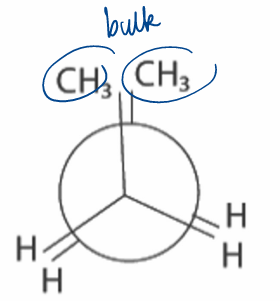
[STEREOISOMERS: Conformational]
The type of strain present in the eclipsed conformation of butane due to alignment of bonds
a. Ring strain
b. Angle strain
c. Steric strain
d. Torsional strain
d. Steric strain
[STEREOISOMERS: Conformational]
The type of strain present in the eclipsed conformation of butane due to bulky groups
a. Torsional strain
b. Angle strain
c. Ring strain
d. Steric strain
c. Syn conformation
[STEREOISOMERS: Conformational]
The alternative name for the eclipsed conformation of butane
a. Anti conformation
b. Gauche conformation
c. Syn conformation
d. Staggered conformation
d. Gauche conformer
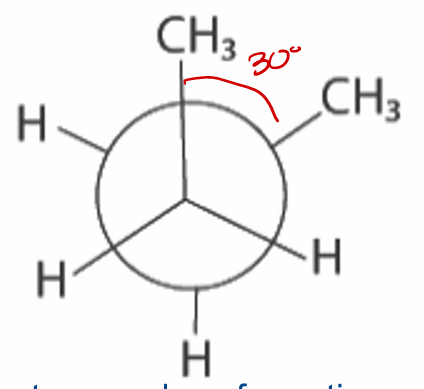
[STEREOISOMERS: Conformational]
The staggered conformation of butane where bulky groups are near each other, making it not the most stable
a. Anti conformer
b. Syn conformer
c. Eclipsed conformer
d. Gauche conformer
c. Bulky groups are near each other (30 deg away)
[STEREOISOMERS: Conformational]
The reason the gauche conformer of butane is not the most stable staggered conformation
a. It has high torsional strain
b. It has ring strain
c. Bulky groups are near each other
d. It has angle strain
d. Anti conformer
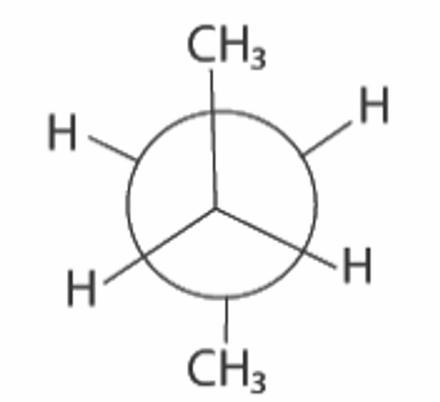
[STEREOISOMERS: Conformational]
The staggered conformation of butane with low torsional strain and low steric strain
a. Gauche conformer
b. Syn conformer
c. Eclipsed conformer
d. Anti conformer
d. Anti conformer
[STEREOISOMERS: Conformational]
The most stable conformation of butane
a. Gauche conformer
b. Eclipsed conformer
c. Syn conformer
d. Anti conformer
a. Anti > Gauche > Eclipsed
[STEREOISOMERS: Conformational]
The correct ranking of butane conformers from most stable to least stable
a. Anti > Gauche > Eclipsed
b. Gauche > Anti > Eclipsed
c. Eclipsed > Gauche > Anti
d. Anti > Eclipsed > Gauche
d. 60 degrees
[STEREOISOMERS: Conformational]
The degree of rotation needed to convert a gauche conformer to an eclipsed conformation in butane
a. 109.5 degrees
b. 180 degrees
c. 120degrees
d. 60 degrees
c. Optical isomers
[STEREOISOMERS: Configurational]
Type of configurational isomer that has at least one chiral center with 4 different substituents on carbon
a. Geometric isomers
b. Conformational isomers
c. Optical isomers
d. Chain isomers