Lecture 5 - Electrochemical gradients and equilibrium potentials
 Call Kai
 Learn
 Practice Test
 Spaced Repetition
 Match
 Flashcards
 Knowt Play
1/6

There's no tags or description
Looks like no tags are added yet.
7 Terms
When do ions move across cell membrane and how?
in resting state, ions are moved across the cell membrane through leak ion channels
2K for 3 Na
ions move across cell membrane of excitable cells
difference in voltage in and out of cell is result of different concentration of ions and is referred to as resting membrane potential of cell
What do you think MOSTLY DETERMINES the set membrane potential of a resting excitable cell?
the leak of potassium ions across the cell membrane
at rest, membrane of excitable cells = mostly permeable to potassium ions
leak channels are most abundant and open
What is the resting membrane potential?
it is the difference in ion concentration across the cell membrane of an excitable cell at rest
What is the electrochemical gradient?
a combination of both chemical and electrical forces act upon ions across a cell membrane
What is equilibrium potential?
the membrane potential when the electrical gradient exactly balances chemical gradient and there is NO NET movement of that ion
all ions move to attempt to reach equilibrium potential
How do you calculate equilibrium potential for an ion?
use NERNST equation
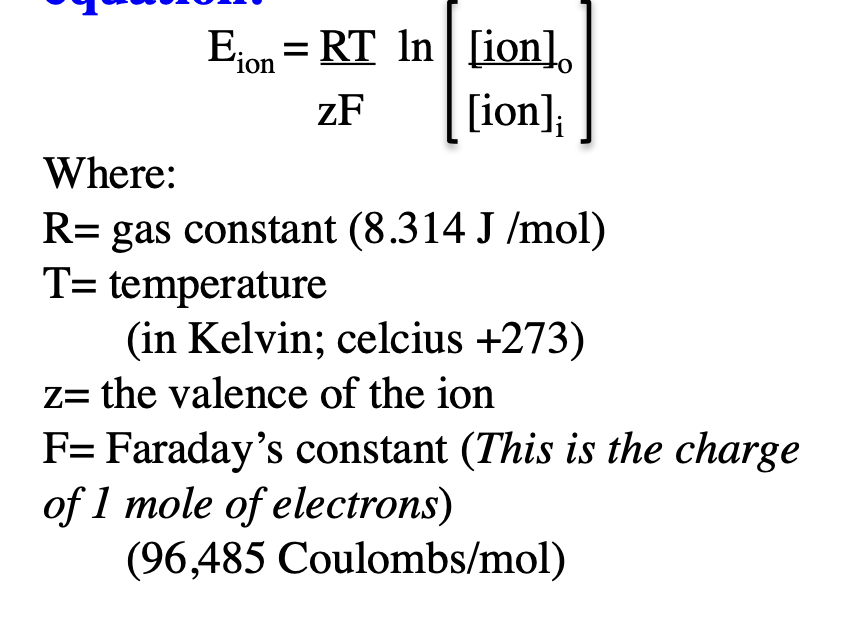
What is the simplified NERNST equation?
to convert natural logarithm (ln) to base 10 log —→ multiply by 2.3
