LIFESP 2-5 years
 Call Kai
 Learn
 Practice Test
 Spaced Repetition
 Match
 Flashcards
 Knowt Play
1/33

There's no tags or description
Looks like no tags are added yet.
34 Terms
physical growth changes
rate of growth slows down
average increase in height: 5cm/year
average increase in weight: 2.3kg/year
minimal differences in gender
Bone growth
bones ossify rapidly - bone replaces cartilage
Epiphyseal cartilage (growth plate) continues to grow at the epiphyseal surface, so the bone will increase in length.
Brain development
brain is 75% of adult weight by age 3, 90% by age 6
mid brain almost fully developed at birth
cerebral cortex complete at age 4
myelination continues. myelination of cerebellum enables child to execute increasingly complex movement patterns
Fundamental movement phase stability
Postural control, dynamic, static, axial:
Single foot balance
walking on low beam
axial movements
Fundamental movement phase locomotion
walking
running
jumping
hopping
Fundamental movement phase manipulation
Throwing
catching
kicking
striking
Fundamental movement phase progression and transition
Initial, elementary, mature.
constrained by cephalocaudal and proximodistal principles
Fundamental phase: initial stage
first purposeful attempt at the task
usually crude and uncoordinated
movement grossly exaggerated or inhibited
2-3 year olds usually at this stage
Fundamental phase: elemntary stage
3-5 y/o
gaining greater control over movements
still somewhat awkward
Fundamental phase: Mature stage
Integration of all the component parts of movement pattern into a well-coordinated, mechanically correct, and efficient act
Most have potential to reach mature stage by 7y/o
often age 6-7y/o
Not all reach this stage: can lead to frustration and possible failure
Fundamental phase developlment considerations
Movement skills take a long time to master
240-600 minutes (4-10 hrs) of instruction to perform correctly
Teachers teach for awareness/participation, not mastery
FMS stability key milestones
Static balance: maintaining equilibrium wide while CoG remains stationary
balance on 1 foot for 3-5 sec: 3-5 yrs
3 point inverted position (downward dog with leg up): 4-6 yrs
Dynamic balance: maintaing equilibrium while CoG shifts
walk along 2.5cm wide straight line: 2-4 yrs
walk along a 2.5cm wide circular line 3-5 yrs
Stands on low balance beam: 2-3yrs
Walk on 10cm wide beam - short distance : 2-4 yrs
Walk on 10cm wide beam alternating feet: 3-5 yrs
Axial movements
Static postures involving bending, twisting, stretching
Develop in early infancy, progressively refined and incorporated into other activities at 2months -6yrs old.
FMS Locomotion key milestones WALKING
Forwards, backwards, sideways, upstairs with help, by end of age 2.
Walk upstairs and downstairs alone, follow step: 20-25 months old
FMS Locomotion key milestones RUNNING
First proper: 2-3 years
Efficient and refined: 4-5yrs
FMS Locomotion key milestones JUMPING
Jump off floor with both feet: 24-28 months
Jump for distance 1 m: 4-5 yrs
Jump for height 30cm: 4-5 yrs
FMS Locomotion key milestones HOPPING
Hop 3x with preferred foot: 2-3yrs
Hop skillfully, mature pattern: 5-6yrs
FMS Locomotion key milestones GALLOPING
Inital: 3-5yrs
Mature: 5-6yrs
FMS Locomotion key milestones SKIPPING
One-footed: 3-4yrs
Mature: 5-7yrs
Hopping inital stage
Begin with balancing on one leg
Non supporting leg flexed 90 degrees or less
Non-supporting thigh parallel to grounf
Body upright
Arms flexed at elbows and held slightly to side
little height
balance lost easily
limited to 1/2 hops

Hopping elementary stage
Non-supporting leg flexed
Non-supporting thigh at 45 degrees
Slight fwd lean, trunk flexed
Force absorbed by flexing at hip
non-supporting thigh flex and extend at hip to produce force
arms move up/down vigorously
Balance poorly controlled
limited no. of hops

Hopping mature stage
Non supporting leg at 90 degrees of less
non-supporting thigh lifts as supporting foot thrusts
greater body lean
rhythmical action of non-supporting leg
arms move in rhythmical lifting
arms not needed for balance but used to generate force

Manipulation: gross>fine
Follows gesells principles:
Catching
throwing
handwriting/colouring
play
ADLs: dressing, feeding
Catching: elementary stage
Trap ball against body, scooping of larger ball
Palms of hands face each other
awkward adjustment of body
arms and trunk begin to move in relation to ball flight path
head remains upright (awkward positioning)

Catching: initial stage
turns head away
no ball tracking
no arm hand adjustment (palms face up)
no finger ‘give’
movements out of sync with ball
little trunk involvement
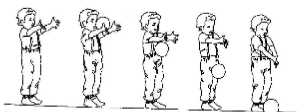
Catching: mature stage
arms extend to meet ball with hands
arms and body ‘give’
ball caught in hands
palms adjust to ball in flight and ize
feet, trunk, arms, and fingers adjust to flight of ball and ball size
Full proficient when catching ball away from body
2 handed catching —> then 1 handed
Fine motor skills
Coordinated use of eyes, hands, and mouth
Requires attention to task
Manipulation: skiilful and refined use of the hands
Play and opportunity to use hands are important
Fine motor skills: handedness
3-4y/o: definite hand preference (75% R)
6 years: establised preference 90% R
Increased capacity of one side of the brain to carry out skilled motor action - dominant cerebral hemisphere
Fine motor skills: handwriting
Palmar supinate: 1-1.5yrs
Digital pronate: 2-3yrs
Static tripod: 3.5-4yrs
Dynamic tripod: 4.5-6yrs

Handwriting considerations: Neurodevelopmental and musculoskeletal
anatomical
ROM
strength (grip strength, UL strength for stability)
Muscle tone (joint stability, writing speed and endurance)
Posture: Upright, knees & ankles 90degrees
Hand preference and integration
prehension
Handwriting considerations: Cognitive
attention and motivation
visual perception
auditory perception
language, memory, and learning
Task organisation
Handwriting considerations: sensory-perceptual
visual acuity
visual motor integration
hearing
tactile processing
kinaesthesia
Fine motor skills: ADLs
13 months: drink from cup
15 months: use a spoon
3 yrs: put on shoes
4yrs: button clothes, lace shoes, pull on clothes
Motor behaviour and play stage 1-5 yrs
Mobility and postural control
somatosensory play (large motor, fine motor, music)