TMJ Dysfunction
 Call Kai
 Learn
 Practice Test
 Spaced Repetition
 Match
 Flashcards
 Knowt Play
1/66

There's no tags or description
Looks like no tags are added yet.
67 Terms
what is the general demographic of people who experience TMD (temporomandibular dysfunction)?
most commonly occurs in individuals between 20-40 years of age, also 4x more common in women (manifests as orofacial pain)
what is orofacial pain?
pain in the face and jaw/mouth region
what are some contributing factors to TMD?
macro and microtrauma (bruxism, mouth breathing, nail biting), degeneration, cervical spine, hypermobility, psychosocial factors (stress, anxiety, anger, depression)
what part of the TMJ joint compartment is responsible for rotation?
The inferior compartment of the TMJ joint.
what part of the TMJ joint compartment is responsible for translation?
The superior compartment of the TMJ joint.
what is the normal ROM for opening the mouth?
40-50 mm
what is the normal ROM for laterally deviating the jaw?
10-12 mm
what are the common conditions of the TMJ?
articular disorders, masticatory muscle disorders, arthritides, headache and other craniofacial conditions
what are some conditions that fall under the arthralgia and arthritis group?
OA, RA, psoriatic arthritis, capsulitis, synovitis (acute flair up)
what are the characteristics of arthralgia and arthritis?
periarticular pain without referral elsewhere, tender lateral pole and posterior pole, crepitus is possible, positive TMJ loading (retrusive overpressure, contralateral pain with force biting), mandibular mobility is usually hypomobile, deflection possible
what kind of deflection typically occurs with degeneration leading to hypomobility?
usually to the ipsilateral side
what are the main disc related pathologies?
disc derangement with reduction, disc derangement without reduction
how might a patient present with DDwR?
see deviation with opening, there is an opening click and a closing click (reciprocal), ROM tends to be grossly WNL, there may be a hx of hypermobility, and see a typical S curve (often have a myalgic component as well)
describe the pattern of motion of the TMJ with DDwR
the disc is first displaced anteriorly creating a click during mouth opening, a reciprocal click during mouth closing as the condyle glides posteriorly due to malalignment of the disc

describe how a pt with DDwoR might present
see a deflected mandible with opening to ispilateral side, no clicking but may have possible crepitus, there is a hypomobile stage with less than 40 mm opening, decreased laterotrusion, may have had a hx of clicking
why is there such a significant loss of motion with DDwoR?
the disc stays anterior to the condyle through the whole motion of opening, which prevents the condyle from translating forward as is needed during normal opening of the jaw
what can DDwoR lead to?
long term degeneration and eventually to early onset arthritis
describe the characteristics of impaired motor control/mvmt coordination of the TMJ?
may present as hypermobility or subluxation, loud clunking or popping, “feels out of place”, may see excessive motion of the lateral pole that is palpable. unilateral deviation of the CL side, and often see opening greater than 55 mm
what is impaired motor control of the TMJ related to?
disc displacement, congenital laxity, anatomical variance, trauma, habit/conditioning
what conditions might cause joint hypomobility?
DDwoR, arthropathies, muscle contracture, capsular length (causing ipsilateral deflection and deviation restriction)
what are the common masticatory muscle disorders?
myofascial pain disorder and trismus the most common
myositis
myospasms
dystonia
guarding due to pain/recent oral procedure
oropharyngeal surgery/neoplasm
what is trismus?
condition characterized by restricted mouth opening due to involuntary muscle contraction, often caused by trauma, surgery, or inflammation.
how might myofascial disorders present in a patient?
see trigger points in the massater, temporalis, medial pterygoid, positive ipsilateral forced biting test, deviations in mandibular movements, mild limitation of joint mobility, NO CLICKING or crepitus
how might myofascial pain disorder of the masseter and temporalis present?
reproduction of pain with palpation, weak/painful biting, limited opening (less than 40 mm) with end range pain, resisted protrusion not painful
how might myofascial pain disorder of the pterygoids present?
lateral face pain, weak/pain with resisted protrusion, not painful at end range opening (might also see strange pain referral- like behind eyes, might feel like congestion in nose and ears)
what percentage of patients with myofascial pain disorder experience referred pain?
about 60%
what are the associated symptoms of conditions of TMD?
cervical or postural referral
headaches
ear symptoms (tinnitus, earache, ear fullness, vertigo, dizziness)
swallowing/speech difficulties
psychological affect
trigeminal neuralgia
atypical odontalgia
post-herpetic neuralgia
what is atypical odontalgia?
phantom tooth pain
what is post-herpetic neuralgia?
pain condition that occurs following shingles, caused by damage to the nerves from the varicella-zoster virus, leading to persistent pain in the affected area.
what are important history questions to ask for TMD?
pain or stiffness in the face, jaw, temple, front of the ear, or ear in the past month?
if yes, aggravated by chewing, talking, singing, yawning, kissing, moving the jaw?
have you ever had the jaw catch or lock so that it would not open?
ever had clicking, popping, or other sounds in the joint?
headaches?
other orofacial conditions, surgeries, RoS for neuro, suspected autoimmune?
what is an appopriate outcome measure of TMD?
jaw functional limitation scale (20 items but is also a version with 8), assessed mastication, mobility, verbal and emotional communication
should a psychological screen be performed?
yes! need to listen for reports of overload, malaise, anxiety, sleep disturbance, changes in eating patterns, weight changes, fatigue, and other signs of depression
what questions are part of the two question screening for depression?
Over the past two weeks, how often have you felt down, depressed, or hopeless?
Over the past two weeks, how often have you felt little interest or pleasure in doing things?
is scales from 0 being not at all, 1 being several days, 2 being more than half the days, and 3 being nearly every day
what other tools can be used to assess the pt’s psychological status?
patient health questionnaire for depression and anxiety
graded chronic pain scale
OSPRO-YF (yellow flags)
what percentage of pts with TMD have forward head posture?
85%, make sure you assess posture then!
what aspect of forward head posture put increased pressure on the TMJ?
tight suboccipitals rotate the cranium posteriorly, mandibular mechanics are affected, lengthened masseter and temporalis
what observations of the face should be made?
looks at fascial symmetry and vertical dimension- corner eye to corner mouth, corner mouth to center chin, alignment of center points, clenching teeth, and mouth breathing
what is the difference between overbite and overjet?
Overbite refers to the vertical overlap of the upper front teeth over the lower front teeth, while overjet measures the horizontal distance between the upper and lower incisors.
what aspects need to be assessed during palpation?
joint sounds (using palpation and auscultation)
what might clicking or popping of the joint indicate?
ant displace disc, condyle hitting the eminence. hypermobility, muscle incoordination
what might crepitus and crackling indicate?
arthritis
which muscles should be palpated during the examination?
masseter, temporalis, lateral and medial pterygoids, trapezius, SCM, suboccipitals, hyoids
how many knuckles of opening is considered functional opening?
3 knuckles/fingers
describe the TMJ rhythm
early phase is 30-50% rotation, late phase is 50-65% translation
what is the difference between deviations (like the C and S curve) vs deflections?
Deviations are lateral movements of the mandible during opening that end up neutral alignment, with C and S curves representing different patterns; deflections refer to a persistent movement away from the midline, typically indicating an underlying issue.
what does assymetry of lateral excursion indicated?
internal derangement
what are the normal end feels of the TMJ?
closing should feel hard, opening should feel springy
what can you do to assess joint mobility?
can perform distraction, compression, anterior and posterior glides, should compare side to side
what does the forced biting provocation test tell us?
helps to assess between muscle/tendon irritation and joint irritation
what does it mean if you do the cotton roll bite test and have ipsilateral pain? (on side of where cotton ball is)
likely muscle/tendon irritation
what does it mean if you do the cotton roll bite test and have pain on the contralateral side?
indicates possible joint irritation or dysfunction.
what should be assessed during the systems review?
cervical disorders
dental/oral conditions
polyarthritis (RA, JRA, lupus)
neoplasm
MI
cranial nerve screen (recall that V, VII, III, and IX are all involved in the face/tongue for sensation and motor)
which treatments have been shown to be the most efficacious for TMD?
therapeutic exercise and manual therapy
what kinds of IMPORTANT patient education should be given for TMD patients?
educate on proper positioning of jaw/tongue (tongue position on roof of mouth with teeth 2-3 mm apart, lips together, breathe through nose with diaphragmatic breathing), eat softer foods, take smaller bites. Avoid uncontrolled yawning, gum chewing, nail biting, resting chin in hands, stomach sleeping. get adequate sleep (7/8 hours), improve upper quarter posture, night splint possible or bite guard for nighttime grinding
what exercises should be done for upper quarter posture?
activate/strengthen: DNF, cervical extensors, scapular retractors
lengthen/flexibility: suboccipitals, scalenes, SCM, pectorals
what should treatment look like for joint inflammation?
joint protection (parafunctions, chewing and ROM)
ice
ionto/phonophoresis
what should treatment look like for joint mobility?
joint mobilizations, PROM/AROM with caution
what should treatment look like for disc or articular dysfunction?
address impairments of joint pain and reduced ROM
conservative therapy will not alter disc displacement of degeneration significantly
DDwoR: educate pt about remodeling phase, noise, and motion should normalize over time
what should treatment look like for masticatory muscle dysfunction?
modalities, manual therapy, and stretching for muscle pain and guarding
stabilization exercises and proprioception for muscular imbalance/motor control
describe the technique for STM of the masseter, pterygoids, and temporalis
use gloves, intraoral, 5-30 seconds at a time. make sure to communicate with patient and expect some soreness (should be less than 7/10), may experience rebound headache
what kinds of joint mobilizations can be used at the TMJ?
distraction, anterior glide, lateral glides (grades and volume determined by SINS)
what are the rocabado 6×6 exercises?
nasal breathing (tongue to roof of mouth, 6 breaths)
controlled TMJ rotation on opening (opening with tongue on hard palate, this limited protrusion)
mandibular rhythmic stabilization
upper cervical distraction- OA nodding
axial extension of the cervical spine (chin tuck)
shoulder girdle retraction (w/ thor extension)
describe how controlled opening should look like
tongue on roof of the mouth, palpate the TMJ, then slowly open and close the mouth as far as possible with tongue staying on roof, palpate bilaterally to synchronize movement
what consists of mandibular rhythmic stabilization?
perform isos on mandible, all direction, force of one finger, hold 6-10 seconds, progress to short hold times

what stretch is demonstrated in the image?
masseter stretch
what is a good technique for improving TMJ proprioception?
the TMJ proprioception exercises with a rubber tube/heavy theratube/surgical tubing
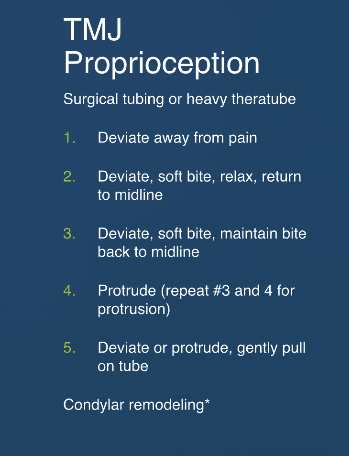
the TMJ proprioception exercise works based on condylar remodeling, which is what?
idea that you can normalize forces between the disc and musculature, co-contraction enhances stabilization, contralateral deviation will gap and glide the condyle anterior on the eminence while the disc remains positioned correctly- biting in this position creates a con-contraction of the musc acting on the disc and facilitates stabilization