independent assortment of genes
 Call Kai
 Learn
 Practice Test
 Spaced Repetition
 Match
 Flashcards
 Knowt Play
1/6

There's no tags or description
Looks like no tags are added yet.
7 Terms
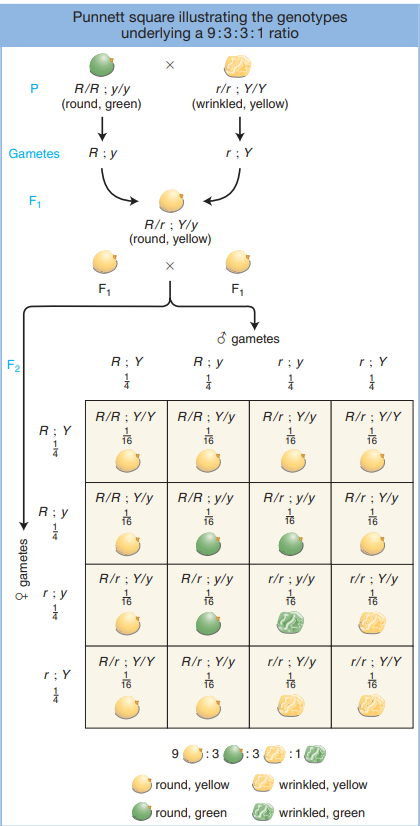
what is the phenotype for a selfed dihybrid cross
the F2 generation would have four different types in the following proportions of
9:3:3:1

why are the phenotypes of dihybrid crosses like that
the 9:3:3:1 phenotypic ratio of dihybrid crosses is the result of two 3:1 ratios that occur on with each trait combined.
when does mendel’s law of independence apply
this law applies to genes on different chromosomes. genes on the same chromosome generally do not assort independently because they are held together by the chromosome itself
how can you arrive at the 9:3:3:1 ratio from the gamete frequency
from the f1 dihybrid we can predict that ¼ of gametes will have R;Y , ¼ R;y , ¼ r;Y , ¼ r;y.
Assembling these gametes into a punnett square, you make 16 individuals. The F2 gen carries a variety of genotypes, but there are only four phenotypes, and their proportions are in the 9:3:3:1 ratio.
what are two ways you can work with genetics
predicting the unknown genotypes of parents by using phenotypes ratios of progeny
predicting progeny phenotype ratios from parents of known genotype
what does the product rule state
that the probability of independent events occurring together is the product of their individual probabilities
what does the sum rule state
that the probability of either one or the other of two mutually exclusive (cannot happen at the same time) events occurring is the sum of their individual probabilities