Lecture 13. Genetics in Bloodbanking
 Call Kai
 Learn
Learn Practice Test
 Spaced Repetition
 Match
Match Flashcards
 Knowt Play
1/39

There's no tags or description
Looks like no tags are added yet.
Name | Mastery | Learn | Test | Matching | Spaced | Call with Kai | Chat |
|---|
No analytics yet
Send a link to your students to track their progress
40 Terms
What are blood group systems?
Groups of antigens on the RBC membrane that share related serologic properties and genetic patterns of inheritance
DNA is contained in
Chromosomes
Genetic material is replicated either by _____ or _____
Mitosis/Meiosis
Phenotype
Physical expression of traits (what is observed)
Genotype
Actual genetic makeup (not directly observed)
A person with the phenotype A could have the genotype:
A/A or A/O
Allele
Variant form of a gene at a specific location of a chromosome
A Punnett square predicts:
The probability of an offspring’s genotype
Each person inherits one allele from:
Each parent
Antithetical Antigens
Opposite versions of a blood group antigen
Kpa and Kpb antigens are examples of:
Antithetical antigens
ABO do NOT have antithetical antigens (involves codominance, not simple opposite pairs)
True
K and k,
Kpa and Kpb
Jsa and Jsb
These pairs belong to the:
Kell Blood Group System
C and c,
E and e
These pairs belong to the:
Rh Blood Group System
Fya and Fyb belong to the:
Duffy Blood Group System
Jka and Jkb belong to the:
Kidd Blood Group System
M and N,
S and s
These belong to the:
MNS Blood Group System
Lua and Lub belong to the:
Lutheran Blood Group system
Recessive gene
Is expressed only when inherited by both parents
Codominant gene
Equal expression of two different alleles
Blood group antigens are
Codominant
Dominant gene
Gene that is expressed over another gene
Genes that do not express a detectable product are considered
Amorphic (O gene)
Mendelian principles apply to:
Blood group antigen inheritance
Independent segregation
Each parent passes one gene to the offspring
Independent assortment
Blood group antigens on different chromosomes are inherited separately, creating genetic variation
Linkage
When two genes close together on a chromosome are inherited together
Crossing over happens when:
Two genes on the same chromosome exchange segments
Homozygous occurs when:
A person inherits two identical alleles
MM (M+ N-) is an example of
Homozygous alleles
Heterozygous allele
A person inherits two different alleles
MN (M+ N+) is an example of:
Heterozygous alleles
When it comes to a dosage of antigens, people who have homozygous alleles:
Have a “double dose” of an antigen because they inherited two identical alleles
When it comes to a dosage of antigens, people who have heterozygous alleles:
Have a “single dose” of an antigen because they inherited two different alleles

Cell #1 likely contains
Homozygous c alleles

Cell #2 likely has”
Heterozygous C and c alleles
Phenotype calculation is used to:
Determine the likelihood of finding RBC units with specific antigen characteristics
The Phenotype calculation is particularly useful in:
Identifying antigen-negative blood for patients with alloantibodies
Hardy-Weinberg formula
An equation used to determine gene frequencies that contribute to a trait in a population
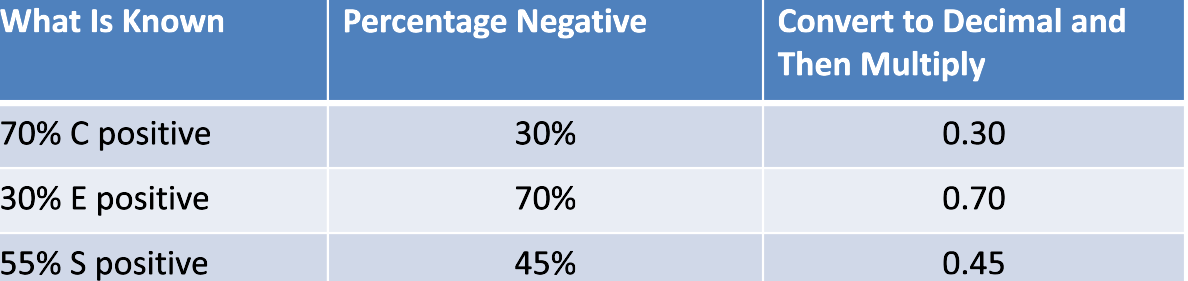
A patient with multiple antibodies (anti-C, anti-E, anti-S) needs blood, when all three positive results are multiplied, it comes out to 10%. What does this mean for finding someone who would be compatible for the patient?
Only 10% of the population will be negative for all three antigens; about 1 in 10 units will be compatible