GEOSCI 100 FINAL
 Call Kai
 Learn
 Practice Test
 Spaced Repetition
 Match
 Flashcards
 Knowt Play
1/81

There's no tags or description
Looks like no tags are added yet.
82 Terms
Why does oceanic crust sit at lower elevations than continental crust?
Oceanic crust is denser and continental crust is thicker.
What is magnetic reversal?
a change in magnetic field direction
What are seafloor magnetic anomalies?
stripes with different magnetic direction in the oceanic crust
What is the magnetic timescale?
the pattern of magnetic stripes that have known ages
The plate tectonic model says that ___ move around on top of a ___ and interact mainly ___.
rigid plates, weak asthenosphere, along their edges
Mid-ocean ridges are..
offset by transform faults, pushing plates apart
The convergence of ocean crust with continental crust usually produces…
a subduction zone, a continental volcanic arc (like the Andes)

This is a map of Atlantic seafloor age. Match each letter with the feature it labels.
A: mid-ocean ridge
B: oldest oceanic crust
C: continental crust
D: transform fault
Put the phases of the earthquake cycle into the correct order.
1.Stress builds up and rocks bend
2.Fault slips and earthquake is produced
3.Stress decreases
4.Repeat steps
The largest earthquakes occur at which type of plate boundary?
subduction (convergent) boundary
Which of the following are hazards associated with earthquakes?
quicksand, building damage, tsunami, landslide
S waves are…
unable to move through liquids, slower than P waves
What is a body wave?
waves that pass through Earth’s interior
What is a seismograph?
instrument for measuring ground motion due to seismic waves
What is a shadow zone?
area on Earth’s surface that receives no body waves from certain earthquake locations
What is a surface wave?
waves that travel at the ground-air interface
Seismic ray paths ___ as they move through the Earth because they ___ at the boundaries between layers.
bend, refract
What does NOT meet the definition of a mineral?
glass
Some minerals are valuable to people because…
they have useful physical properties, they are rare
Rank the atomic bonds from weakest to strongest.
1.Intermolecular Forces (IMF)
2.Metallic
3.Ionic
4.Covalent
Of the >5000 recognized minerals, most rocks are built from about 10 common rock-forming minerals.
10
Which element is more abundant in Earth's crust than in Earth's mantle and core?
Na (sodium)
Which of the three major types of rocks is good at recording Earth's chemical evolution?
igneous
We describe and classify rocks based on what two features?
textures, mineralogy
A sedimentary rock can become an igneous rock through the rock cycle.
true
Rapid cooling of magma usually produces an igneous rock that is ___, whereas slow cooling of magma usually produces an igneous rock that is ___.
fine-grained, coarse-grained
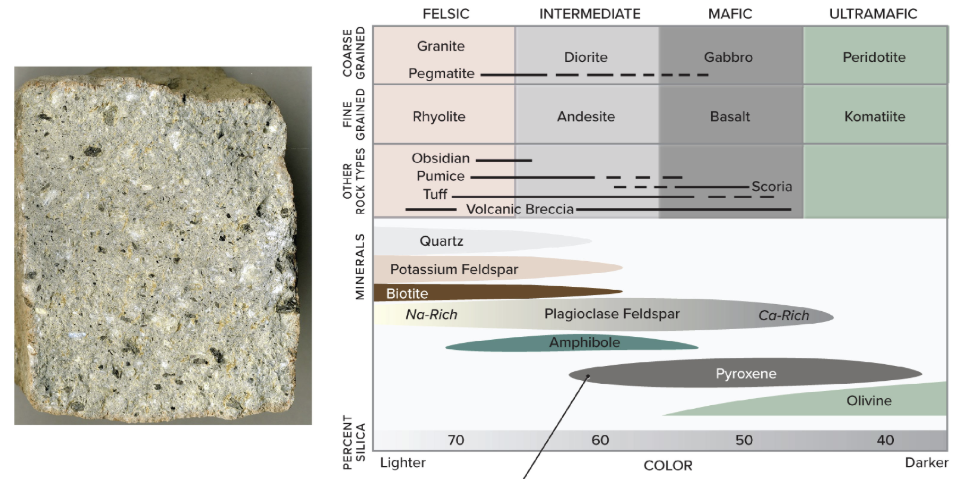
You find the igneous rock on the left. The black crystals are amphibole. The white crystals are plagioclase feldspar. What is the best name for this rock on the chart to the right?
Andesite
Which of the following is an EXTRUSIVE form of igneous rock?
bomb
Magmas move upward toward Earth's surface because...
they are less dense than surrounding rocks
___ drives volcanic eruptions..
expanding gas
Which combination of magma characteristics is most likely to produce a highly explosive eruption?
felsic composition and lots of gas
Match the magma composition with a type of volcano it will form. (note that no answers are repeated)
Andesite - composite volcano
Basalt - shield volcano
Dacite - dome
Rhyolite - caldera
Frost wedging and thermal expansion are types of ___ that ___ break down rocks.
physical weathering, mechanically
Which type of chemical sedimentary rock can be formed from the shells of organisms? (select all that apply)
carbonates, siliceous rocks
Please match the sedimentary rock on the left with the correct category on the right.
Conglomerate - clastic
Iron Formation - chemical
Siliceous - chemical
Carbonate - chemical
Evaporite - chemical
Shale - clastic
Sedimentary rocks are good at recording sequences of geologic events and environmental changes over time because they are deposited ___ and ___.
horizontally, oldest at the bottom to youngest on top

Select the depositional environment where well sorted sediments are commonly deposited. Select all that apply.
dune field, lake
As depositional environments move over time, the sediments deposited in environments that were once next to each other are ___.
stacked on top of each other
Metamorphism changes the ___ and the ___ of a rock.
mineralogy, texture
A metamorphic rock has a fabric when you can observe....
repeated planar or linear patterns

Which of the metamorphic rocks pictured does NOT have a fabric?
C
Match the description on the left with the correct type of metamorphism on the right. Answers may be repeated.
occurs near a plate boundary - regional metamorphism
involves changes in pressure - regional metamorphism
produces metamorphic rocks with no fabric - contact metamorphism
occurs near a batholith - contact metamorphism
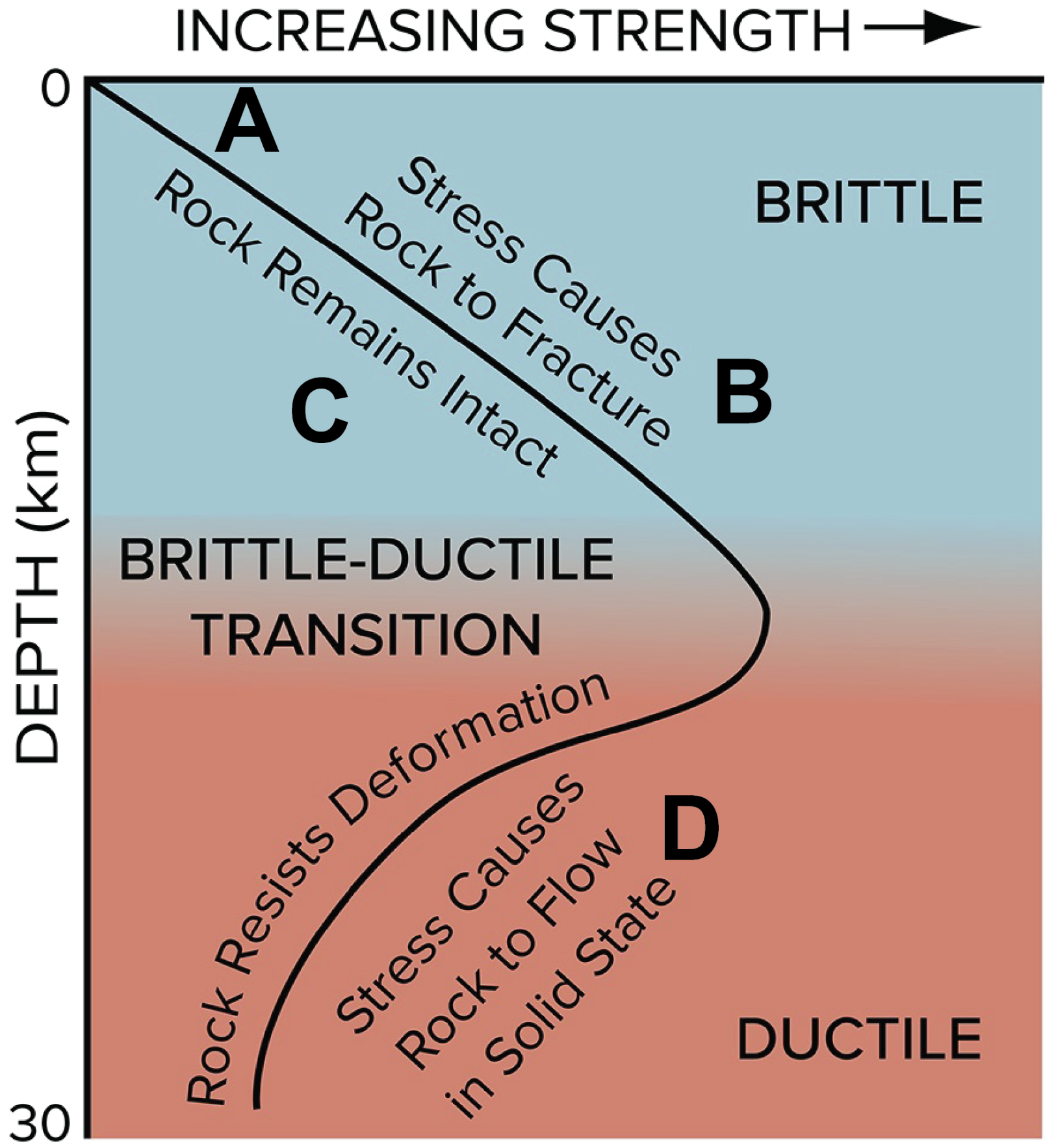
Each letter represents a rock with a different depth and strength. Match the letter with how the rock will deform at each location. (Pay attention to whether the letter is above or below the failure line.)
A - Rock fails, joints formation
B - Rock fails, faults form
C - Rock remains undeformed
D - Rock fails, folds form

This is a satellite image of Earth's surface. A fault is traced out with the white dashed line. What type of fault is it? (Pay attention to the river and alluvial fan)
left-lateral strike-slip
The most tightly curved part of a fold at its crest is called the ___ and the straight sides of a fold are called the ___
hinge, limbs
Match the relative dating principle to its description on the right.
Original horizontality - Most sediments are deposited in horizontal layers
Superposition - Younger rocks are deposited on top of older rocks
Crosscutting relations - Younger rocks or features can crosscut older rocks or features

Six geologic events have affected this area. They are listed below. What is the last geologic event to have occurred in this area?
E - normal fault
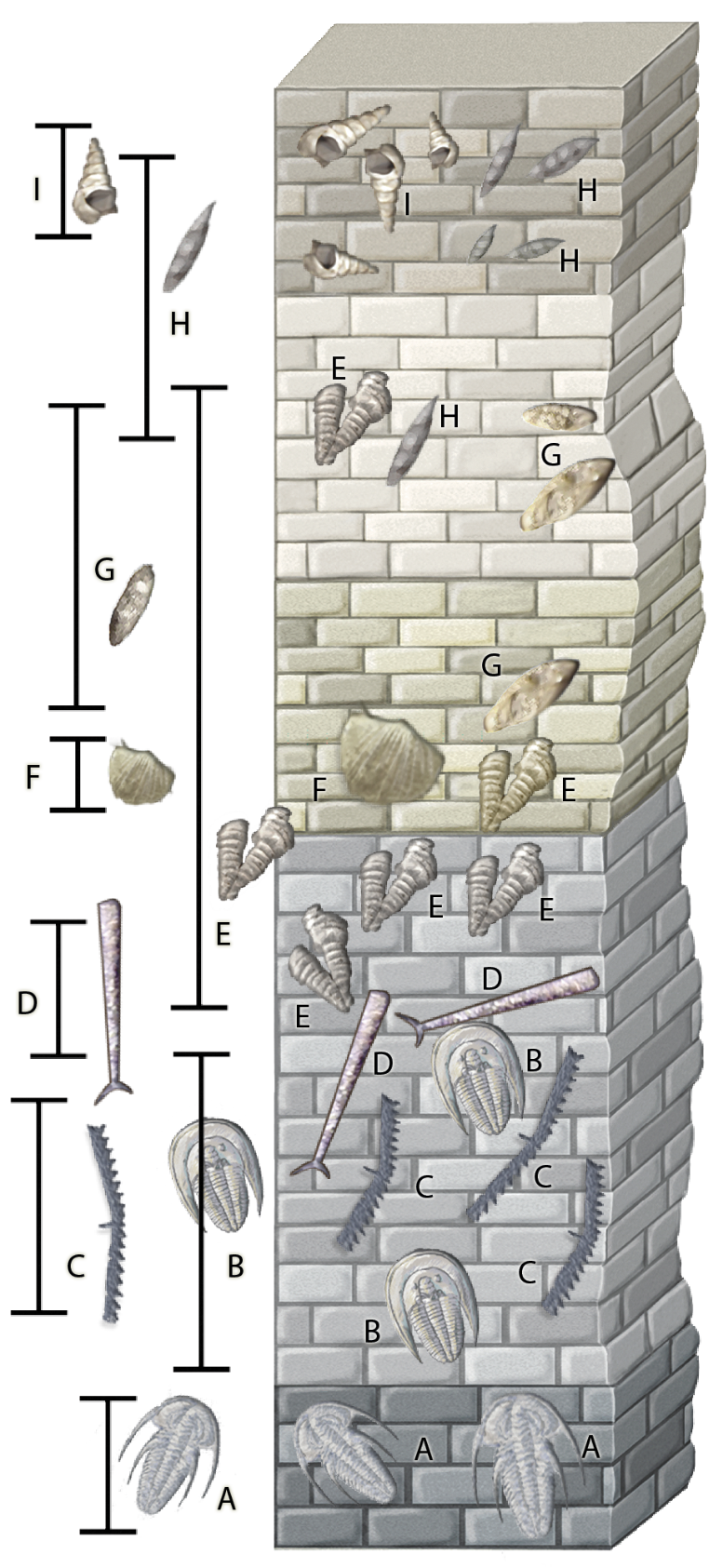
Which fossil combination in this sequence of sedimentary rocks covers the shortest period of time (and thus provides the most exact age)?
E, G, and H
The major subdivisions of the geologic timescale are based on the appearance or disappearance of ____.
organisms (fossils)
Which property of a radioactive isotope allows us to measure time? What is the "clock"?
constant half-life
In order to date a geologic event, we can measure the ___ in a ____.
parent/daughter isotope ratio, rock or mineral
Uniformitarianism is the idea that catastrophic processes formed Earth long ago.
false
The currently accepted age for the formation of the Earth is ___. This was discovered in the ___ .
4.5 billion years, 1950s
Evidence for the earliest forms of life are preserved in rocks as…
stromatolites, microfossils, and biomarkers
Earth's atmosphere experienced___ in oxygen concentration because of ___.
two increases, changes in living organisms
The energy that powers Earth's surface processes comes mostly from....
the sun
___is local temperature, pressure, and precipitation conditions, whereas ___ is longer-term, bigger-scale patterns of temperature, pressure, and precipitation conditions.
weather, climate
How are heat and water transported and distributed around Earth's surface?
by wind and ocean currents
The Thermohaline Conveyor is an ocean current that...
moves water and nutrients between the deep and shallow oceans
Seasonal variations in temperature and precipitation result from ___ , which are caused by ___
variations in solar energy, the tilt of the Earth’s rotation axis
Deserts form where there is ___ air. Deserts can expand in a process called___ , especially where there is ___.
dry, cool, descending air, desertification, soil loss

Which picture below shows wind-blown sand, and WHY?
A, because grains are well sorted and well rounded
Only ___ -sized particles can be suspended by wind and travel in the upper atmosphere. When deposited in the oceans they can provide ___ to marine organisms.
dust, essential nutrients
Two fundamental characteristics of glaciers are that they ___ and that they___ .
move, carry rocks and sediment
Glaciers can lose snow and ice by...
calving, wind, sublimation, melting
Match the features on the left with the type of glacier on the right.
hold most of the fresh water on Earth - continental ice sheet
flow through channels - valley glacier
can depress Earth's crust - continental ice sheet
spread out at a mountain front - piedmont glacier
carve mountains into sharp ridges and horns - valley glacier
leave behind drumlins - continental ice sheet
Glaciers can move by…
sliding on a film of water, plastic flow
Which features do you expect to see during glacial periods versus during interglacial periods?
large piles of glacial debris - interglacial
high sea levels - interglacial
abundant valley glaciers - glacial
very large ice caps - glacial
Evidence for recent glaciation includes ___ and ____. Evidence of glaciation billions of years ago includes ___.
U shaped valleys, cave formation growth, glacial conglomerates
___is the main natural control on when the Earth experiences glacial versus interglacial conditions. This is because it changes the length of summer and the amount of glacial___
Earth’s tilt, melting
Wave motions are greatest at depth in the ocean and smallest near the surface of the ocean.
false
Which of the following correctly describe waves? (select all that apply)
they can bend near shore, they can cause shoreline erosion, they form due to wind
One of the most damaging and deadly aspect of a hurricane is...
storm surge flooding
Tides are mainly the result of the gravitational pull of ___ on the Earth. Alignment of the ___ causes Spring tides.
the Moon, Sun and Moon
Falling sea level will do what to shorelines and beaches? Select all that apply.
increase erosion on continents, move their position farther out toward the ocean
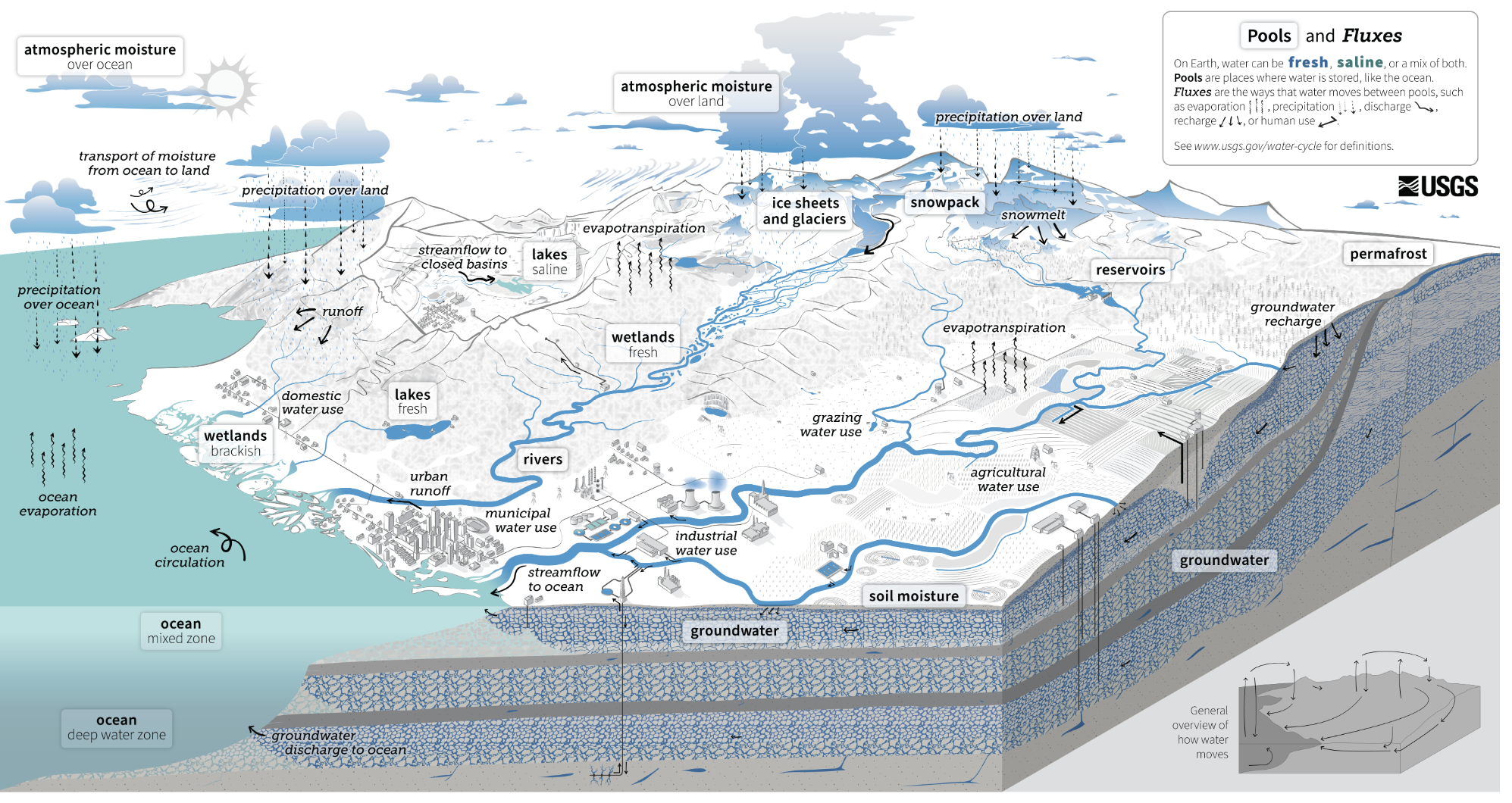
This diagram illustrates the ___ in which water moves between environments at or close to Earth's surface. For instance, it shows how dams hold water from ___ in reservoirs.
hydrologic cycle, rivers
Match the terms on the left with the correct definitions on the right.
drainage basin - region drained by a stream
headwaters - area where water initially collects to form a stream
discharge - amount of water flowing in a stream
tributary - a smaller stream that joins up with a larger stream
Which of the following usually increase downstream? Select all that apply.
stream channel size, water velocity, discharge
A stream terrace is an abandoned stream floodplain above the present-day stream level.
true
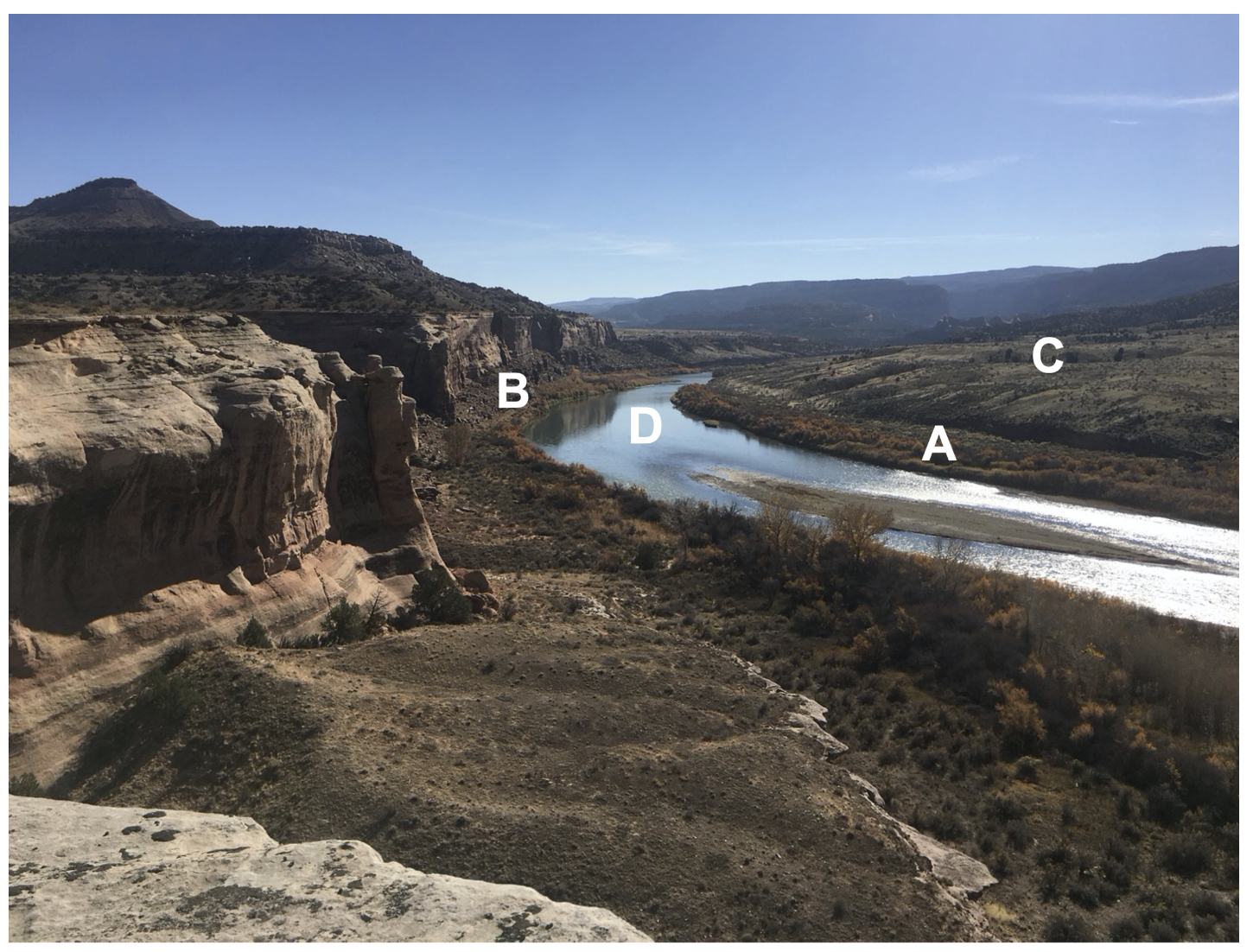
Match the letter with the river feature.
D - stream channel
C - stream terrace
B - cut bank (sediment eroded)
A - point bar (sediment deposited)
What is the probability that a flood with a 100-year recurrence interval (sometimes just called "a 100-year flood") will occur in any given year?
1%
When a stream reaches its ___, it can no longer erode and instead it ___.
base level, deposits sediment