History Year 3 Quizes
 Call Kai
 Learn
Learn Practice Test
 Spaced Repetition
 Match
Match Flashcards
 Knowt Play
1/28

There's no tags or description
Looks like no tags are added yet.
Name | Mastery | Learn | Test | Matching | Spaced | Call with Kai | Chat |
|---|
No analytics yet
Send a link to your students to track their progress
29 Terms
In "Osteopathic Research: The needed paradigm shift," I.M. Korr states that conventional clinical research protocols for the assessment of efficacy of most chemical and physical therapeutic agents are ill-suited for the assessment of osteopathic medical care.
a. True
b. False
Answer: A True
Why?
Korr argued that standardized clinical research methods used for pharmaceuticals are ill-suited for osteopathy because OMT is individualized and cannot be standardized like a drug treatment.

match structures according to Charlotte Weaver's cranial paradigm.
a. Arterial influence relation to superior passage of ICA's
b. Venous influence ophthalmic & cerebral veins
c. Similarly derived as the vertebral laminae
d. Pituitary glandular influence
G. Foramen Lacerum
F. Cavernous Sinus
H. Parietal Bones
E. Sella Turcica
Answer:
G. Foramen Lacerum → Arterial influence
F. Cavernous Sinus → Venous influence
H. Parietal Bones → Derived from vertebral laminae
E. Sella Turcica → Pituitary influence
Who wrote the seminal work "De Motu Animalium" that became the basis for muscle and joint-based biomechanics?
a. Borelli
b. Kepler
c. Steiner
d. Galen
e. Harvey
Answer: A Borelli
Why?
Giovanni Borelli 1608-1679 wrote "De Motu Animalium", which applied mechanical principles to muscle and joint biomechanics.

What was the focus of J.S. Denslow's 1941 Neurophysiology research?
a. Skin color changes to study vasomotor disruption
b. EMG to measure abnormal reflex contractions
c. Skin temperature changes in lesioned dermatomes
d. ESR to map lesion effects on sudomotor activity
e. All of the above
Answer: B Using EMG to measure abnormal reflex contractions in lesioned spinal segments
Why?
Denslow's research used electromyography EMG to study neuromuscular dysfunction associated with osteopathic lesions.
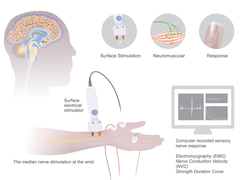
According to Stecco's fascial vocabulary, each functional segment has a center of perception situated in the joint connected to voluntary muscles. The center of perception is the sum of afferents from articular components, united by fascia. The cerebral cortex interprets these signals according to relative direction.
a. True
b. False
Answer: A True
Why?
The Center of Perception is where joint proprioceptors, fascia, and muscular afferents integrate sensory input, which the brain interprets as movement direction.
Please match structure to associated "cranial vertebra" model structure.
a. First Cranial Vertebra
b. Third Cranial Vertebra
c. Intervertebral Disc
d. Second Cranial Vertebra
G. Dorsum Sellae
E. Occipital Bone
H. Sphenobasilar Synchondrosis
F. Sphenoid Bone
Answer:
G Dorsum Sellae → First Cranial Vertebra
E Occipital Bone → Third Cranial Vertebra
H Sphenobasilar Synchondrosis → Intervertebral Disc
F Sphenoid Bone → Second Cranial Vertebra
Who Debuted a Physical Spinal Model at the 1919 AOA Convention
a. J S Denslow
b. Louisa Burns
c. Harrison Fryette
d. H V Halladay
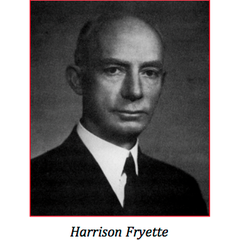
Answer: C Harrison Fryette
Why?
Fryette developed principles of spinal mechanics, and in 1919, he presented a physical spinal model at the AOA convention to demonstrate these principles.
Charlotte Weaver's 3 Vulnerable Cranial Areas
a. OA ligaments
b. Vomer
c. Foramen Lacerum
d. Cavernous Sinus
e. Sella Turcica
f. Ala of the Sphenoid
Answer: B, C, and E
B Vomer
C Foramen Lacerum
E Sella Turcica
Does Weaver's Cranial Concept Use Flexion and Extension for Motion
a. True
b. False
Answer: B False
Why?
Unlike Sutherland's cranial model, Weaver described cranial motion differently, not using the terms flexion and extension.
Who Encouraged Weaver to Research Cranial Circulation
a. A T Still
b. Harold Magoun
c. John Martin Littlejohn
d. William Garner Sutherland
Answer: C John Martin Littlejohn
Why?
Littlejohn emphasized circulatory influences in osteopathy and encouraged Weaver's cranial research on circulation and dura mater function.

Key Findings of Louisa Burns' 1907 Research
a. A very important, if not only pathway of viscero-sensory impulses enters the SC through its posterior
b. There was a considerable difference in reaction time to the experimental stimulus across individuals
c. Somato-visceral reflexes are much less circumscribed & direct than viscerosomatic reflexes
d. All of the above
Answer: D All of the above
Why?
Burns' research supported the viscerosomatic and somatovisceral reflex connection in the spinal cord.
Match Planar Motion to Myofascial Units
a. Mediomotion
b. Antemotion
c. Intrarotation
d. Lateromotion
e. Extrarotation
f. Retromotion
I. Ankle Inversion
G. GH Flexion
K. CF Internal Rotation
J. Ankle Eversion
L. CF External Rotation
H. GH Extension
Answer:
I. Ankle Inversion → Mediomotion
G. GH Flexion → Antemotion
K. CF Internal Rotation → Intrarotation
J. Ankle Eversion → Lateromotion
L. CF External Rotation → Extrarotation
H. GH Extension → Retromotion
Match Connective Tissue to Function
a. Tough collagen fibers in series with muscle to transmit force
b. Sheaths muscle groups into compartments, forming laminae
c. Loose connective tissue with fat, NAVL, provides cushioning
d. Encloses each muscle, regulates tension via spindles and GTOs
E. Superficial Fascia
F. Deep Fascia
G. Epimysium
H. Aponeurosis
Answer:
H Aponeurosis → Inextensible collagen fibers in series with muscle
F Deep Fascia → Encloses muscle groups into compartments
E Superficial Fascia → Contains fat, NAVL, and cushions skin
G Epimysium → Surrounds individual muscles and regulates tension
Did Korr Describe Mechanistic Reductionism in Medicine
a. True
b. False
Answer: A True
Why?
Korr criticized the mechanistic, reductionist approach in medicine, arguing for a more integrative osteopathic perspective.
According to Stecco, a myofascial unit has a center of coordination that directs muscular forces.
a. True
b. False
Answer: A True
Why?
Stecco described how muscle spindles interact with fascia, forming predictable vectors that converge at centers of coordination, helping distribute force efficiently.
According to Korr, what are two reasons osteopathic research has seen little increase? Select 2.
a. Misperception that osteopathic research is limited to manipulation
b. Belief that osteopathic principles are too self-evident for study
c. Lack of funding for non-allopathic research
d. Suppression by allopathic medicine
e. Shortage of research participants
Answer: A and B
Why?
A Osteopathy is wrongly seen as just manipulation, limiting research.
B Its principles are assumed too self-evident to warrant study.
Who described the skull as modified vertebrae with intervertebral discs and articular surfaces housing the brain's ventricles?
a. William Garner Sutherland
b. A.T. Still
c. John Upledger
d. Charlotte Weaver
Answer: D Charlotte Weaver
Why?
Weaver proposed that cranial bones evolved as modified vertebrae, each functioning like a spinal segment housing the brain's ventricles.

According to Weaver, where does the cranial dura separate into two layers allowing for motion? Select all that apply.
a. Superior Orbital Fissure
b. Foramen Lacerum
c. Cavernous Sinus
d. Sella Tunica
Answer: B, C, and D
B Foramen Lacerum
C Cavernous Sinus
D Sella Tunica
Who coined the term Common Compensatory Pattern in 1979?
a. Philip Greenman
b. Irvin Korr
c. J. Gordon Zink
d. J. Stedman Denslow
e. Carla Stecco
Answer: C J Gordon Zink
Why?
Zink identified a predictable fascial pattern known as the Common Compensatory Pattern CCP.

According to Stecco, each functional segment has a center of perception in the joint connected to voluntary muscles.
a. True
b. False
Answer: A True
Why?
The Center of Perception integrates proprioceptors, fascia, and muscle afferents, which the brain interprets as movement direction.
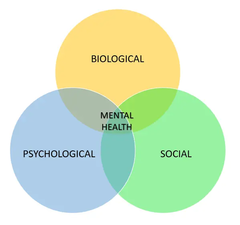
According to Korr's 1951 address, which three categories describe all manifestations of the osteopathic lesion? Select 3.
a. Biological
b. Psychological
c. Autonomic or vegetative
d. Motor or neuromuscular
e. Social
f. Sensory or suprasegmental
Answer: A, B, and E
A Biological
B Psychological
E Social
Where would Korr's experiential findings fall within the evidence hierarchy?
a. Systematic Review
b. Meta-Analysis
c. Case Control Studies
d. Background Information & Expert Opinion
e. Randomized Control Trials
f. Cohort Studies
Answer: D Background Information & Expert Opinion
Why?
Korr's work combined scientific research with clinical observation, placing it in expert opinion.
Who defined embryologic segmentation as "a process of transporting essential materials to their appropriate place and excluding them from other tissue"?
a. William Garner Sutherland
b. John Martin Littlejohn
c. A.T. Still
d. Charlotte Weaver
Answer: D Charlotte Weaver
Why?
Weaver described embryologic segmentation as the directing of essential materials to their correct locations.
Did Johnston's MSU research find palpatory inconsistency among operators?
a. True
b. False
Answer: A True
Why?
Johnston's research showed that palpatory reliability varied between operators, raising concerns about subjectivity in osteopathic assessments.

When was the A.T. Still Research Institute established in Chicago?
a. 1913
b. 2001
c. 1941
d. 1917
Answer: D 1917
Why?
The A.T. Still Research Institute was founded in 1917 in Chicago to promote osteopathic scientific inquiry.

Fill in the blank: A.T. Still 1908 stated, "I love my patients... I see God in their faces and their ______."
a. Form
b. Deeds
c. Mind
d. Intentions
Answer: C Mind
Correct Quote:
"I love my patients... I see God in their faces and their mind."

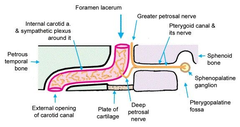
The foramen lacerum is...
a triangular opening at the base of the skull, bordered by the sphenoid, temporal, & occipital bones.
The ICA passes above, not through it.
It transmits small meningeal branches of the ascending pharyngeal artery & emissary veins
The cavernous sinus is...
A sinus containing venous blood located on each side of the body of the sphenoid bone, near the base of the brain, behind the bridge of the nose

The sella turcica is...
depression in the sphenoid bone where the pituitary gland is located
