Chapter 7 Memory
 Call Kai
 Learn
 Practice Test
 Spaced Repetition
 Match
 Flashcards
 Knowt Play
1/62

Earn XP
Description and Tags
Semantic Memory
63 Terms
What is semantic memory?
Our general knowledge of the world that is NOT tied to a specific time or place.
EX: the fact that American school busses are yellow
What did Spiers et al. (2001) find about HCF (hippocampal formation) damage?
HCF causes episodic impairment but only modest semantic impairment.
BUT
If semantic knowledge is learned BEFORE incident that caused amnesia: they have good semantic memory
If semantic knowledge is learned AFTER incident that caused amnesia: they have very poor semantic memory
What was unusual about Patient AD?
They had severe amnesia with good new semantic memories (Polling et al., 2023)
What did Lynch et al. (2020) find about amnesia HCF patients?
There is difficulty when scene constructing is required for describing actions; for example taking a bus.
Can semantic memory be impaired more than episodic?
Yes it can!!
What is semantic dementia? What does it impair/what is left okay?
Degeneration of anterior temporal lobes. When there is damage here, individuals will have a loss of concept knowledge BUT their episodic memories tend to be okay.
They can reproduce complex visual designs
They can still talk about their recent autobiographical experiences
Their cognitive functions are somewhat okay/tend to be preserved
Normal attention
Normal non verbal problem solving
Describe the Renoult et al. (2016) study and their findings using ERPs.
They gave participants stimuli such as “Did you drink coffee this morning” which is a unique event that happened at a specific point in time which is assumed to be an episodic memory.
Then they gave another stimuli, “Do many people drink coffee?”. This is general factual knowledge that is not tied to any one place of time, making it an assumed semantic knowledge.
Then they gave another stimulus, “Do you drink coffee every day?” and “Have you drunk coffee while shopping?”. These are an autobiographical fact which are assumed personal semantic memory (combination of episodic and semantic)
They found very clear ERP signatures/very clear brainwave patterns for episodic vs semantic memory (DISTINCTIVE BRAINWAVES that differed between the two). BUT for immediate categories looking at personal semantic memory (combination of episodic and semantic) they saw an intermediate patterns that was between semantic and episodic waves.
What did Tanguay et al. (2018) propose?
Personal Semantics: idiosyncratically personal facts that are linked in contextual details. AKA we do have semantic knowledge that is limited to our own personal experiences.
What did Cabeza et al. (2018) argue?
Argued that specific processes are most relevant for the task at hand.
What is semanticization?
Transformation of episodic memories into semantic.
EX: Memories of your childhood like vacations/holidays where details of vacation went away but there is a personal semantic knowledge of the place you visited even if you cannot remember exactly what happened when you were there.
Describe the Collins & Quillian’s (1969) Hierarchical Network
Major concept nodes with properties. Properties are stored as high on the hierarchy as possible to minimize the amount of information (aka it makes it more efficient)
They found that people are very fast when they are processing information along the same hierarchical node.
EX: if you say to someone a canary is yellow, people are quick to say it’s true bc they can access that information stored very quickly. If you then say that a canary can fly, they will still process it quickly, but not as quickly. This happens bc the information is further away from the original node. This is the idea that we have to jump nodes which causes a longer time to process.
Their findings also proposed the idea that we use inference to answer questions that are coming from our semantic memory.

What are the limitations of the Hierarchical Network?
Slow bc information is unfamiliar to us (EX: we don’t talk about canaries in terms of them having skin)
Some animals may not fit the typicality (EX: “A penguin is a bird".”)
Takes longer than “canary is a bird” even though it is the same distance on the hierarchy
Canaries are more typical (aka the typicality effect)
Concept are more rigidly defined into categories
EX: “Is a pumpkin a fruit?”
People change their minds! Answers can be divided!
Categories depends on life experiences and can differ across individuals
Describe Spreading-Activation proposed by Collins & Loftus (1975). What is the evidence for this?
Idea that information spreads across these hierarchies based on semantic relatedness or the distance between how related something is in meaning.
Evidence of this is shown in priming studies
EX: you have to read a set of words as fast as you can. For example, “cat, dog, rabbit, mouse” compared to “mouse, rabbit, green, flower, car.” In this case mouse is the critical word bc you were primed to expect another animal in the first set of words, making you faster to process it. This is called facilitation.
What did Rose et al. (2019) find about semantically-related distractors?
Semantically-related distractor slows naming of objects, but when you use un-related, then it does not slow it as much
What did Dell (1986) do/find?
Speakers activate word concepts related to first words in a sentence which causes a spread of activation that aids you in producing the rest of that sentence BUT irrelevant word activation can hinder production.
Describe Rosch et al. (1976) study and its findings
Showed that participants have different hierarchies/levels that they can name these words
Basic-level = chair
Subordinate = desk chair
Superordinate = furniture
99% of responses are done at the basic-level. People were fastest at categorizing the image of the chair when they were primed with the basic level name before they saw the image!!

What did Bauer & Just (2017) find about brain regions and naming objects?
More brain regions tend to be activated at the basic-level compared to the other levels
What did Rigoli et al., (2017) find about categorization?
Categorization balances benefits in terms of goal achievement (selecting actions) and costs (metabolic processing, time, and opportunity).
So we say what we need to get to the goal by not taking an extra effort to process it down into the subordinate level
What did Tanaka & Taylor (1991) find about expectations to basic-level preference?
Experts are the exception!! They looked at birdwatchers and dog experts and found that they used subordinate names more in expert terms
What level of categorization are people fastest and most accurate at? Why is this the case?
Superordinate level (aka the highest level). We think this is because there is less information needed to be processed at that level. When you reduce the detailed information, it increases the effect (Ashtiani et al., 2017)
What are the limitations of spreading activation?
Single node for each concept is not fully supported by neuro evidence
Brain activity is ACTUALLY distributed for most concepts
Not clear how concepts are learned and associated
Central focus is on concept connections in memory, real-world concepts are not typically emphasized
What did Gualdoni et al., 2023 find about real-world context?
They looked at what happens if we have people name pictures and then add more context to the pictures. They found that more context results in more variability in naming. Relationship between object names in semantic memory and object naming is more complex.
What did Van Hoed et al., 2023 find?
Concept information and categorization depends on previous perception-action experience with objects (not hierarchical organization). Activation is influenced by context, task, and task goals. Flexibility in concepts/categories to describe objects
What are the theoretical assumptions of concept representation?
Abstract: detached from sensorimotor processes
Stable: same on different occasions
EX: conception of an apple is going to be same today as it is tomorrow
Similar: across individuals
What is the difference between concrete vs abstract concepts?
Concrete: objects we can see, hear, touch (highly imageable)
Abstract: no direct representation in physical world (EX: time or philosophy)
Explain the Barsalou (2016) Grounded Cognition Theory
Also referred to as the sandwich model.
The assumption that cognition is sandwiched between perception and action. Concept processing is influenced by current goals and context. Meanings are GROUNDED in specific perceptual, motor, and other experiences
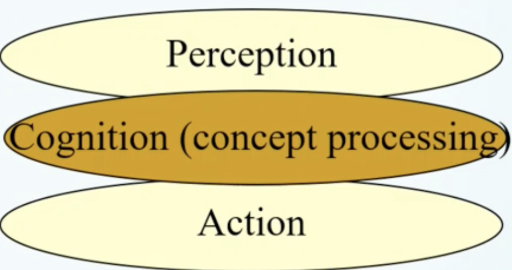
Give an example of grounded cognition theory
We have a general idea of what a bike is BUT the concept of a bike is influenced by the concept of our goals. So if I want to go mountain biking, I would think about the tread on the wheels, height of the seat, etc.
What are the predictions of grounded cognition theory?
Conceptual processing involves perceptual/motor/action systems
Concept processing is flexible and influenced by context and goals
What did Wu & Barsalou (2009) do/find about concrete concepts?
They tested this by having participants write down as many properties as they could for various words.
They found that when participants were asked about the word “lawn”, they gave external properties such as “plant and blades (of grass)”.
When they gave them “rolled-up lawn”, they got internal properties such as “dirt and soil”
When they gave them “watermelon” they got external properties such as “green and rind”
When they have them “half watermelon” they got internal properties such as “red and seeds”.
Their findings showed that the perceptual system IS involved in processing concrete concepts
What is the grounded cognition theory prediction?
Motor system should be involved in processing conrete concepts
Explain how Hauk et al. (2004) supports evidence for grounded cognition theory. Why were their findings criticized
They gave participants words like “Lick, Pick, Kick” and found that there was activation in their motor cortex for the specific part of the brain that is involved in moving the tongue, finger, and foot respectively.
Their findings have been criticized because there is a possibility that the activation was happening AFTER the concept activation.
What did Miller et al. (2018) do and find about limb areas in the brain?
They had participants make action movements in response to action words (ex: seeing the word kick and making a kicking motion). They found that it did NOT activate the limb areas of their brain.
BUT this could be because it was a speeded task, that did not give people time for motor imagery
What did Patient JR tell us about grounded cognition theory?
They had damage in the action production system of the brain, but they still had normal production of action words. This goes against the theory that motor systems are going to be involved in processing concrete concepts
Describe the Vannuscorps & Caramazza (2019) study and its findings about
They did a study on patients with reduced upper limbs. These patients would have experience with some action verbs and not others (ex: they may have experiences with writing but not with shoveling).
They looked at if there was a difference in speed between actions they have done before (ex: writing) compared to actions that they have not done (ex: shoveling)
They found that there was no advantage for practiced verbs. This shows that action verbs can be processed WITHOUT access to motor information.
What did Wang et al. (2010) find about abstract concepts?
Brain areas involved in perceptual processing are more likely activated for concrete than abstract concept processing.
Verbal system and interoception (sensations in the body) are MORE involved in abstract than concrete processing
What did Banks & Connell (2023) do? What did they find about concrete and abstract processing?
Had people rate the sensorimotor strength for various concepts, both concrete and abstract, to see if they’re processed similarly.
They found that both the abstract and concrete concepts were processed along the vision domain.
For concrete processing there was sensorimotor strength related to touch, smell, and taste
For abstract it was more related to auditory and interoceptive

What are the limitations of Barsalou’s Grounded Cognition Theory?
Concepts have a stable core AND concept processing is context-depending
Concept knowledge is more than perceptual and motor features
Similarities between concepts not sharing perceptual or motor features
EX: Watermelon and Blackberry = different motor actions of how to eat the two and diff visual appearance, but they are both fruit concepts
Perceptual and motor processes are NOT NECESSARY to understand concepts, but they may occur after concept meaning is accessed
Where are concepts stored in the brain?
In feature based neural systems
Visual information through visual pathways
Auditory information through auditory pathways
What do we know about brain damaged patients and category specific deficits?
Brain damaged patients might have category specific deficits based on where damage in the brain is.
Damage to anteromedial temporal lobes = deficit for biological entities (e.g., animals)
Describe the Hub & Spoke Model. Who proposed this?
Patterson et al. (2007) proposed the idea that we have a hub (the anterior temporal lobe (ATL)) which is a conceptual framework of where information is. The hub sends information out into the spokes (parts of our different processing area) which as modality-specific sensory and motor processes.
The hub has a modality independent concept representation, meaning that whether you’re seeing, smelling, or eating it, concepts are independent of one another.
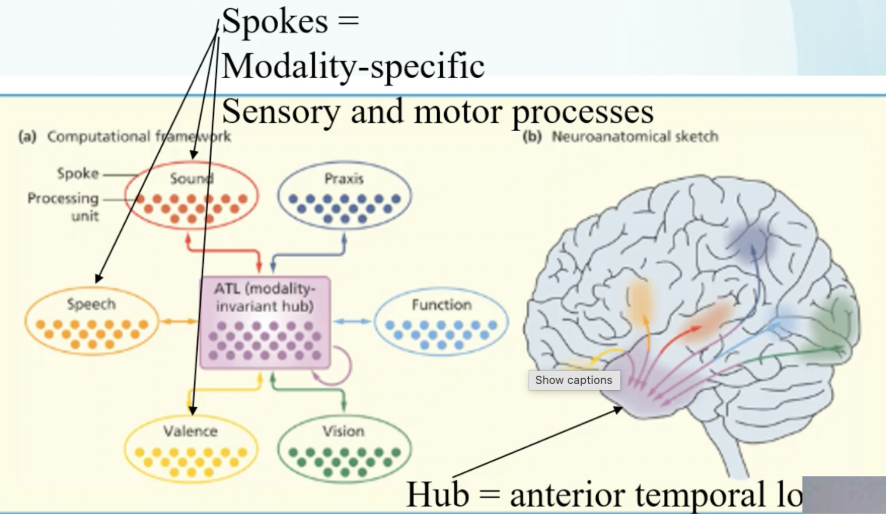
What is the patient evidence for the Hub & Spoke Model?
Patients with semantic dementia (damage to anterior temporal lobes) have general semantic memory deficits.
Chen et al. (2020) found the ATL and connection regions (posterior temporal lobes, insula, ventral frontal lobes) showed the greatest atrophy (degeneration).

What is the healthy population evidence for the Hub & Spoke Model?
Binder et al. (2009) conducted a meta-analysis. Participants did semantic memory tasks and their results showed consistent activation of the ATL.
Early semantic processing = activation in ATL
Later processing = activation in angular gyrus
What is the evidence for Spokes in patients?
Damage to localized areas (spokes) = category specific deficits
Cree & McRae (2003): showed 7 different patterns of categories that have specific deficits
Each pattern = specific features or properties that are impaired
Explain Ishibashi et al. (2018) study. Are there results evidence of spokes in healthy populations?
The results are evidence of spokes in healthy patients!
They used transcranial direct current stimulation while looking at performance accuracy on tool function and tool manipulation. They would pass the current in the inferior parietal lobe and ATL. Task 1 had rapid access to semantic information for tool function (ex: to know that scissors are for cutting); task 2 was tool manipulation (knowing that pliers are gripped by the handles).
They found that when they stimulated the ATL it facilitated BOTH tasks (bc it is a general knowledge hub), but when they stimulated the inferior parietal lobe it ONLY facilitated manipulation task (action-related information)

Explain Fernadino et al. (2022). Are these results evidence of spokes in healthy populations?
The results are evidence of spokes in healthy patients!
They had participants read nouns and asked how often they encountered that type of noun.
Nouns are associated with sensory and motor areas
They found a pattern for a given concept predicted by relevance to sensory and motor areas
This showed that the brain areas during concept processing are predicted by spoke-like dimensions
What are the limitations of the Hub-And-Spoke Model
It is unclear how modality-independent information in the hub is integrated with modality specific information
AKA how are we integrating information from the Hub to the Spokes
More research is needed regarding the information stored in the hub
We need to CONTROL our processing to focus on relevant aspects of a concept for present context
Describe the limitations of the Hub-And-Spoke Model using Hoffman et al. (2018)
They proposed a similar model and added a top-down control mechanism that increases the probability that relevant features are going to be processed when we’re processing a given concept. This accurately predicts content processing in both brain damage and healthy participants.
What did Ghosh & Gilboa (2014) propose about schemas?
Proposed that schemas have certain features:
Associative structure: idea that we have interconnected units
Basis in multiple episodes: integrated features across many similar events
Lack of unit detail: variable details from unique events are absent
Adaptability: Can change and update with new information
What are the 4 kinds of schemas?
1) Scripts: sequence of events
2) Frames: knowledge structures for aspects of the world (e.g., building) containing fixed information (e.g., it has floors) and variable slots (e.g., construction materials)
3) Stereotypes: generalizations (often negative) relating to groups of people
4) Spatial: recurring patterns of spatial relationships (e.g., expected layout of a city or house)
What is Prediction 1 of schemas vs concepts?
Brain areas involved
Content processing happens in the ATL
Schemas processed in vmPFC (but some overlap in ATL)
Some evidence for different regions for processing of schemas and concepts

What is Prediction 2 of schemas vs concepts?
Brain Damage
Semantic dementia (ATL damage): deficit in accessing word and concept meaning; good executive function
Bier et al. (2013)
When they have people with semantic dementia do a script memory task such as, “What would you do if you unknowingly invited two guests for lunch?”
Patients would have to say: dress, shop, meal prep, eat, clean
One patient had no problem with script memory; the other could remember with assistance
This shows that these patients have a deficit in concept meaning, but still have somewhat intact script memory
What brain areas are scrip-related vs concept info?
Scripts are goal-directed = PFC
Schema processing = vmPFC
Describe Ghosh et al. (2014). What did they find about schema processing?
Looked at patients with damage to the vmPFC. They found that when they gave participants a schema such as “getting ready for bed”, they had them make a rapid decision about whether words were related to the schema or not (words such a toothbrush, pillow, face wash, etc.)
They found that patients were slower and less accurate than healthy controls! This shows that damage to the vmPFC seems to affect schema processing!!
What is frontotemporal dementia?
PFC and temporal lobe damage. Intact knowledge of concepts during early stages. Impaired executive function (planning, inhibition or incorrect responses).
THIS IS THE DIRECT OPPOSITE OF SEMANTIC DEMENTIA
Describe the findings of Cosentino et al. (2006)
Looked at semantic vs frontotemporal damage. Gave participants scrips with two different types of errors:
Sequencing errors: fish in bucket before casting the line
Semantic Errors: place a flower on the hook
Semantic dementia and healthy patients detected as many sequencing errors as semantic
Frontotemporal dementia patients failed to detect TWICE as many sequencing errors as semantic. This highlights intact semantic but impaired script memory.
Describe the Zahn et al. (2017) and their findings
They looked at patients with frontotemporal dementia with vmPFC and ATL damage. They tested participant’s knowledge of social concepts (such as being adventurous) and knowledge of social scrips (consequences of ignoring employer’s requests).
They found that patients with MORE damage to frontotemporal had WORSE knowledge for script than social concept; patients with MORE damage to ATL had WORSE knowledge for concepts than scrips.
This gives evidence that concepts are linked to the ATL and the scrips are linked to the vmPFC
What are the 5 ways that schemas are useful?
1) Useful in making predictions and sets up expectations for how to act in given situations
2) Fill in the gaps to enhance understanding
Draw inferences
3) Can be used to reduce cognitive overload
Stereotypes allow for faster and less demanding judgements (but these can be problematic)
4) Facilitate in object recognition
5) Useful for adapting to new information
Cognitive behavioral therapy: change negative maladaptive schemas of patients
EX: Social anxiety disorder: use imagery based stimulation training to imagine positive interactions
What did Bransford & Johnson (1972) find about filling in gaps to enhance understanding?
They gave participants passages that were incomprehensible and not remembered well. They found that if the participant was given a title before the passage, it was remembered better!!
The title after reading did NOT help, so it wasn’t due to retrieval cues, but due to comprehension.
What did Brewer & Treyens (1981) tell us about schemas causing errors in memory?
They looked at naturalistic learning. They had participants sit for 35 seconds in a graduate student’s office room. There were schema consistent objects (desk, calendar, pencils), inconsistent schema objects (skull, toy), and not present schema consistent (books)
They had participants do recognition and recall tests. They found that people recalled more schema consistent items better than inconsistent AND recognized with high confidence if schema was consistent (saying a book was in the room even though it was not!!)
These findings tell us that schemas can cause errors in memory!!
What did Quent, Greve, and Henderson (2022) do and find?
They looked at schemas on LTM. They did a virtual reality study where participants were shown 20 objects in locations with varying congruency with kitchen schema.
Either congruent or not (ex: showing objects such as a fridge in a location you would expect in a kitchen)
They looked at the memory for items that were highly expected, highly unexpected, or items in the middle
Their findings showed a U-shaped curve where the highly expected items and the super unexpected were remembered well, but if they were just consistent with the schema but not highly expected, they were NOT remembered as well!!
Why did Quent, Greve, and Henderson (2022) have these results?
Predictions are based on schematic knowledge
New information that is consistent makes it easier to integrate
Information that is very inconsistent = additional processing during encoding which facilitates retrieval because it is distinctive
What are the limitations of schema theories?
More research is needed for interaction of schemas with conceptual episodic memory
Memory representations are more complex than what is being tested in the studies
Much research lacks ecological validity and exaggerates the number of schema driven memory errors IRL
E.g., Brewer & Treyens (1981)
People might be less likely to recall not presented objects in a natural environment than if in a fake environment
False recall rate was low (9%) because guesses were likely to be correct
E.g., Gauld & Stephenson (1967)
Emphasized the importance of accurate recall, which reduced memory errors by 50%. So they were consciously guessing in other studies!!
What study found that we might be exaggerating the number of schema-driven memory errors?
Diamond et al. (2020)
Had participants recall mask-fitting procedure two years after the event of learning how to do this procedure
Memory accuracy was over 90%
Memory experts guessed that accuracy would only be 20%
Had 70 year old participants recall audio-guide tour of hospital 9 months later
There was a 90% accuracy of recall
Memory experts guessed that there would only be 30% accuracy!!
This tells us that memory distortions and errors may actually be less than what we originally thought!!