Initiation and coordination of the action of the heart.
 Call Kai
 Learn
Learn Practice Test
 Spaced Repetition
 Match
Match Flashcards
 Knowt Play
1/7

Earn XP
Description and Tags
https://www.youtube.com/watch?v=mKuBj2j_Hl0
Name | Mastery | Learn | Test | Matching | Spaced | Call with Kai | Chat |
|---|
No analytics yet
Send a link to your students to track their progress
8 Terms
Why is the heart muscle considered myogenic
It can trigger its own beat.
How is heart beat initated
In the wall of right atrium there is a group of specialised cells called the sino-atrial node or SAN (pacemaker)
The cells in the SAN depolarise, this triggers a wave of electrical excitation to spread across the atria, causing the atria to contract.
This contraction of the atria is called the atrial systole.
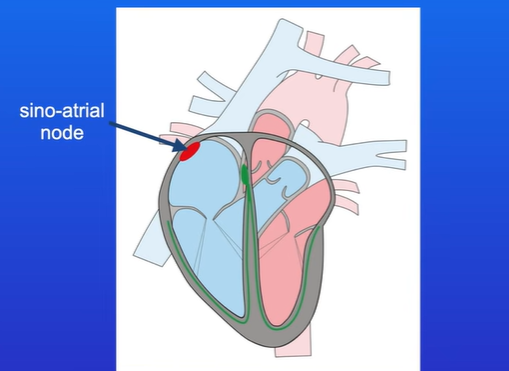
Why can the wave of electrical excitation not spread to ventricles.
This is because the ventricles are separated from the atria by a layer of non conducting tissue, and the tissue wont let the electrical excitation pass through.
What lies between the atria
A group of specialised cells called the atrioventricular node / AVN, and this is connected to conducting fibres called purkyne fibres
Initially , the purkyne fibres are bundled together, scientists call this the bundle of his.
Where are purkyne fibres found
The bundle of his branches, with purkyne fibres running down to the apex , or base of the heart then up the walls of the ventricles.
What does AVN do
Detects the electrical excitation passing over the atria, after a short delay it transmits the electrical excitation down the purkyne fibres, and this electrical excitation causes the ventricles to contract.
The delay ensures that ventricles contract after the atria have contracted.
How do the ventricles contract
From the apex upwards , this ensures that the max volume of blood is pumped out the ventricles.