BioChem Amino Acids
 Call Kai
 Learn
Learn Practice Test
 Spaced Repetition
 Match
Match Flashcards
 Knowt Play
1/23

There's no tags or description
Looks like no tags are added yet.
Name | Mastery | Learn | Test | Matching | Spaced | Call with Kai | Chat |
|---|
No analytics yet
Send a link to your students to track their progress
24 Terms
Hydrophobic Amino Acids
Have nonpolar side chains of different shapes and sizes that: Do not interact well with polar substances such as water and pack together to form compact structures
tryptophan = bulkiest hydrophobic amino acid; contains an indole group in its side chain and has potential for hydrogen bonding

Glycine (Gly, G)

Alanine (Ala, A)

Proline (Pro, P)

Valine (Val, V)
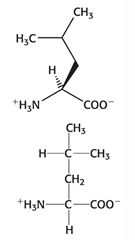
Leucine (Leu, L)
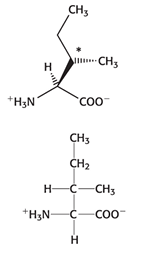
Isoleucine (Ile, I)

Methionine (Met, M)

Tryptophan (Trp, W)

Phenylalaline (Phe, F)
Polar Amino Acids
Side chains that make polar amino acids hydrophilic and more reactive than hydrophobic amino acids
cysteine = contains a sulfhydryl (thiol, –SH) group– Pairs of –SH groups can form disulfide bonds
histidine = often found in enzyme active sites

Serine (Ser, S)

Threonine (Thr, T)

Tyrosine (Tyr, Y)

Asparagine (Asn, N)

Glutamine (Gln, Q)
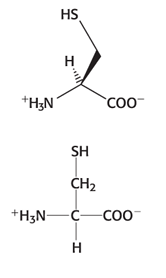
Cysteine (Cys, C)
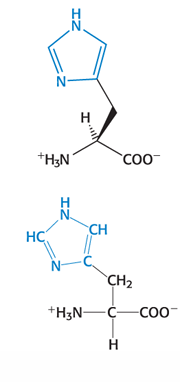
Histidine (His, H)
Positively Charged Amino Acids
Positive refers to likely charge at physiological pH; highly hydrophilic
Arginine: contains a guanidinium group

Lysine (Lys, K)

Arginine (Arg, R)
Negatively Charged Amino Acids
Negative refers to likely charge at physiological pH
Carboxylic functional group
Protonated (aspartic and glutamic acid) only at a highly acidic pH

Aspartate (Asp, D)
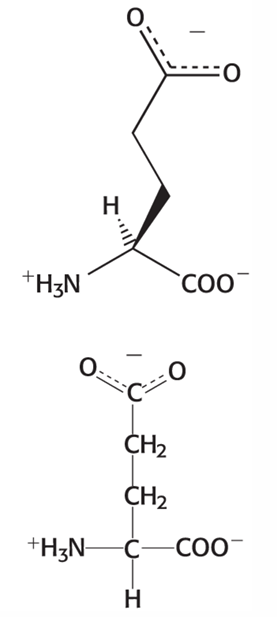
Glutamate (Glu, E)