Module 2
0.0(0)
Studied by 0 people Call Kai
 Learn
 Practice Test
 Spaced Repetition
 Match
 Flashcards
 Knowt Play
Card Sorting
1/44

Earn XP
Description and Tags
45 Terms
1
New cards
Epidemiology
Study of distribution and determinants of health-related states/events
2
New cards
Epidemiology Uses
Application to control health issues
Reveal need for and effectiveness of interventions
Reveal need for and effectiveness of interventions
3
New cards
Descriptive Epidemiology: Person
Inherent characteristics
4
New cards
Descriptive Epidemiology: Place
Geographic extent of disease occurrence
Compare to other locations
Compare to other locations
5
New cards
Descriptive Epidemiology: Time
Disease occurrence pattern change over time
Anticipate seasonal disease occurrence
Anticipate seasonal disease occurrence
6
New cards
Indigenous Peoples Data Sovereignty
Full right and power of governing body over itself
7
New cards
Data Decolonization
Classify Indigenous as problematic
False dependency on external help
False dependency on external help
8
New cards
Data Decolonization Categories
1. Disparity
2. Depravation
3. Disadvantage
4. Dysfunction
5. Difference
9
New cards
Indigenous Data Governance
First Nations Principles of OCAP: Control data collection processes in communities
Control information collection, use, sharing
Control information collection, use, sharing
10
New cards
Prevalence
Existing cases in population
Disease burden proportion
\# cases/total population
Disease burden proportion
\# cases/total population
11
New cards
Point Prevalence
Specific point in time
\# cases at time/total population at time
\# cases at time/total population at time
12
New cards
Period Prevalence
Specific time period
\# cases over time/average population over time
\# cases over time/average population over time
13
New cards
Incidence
New case development over time period
Only consider at-risk population
Risk rate
Only consider at-risk population
Risk rate
14
New cards
Cumulative Incidence (Proportion)
Proportion of population developing disease over time
\# new cases over time/population at risk (total population - existing cases)
\# new cases over time/population at risk (total population - existing cases)
15
New cards
Incidence Density Rate (Person-Time)
Length of time people at risk of disease
\# new cases/# person-years at risk
\# new cases/# person-years at risk
16
New cards
At-Risk Population
Not constant
Increase: Births, immigration
Decrease: High incidence, high death, emigration
Increase: Births, immigration
Decrease: High incidence, high death, emigration
17
New cards
Disease Onset
Prevalence: Proportion of pop with disease
Incidence: Proportion of pop developing new cases
Incidence: Proportion of pop developing new cases
18
New cards
Diagnosis Time
Prevalence: Current surviving cases
Incidence: Newly diagnosed
Incidence: Newly diagnosed
19
New cards
Denominator
Prevalence: Total pop
Cumulative Incidence: People free of disease
Incidence Rate: Person-years free of disease
Cumulative Incidence: People free of disease
Incidence Rate: Person-years free of disease
20
New cards
Crude Mortality Rate
(# deaths over time x 100 000)/population at midpoint
21
New cards
All-Cause Crude Mortality
Deaths for any reason
22
New cards
Cause-Specific Crude Mortality
Deaths from specific disease
23
New cards
Specific Mortality Rate
Subgroup mortality
(# deaths over time period in subgroup x 100 000)/subgroup population at midpoint of time period
(# deaths over time period in subgroup x 100 000)/subgroup population at midpoint of time period
24
New cards
Standardized Mortality Rates
Compare mortality of pop with different characteristics
Account for confounding variables
Account for confounding variables
25
New cards
Vital Event Registration
System to track country's statistics on vital events
Difficult to obtain in developing countries
Difficult to obtain in developing countries
26
New cards
Verbal Autopsy
Interview caregivers of individuals dying out of clinical settings
Assess symptoms
Diagnosis cause of death
Assess symptoms
Diagnosis cause of death
27
New cards
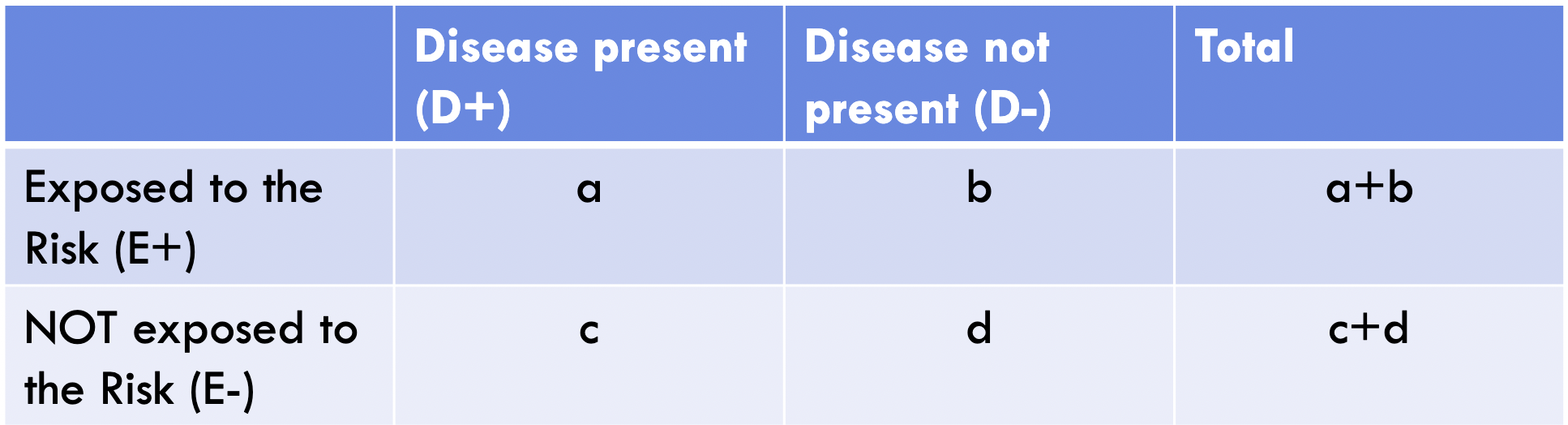
Relative Risk (RR)
(a/(a+b))/(c/(c+d))
Make 2x2 table
How many times more likely one group will become ill compared to another
Cumulative incidence of being exposed to illness
Make 2x2 table
How many times more likely one group will become ill compared to another
Cumulative incidence of being exposed to illness
28
New cards
Primary Group (E+)
Exposed to risk
a: E+ with disease
b: E+ without disease
a: E+ with disease
b: E+ without disease
29
New cards
Comparative Group (E-)
Not exposed to risk
c: E- with disease
d: E- without disease
c: E- with disease
d: E- without disease
30
New cards
RR: Cause and Occurrence
Determine disease cause
No info on disease occurrence
No info on disease occurrence
31
New cards
RR Groups
Demographic factors
Exposure to risk
Exposure to risk
32
New cards
RR Interpretation
RR<1: Exposure lower disease risk
RR = 1: Equal disease risk
RR>1: Exposure higher disease risk
RR = 1: Equal disease risk
RR>1: Exposure higher disease risk
33
New cards
Odds Ratio (OR)
(axd)/(bxc)
Make 2x2 table
Odds of case being exposed vs odds of control having exposure
Make 2x2 table
Odds of case being exposed vs odds of control having exposure
34
New cards
OR Drawbacks
No info on incidence
For rare outcome
Cannot quantify at-risk pop
For rare outcome
Cannot quantify at-risk pop
35
New cards
OR Interpretation
OR<1: Exposure negatively associated with disease (protective factor)
OR>1: Exposure positively associated with disease (risk factor)
OR>1: Exposure positively associated with disease (risk factor)
36
New cards
OR: Cause and Occurrence
Approximate risk for cause or occurrence
Comparator chosen by researcher cannot equate to RR
Comparator chosen by researcher cannot equate to RR
37
New cards
Disability Adjusted Life Year (DALY)
Measure overall disease burden
Cumulative years lost from ill-health, disability, early death
Years lived with disability (YLD) + Years of lose life (YLL)
Cumulative years lost from ill-health, disability, early death
Years lived with disability (YLD) + Years of lose life (YLL)
38
New cards
DALY Criticism
Ableist lens: Able-bodied people valued more than disabled people
Not account for age: Related to contribution ability
Not account for age: Related to contribution ability
39
New cards
DALY Support
Prioritize interventions based on potential contributions
40
New cards
Quality Adjusted Life Year (QALY)
Measure time "gained" from intervention
Years of life gained x adjustment for quality
Years of life gained x adjustment for quality
41
New cards
Oral Histories
Convey events from past specific to time period/event
Historically accurate
Historically accurate
42
New cards
Orators
Indigenous members selected to be public speakers
Carry forward histories
Add own experience to increase protective knowledge
Carry forward histories
Add own experience to increase protective knowledge
43
New cards
Oral History Accuracy
Complex and sophisticated methods unite past and present memory
Performative practices (Dancing and drumming)
Performative practices (Dancing and drumming)
44
New cards
Storytelling
Offer lessons
Creative liberty to emphasize teachings
Creative liberty to emphasize teachings
45
New cards
Oral and Written Record Keeping
Combine oral knowledge transmission with written documents
Ex: SARS outbreak and smallpox to combat COVID
Ex: SARS outbreak and smallpox to combat COVID