A&P (muscular system)
 Call Kai
 Learn
 Practice Test
 Spaced Repetition
 Match
 Flashcards
 Knowt Play
1/53

There's no tags or description
Looks like no tags are added yet.
54 Terms
What are the functions of the musclar system?
1. movement
move body parts and contents in breathing, circulation, and digestion
2. stability
stabilizes joints by maintaining tension
maintains posture by preventing unwanted movements
3. control of openings and passages
use of sphincters
4. heat production
acomplished by skeltal muscles
5. communication
facial expressions
6. gylcemic control
regulates blood sugar and glucose concentration
What are the connective tissues of the muscles?
endomysium
perymysium
epimysium
fascia
Endomysium
connective tissue surround each muscle fiber
Perymysium
connective tissue surrounding fascicles
Epimysium
fibrous sheath surrounding entire muscle
Fascia
thick connective tissue sheet seperating muscles or muscle groups from each other
Fasicles
bundles of muscle fibers (cells) surrounding each other
What is the purpose of the connective tissues of the muscles?
supplying nerves and blood to muscles
Prime mover
agonist
muscle producing most of force during a muscle action
Synergist
muscles that assists the prime mover
Antagonist
muscles that opposes the prime mover
ex. contracts to prevent excessive movement or relaxes to give prime mover control over an action
Antagonistic pairs
muscles that act on opposite sides of a joint
Fixator
muscle that prevents movement of bone
ex. eliminate action of prime mover
Innervation of a muscle
refers to the identity of the nerve that stimulates it
ex. enables diagnosis of nerve, spinal cord, and brainstem
injuries from muscle tests
Spinal nerves
originate in spinal cord
C 1-5, T 1-12, L 1-5, S 1-5, CO 1
Cranial nerves
originate from the base of the brain
CN 1-12
What are some general features of spinal nerves?
emerge through intervertebral foramen
immediately branch into posterior and anterior rami
innervate muscles below the neck
composed of spinal nerves adjacent to the vertebral column
What are the general features of the cranial nerves?
emerge through skull foramina
innervate the muscles of the head and neck
What are the two types of muscle attachments?
direct
muscle to bone
indirect
bridged by tendons and ligaments
Retinaculum
connective tissue band that tendons from separate muscles pass under
ex. found within indirect muscle attachment
Somatic motor neurons
nerve cells whose cell bodies are in the brainstem and spinal cord that serve skeletal muscles
Somatic motor fibers
axons that lead directly to skeletal muscles
Motor unit
one nerve fiber and all the muscle fibers innervated by it
How many muscle fibers does the average motor unit contain?
200
Small motor unit
fine degree of control
a motor unit send orders to a few muscle fibers
ex. eye and hand muscles
Large motor unit
more strength than control
a motor unit sends messages to many muscle fibers
ex. quadriceps femoris and gastrocnemius
How are the muscle fibers of a motor unit arranged?
they are dispersed throughout the muscle and contract in unison
ex. provide ability to maintain long-term contraction as unit take turns contracting
Sarcolemma
plasma membrane of a muscle fiber
Sarcoplasm
cytoplasm of muscle fiber
components:
myofibrils
small fibers
glycogen
carb storage (glucose)
myoglobin
red pigment storing oxygen
True or false, a muscle fibers contains multiple nuclei?
true
Sarcoplasmic reticulum
smooth ER forming a network around each myofibril and composed of terminal cisterns
ex. stores calcium for use
Terminal cisterns
dilated end-sacs of SR which cross the muscle fiber from one side to the other
ex. serves as calcium reservoir for contraction
T tubules
tubular infoldings of the sarcolemma which penetrate through the cell and emerge on the other side
Structure of a skeletal muscle fiber
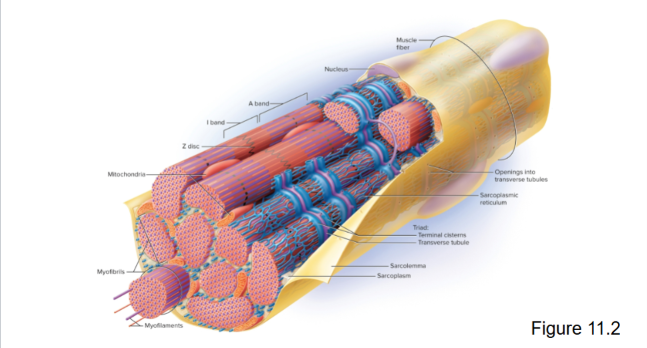
What are the striations within cardiac muscle compared to skeletal muscle?
similar to skeletal muscle
cardiomyocyte cells are shorter and thicker
sarcoplasmic reticulum is less developed
T tubules are larger and allow CA from extracellular fluid
How do striations come about in relation to cardiac and skeletal muscle cells?
the organization of myosin and actin
ex. alternating “A” and ‘“I” bands
A band (dark)
anisotropic
composed of H band (middle of A) and M line (middle of H)

I band (light)
isotropic
the way the bands reflect polarized light
ex. contains Z disc providing anchorage for thin filaments

Sarcomere
arrangement of thick and thin filaments
ex. contractile units
Synapse
point where nerve fiber meets target cell
Neuromuscular junction (NMJ)
when target cell becomes a muscle fiber
Axon terminal
swollen end of a nerve fiber
contains synaptic vesicles carrying acetylcholine (ACh)
Synaptic cleft
a gap between the axon terminal of nerve fiber and sarcolemma of muscle fiber
Acetylcholinesterase (AChE)
enzyme that breaks down excess ACh
ex. allows relaxation
What does ATP supply depend on the availability of?
oxygen, glucose, and fatty acids
Anerobic fermentation
enables cells to produce ATP with no oxygen
yields little ATP (2) and much lactate
ex. uses glucose
Aerobic respiration
produces ATP with continual supply of oxygen
yields much ATP (26-32) and no lactate
Phosphagen system
the combination of ATP and CP which provides nearly all
energy for short bursts of activity
How the body generates immediate energy

Muscle fatigue
progressive weakness from prolonged use of muscles
What are the four factors for muscle fatigue?
Fuel depletion as glycogen and glucose levels decline
Electrolyte loss through sweat
Central fatigue when less motor signals are issued from brain
Decrease blood supply (O2 max)
EPOC
oxygen debt
excess post-exercise oxygen consumption

Resistance exercise
contraction of a muscle against a load that resists movement
growth occurs through cellular enlargement (hypertrophy)
ex. uses slow-twitch or red muscle fibers
How much resistance exercise a week is recommended?
a few minutes a few times a week