Study Guide - Biogeochemistry & Carbon/Redox Cycling
 Call Kai
 Learn
 Practice Test
 Spaced Repetition
 Match
 Flashcards
 Knowt Play
1/31

There's no tags or description
Looks like no tags are added yet.
Name | Mastery | Learn | Test | Matching | Spaced | Call with Kai | Chat |
|---|
No analytics yet
Send a link to your students to track their progress
32 Terms
Redfield Ratio
in aquatic ecosystems, marine and freshwater plankton construct cellular material in a highly conserved atomic ratio of Carbon, Nitrogen, and Phosphorus (C:N:P = 106:16:1)
Schindler Whole-Lake Experiments
pioneering whole-lake manipulation experiments conducted by David Schindler in the Experimental Lakes Area (ELA) demonstrated nutrient limitation in freshwater systems
Experimental Design of Schindler Whole-Lake Experiments
lakes were divided with vinyl curtains with one basin receiving C and N, while the other received C, N, and P
Key Findings of Schindler Whole-Lake Experiments
basin receiving P produced massive algal blooms dominated by nitrogen-fixing cyanobacteria
confirms that P is the primary limiting nutrient controlling cultural eutrophication in freshwater lakes
C and N drawn from the atmosphere can compensate for internal deficits, but P availability strictly dictates maximum primary production
Bicarbonate-Carbonate Equilibrium System
dissolved CO2, carbonic acid, bicarbonate, and carbonate ions form an aqueous chemical equilibrium that buffers aquatic ecosystems against rapid pH fluctuation
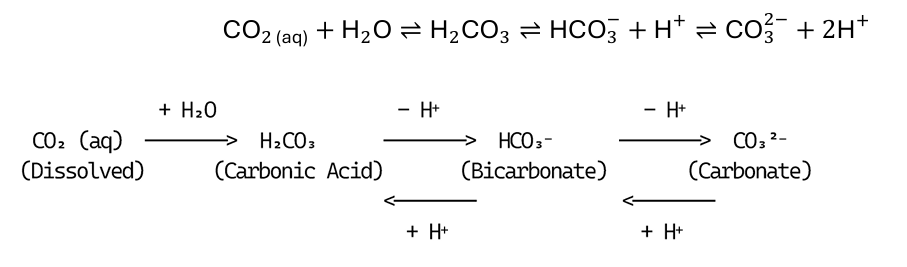
Dissociation and pH Dependence under acidic conditions
pH < 6.4
dissolved CO2 and carbonic acid H2CO3 dominate
Dissociation and pH Dependence under circumneutral conditions
pH 6.4-10.3
bicarbonate ions HCO3 dominate, acting as an effective buffer by absorbing incoming H+ ions or releasing them as base is added
Dissociation and pH Dependence under alkaline conditions
pH > 10.3
carbonate ions CO3 dominate
Photosynthetic pH Shifts - Daytime
photosynthetic uptake of CO2 by aquatic plants and algae consumes dissolved carbonic acid, shifting the chemical equilibrium left
this reduction in free H+ ions causes ambient stream/lake pH to increase
Photosynthetic pH Shifts - Nightime
photosynthesis stops while plant, animal, and microbial respiration continues producing CO2 that dissolves into the water
forms carbonic acid and releases free H+ ions, causing ambient pH to decrease
Anaerobic Respiration causes a _______ of dissolved oxygen
depletion
When aerobic respiration depletes DO, microorganisms shift to…
alternative terminal electron acceptors (TEAs) for anaerobic respiration
Microbes use electron acceptors in order of…
the thermodynamic energy yield, from highest energy yield to lowest
High → to Low Energy Yield Cascade
Molecular Oxygen (O2)
Nitrate reduction / Denitrification (NO3 → N2 gas)
Manganese Reduction (Mn4+ → Mn2+)
Iron Reduction (Fe3+ → Fe2+)
Sulfate Reduction (SO4²- → H2S)
Methanogenesis / Carbon Dioxide Reduction (CO2 → CH4)
Aerobic Respiration terminal electron acceptor
O2
Aerobic Respiration Reduced End Product
H2O
Aerobic Respiration Biogeochemical Implication
highest energy yield; standard aerobic cellular respiration
Denitrification terminal acceptor
NO3^-
Denitrification reduced end product
Nitrogen gas, N2
Denitrification Biogeochemical implication
converts bioavailable fixed nitrogen into inert N2 gas, removing excess nitrogen from aquatic systems
Manganese Reduction terminal electron acceptor
Mn^4+
Manganese Reduction Reduced end product
soluble Mn²+
Manganese Reduction Biogeochemical Implication
dissolves insoluble manganese oxides into water column
Iron Reduction terminal electron acceptor
Fe³+
Iron Reduction reduced end product
soluble Fe²+
Iron Reduction Biogeochemical Implications
dissolves ferric iron complexes, releasing bound phosphate, PO4³-, from sediments into water
Sulfate Reduction terminal electron acceptor
sulfate, SO4²-
Sulfate Reduction reduced end product
Hydrogen Sulfide, H2S
Sulfate Reduction Biogeochemical Implication
generates toxic, rotten-egg-odor hydrogen sulfide gas; precipitates toxic heavy metals as insoluble metal sulfides
Methanogenesis terminal electron acceptor
CO2 / organic C
Methanogenesis reduced end product
Methan CH4
Methanogenesis Biogeochemical Implication
lowest thermodynamic yield, produces methane gas in strictly anoxic conditions