N5 Questions Properties of Matter
 Call Kai
 Learn
 Practice Test
 Spaced Repetition
 Match
 Flashcards
 Knowt Play
1/97

There's no tags or description
Looks like no tags are added yet.
98 Terms
Define the term 'heat'.
A measure of the total kinetic energy of the particles in an object.
Define the term 'temperature'.
A measure of the average kinetic energy of the particles in an object.
Explain why a bowl of ice cream can have a greater heat energy than a glass of hot fudge sauce.
Based on the difference between heat and temperature - heat is a measure of the total kinetic energy of the particles in an object, so if the ice cream has more particles than the hot fudge sauce, its total kinetic energy can be greater than that of the hot fudge sauce.
Name the three methods of heat transfer.
Conduction, convection, radiation
Which of the following - conduction, convection, radiation - involves the transfer of heat by the movement of particles?
Conduction, convection
Which of the following - conduction, convection, radiation - involves the transfer of heat by the movement of waves?
Radiation
Describe what is meant by 'conduction'.
The transfer of heat through a solid from high temperature to low temperature.
Give two examples of conduction as a method of heat transfer.
Cooking food in a frying pan/clothes drying on a radiatior/cup of tea making the cup hot
Describe what is meant by 'convection'.
The transfer of heat from one place to another by the movement of fluids (liquids and gases). Hotter fluid rises and cooler fluid falls, creating a convection current.
Give two examples of convection as a method of heat transfer.
Convector radiatiors/blood flow around the human body/a pond freezing over
Describe what is meant by 'radiation'.
Heat (infrared) waves emitted by an object.
Give two examples of radiation as a method of heat transfer.
Heat from the Sun/the human body
Sketch a diagram of a pot of boiling water on a hob and label where conduction, convection and radiation take place.

Define the term 'specific heat capacity'.
The amount of heat energy required to change the temperature of 1 kg of a substance by 1°C.
Different materials can store different quantities of heat energy and still be at the same ________________.
Temperature
State the specific heat capacity for water.
4180 J kg⁻¹ °C⁻¹
Write down the equation relating heat energy, specific heat capacity, mass and change in temperature.

State the symbol and units for heat energy.
Eh, J
State the symbol and units for specific heat capacity.
c, J kg⁻¹ °C⁻¹
State the symbol and units for mass.
m, kg
State the symbol and units for change in temperature.
ΔT, °C
The greater the specific heat capacity of a substance, the __________ its change in temperature.
Lower
State the 'principle of conservation of energy'.
Energy cannot be created or destroyed, but can change from one form to another.
Write down the equation relating heat energy, power and time.

State the symbol and units for power.
P, W
State the symbol and units for time.
t, s
Name the three states of matter.
Solids, liquids, gases
Name the change of state for a solid turning into a liquid.
Melting
Give another name for 'melting'.
Fusion
Name the change of state for a liquid turning into a gas.
Evaporating
Give another name for 'evaporating'.
Vaporisation
Name the change of state for a gas turning into a liquid.
Condensing
Name the change of state for a liquid turning into a solid.
Freezing
State what happens to the temperature of a substance when it changes state.
Temperature stays the same/constant
If a solid melts to form a liquid, and the liquid evaporates to form a gas, is heat being added or removed for this process to occur?
Added
Sketch a heating curve (temperature vs. time) and label where the changes of state occur.

If a gas condenses to form a liquid, and the liquid freezes to form a solid, is heat being added or removed for this process to occur?
Removed
Sketch a cooling curve (temperature vs. time) and label where the changes of state occur.

Define the term 'specific latent heat'.
The amount of heat energy required to change the state of 1 kg of a substance.
Name the two types of specific latent heat.
Specific latent heat of fusion, specific latent heat of vaporisation
Define the term 'specific latent heat of fusion'.
The energy required to change 1 kg of a solid into a liquid at its melting point.
Define the term 'specific latent heat of vaporisation'.
The energy required to change 1 kg of a liquid into a gas at its boiling point.
State the specific latent heat of fusion and specific latent heat of vaporisation for water.
3.34 x 10⁵ J kg⁻¹, 22.6 x 10⁵ J kg⁻¹
Write down the equation relating heat energy, mass and specific latent heat.

State the symbol and units for specific latent heat.
l, J kg⁻¹
Define the term 'pressure'.
The force per unit area.
Write down the equation for pressure in terms of force and area.
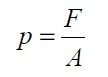
State the symbol and units for pressure.
p, Pa or N m⁻²
State the symbol and units for force.
F, N
State the symbol and units for area.
A, m²
What is 1 pascal equivalent to?
1 newton per square metre
State the value for atmospheric pressure.
1 x 10⁵ Pa
Give two examples of low pressure situations.
Elephant's foot on the ground/wide car tyres/snow shoes/snowboards etc
Give two examples of high pressure situations.
Wearing stiletto heels/blades on ice skates/pointed end of a nail etc
State what happens to the speed of the particles in a substance as its temperature is increased.
The speed increases
State what happens to the speed of the particles in a substance as its temperature is decreased.
The speed decreases
State the coldest temperature in the Universe.
Absolute zero/-273 °C/0 K
Define the term 'absolute zero'.
The temperature at which the pressure in a substance is zero. This occurs at -273 °C (or 0 K), where we assume that the average kinetic energy of the particles is zero.
Write down the rule for converting between kelvin and degrees Celsius.
T(K) = T(°C) + 273 OR 0 K = -273 °C
What is a temperature change of 1 K the same as?
A temperature change of 1 °C
Use the kinetic model to explain why gases have a pressure.
Consider a fixed mass of gas inside a sealed container. The particles move randomly in all directions, colliding with each other and the walls of the container. When they hit the walls of the container, they exert a force per unit area, thus creating a pressure.
State what happens to the average kinetic energy of the particles in a gas as its temperature is increased.
It increases
State what happens to the average kinetic energy of the particles in a gas as its temperature is decreased.
It decreases
During an experiment to investigate Boyle's Law (pressure-volume law), which variable must be kept constant?
Temperature
Describe how you would carry out an experiment to verify Boyle's Law (pressure-volume law). Your answer should include the measurements taken and equipment used.
Change the volume of air in a syringe by moving the piston by set amounts and record the corresponding reading of pressure from the pressure sensor. Plot a graph of pressure vs. 1/volume and draw a curve of best fit.
During an experiment to investigate Boyle's Law (pressure-volume law), why must the tubing between the syringe and pressure sensor be as short as possible?
To minimise uncertainties in the volume readings.
hello
hello

Sketch a graph to show the relationship between pressure and 1/volume for a fixed mass of gas. Numerical values are not required on the axes.

Define 'Boyle's Law' (i.e. the pressure-volume law).
For a fixed mass of gas at constant temperature, pressure is inversely proportional to volume.
Write down the equation for Boyle's law relating the initial and final pressures and initial and final volumes.

State the symbol and units for initial pressure.
p₁, Pa or N m⁻²
State the symbol and units for final pressure.
p₂, Pa or N m⁻²
State the symbol and units for initial volume.
V₁, m³ or cm³ or litres
State the symbol and units for final volume.
V₂, m³ or cm³ or litres
What happens to the pressure of a gas when its volume is decreased?
Its pressure increases
Explain, in terms of the kinetic model, why the pressure of a gas increases as its volume decreases.
As volume decreases, the particles have less space to move around in and therefore collide more frequently with each other and the walls of the container. The particles therefore exert more force per unit area which causes an increase in pressure.
During an experiment to investigate Gay-Lussac's Law (pressure-temperature law), which variable must be kept constant?
Volume
Describe how you would carry out an experiment to verify Gay-Lussac's Law (pressure-temperature law). Your answer should include the measurements taken and equipment used.
Insert a joly bulb containing air into a beaker of water. Heat up the beaker of water using a Bunsen burner. Record readings of pressure from the pressure sensor at different temperature values from the thermometer. Plot a graph of pressure vs. temperature (in kelvin) and draw a line of best fit.
During an experiment to investigate Gay-Lussac's Law (pressure-temperature law), why must the joly bulb be completely submerged in water?
To ensure the gas inside the bulb is heated evenly throughout.
Sketch a graph to show the relationship between pressure and temperature (in ˚C) for a fixed mass of gas. Numerical values are not required on the axes.

Sketch a graph to show the relationship between pressure and temperature (in K) for a fixed mass of gas. Numerical values are not required on the axes.

Define 'Gay-Lussac's Law' (i.e. the pressure-temperature law).
For a fixed mass of gas at constant volume, pressure is directly proportional to temperature (in K).
Write down the equation for Gay-Lussac's law relating the initial and final pressures and initial and final temperatures.

State the symbol and units for initial temperature.
T₁, K
State the symbol and units for final temperature.
T₂, K
What happens to the pressure of a gas when its temperature is increased?
Its pressure increases
Explain, in terms of the kinetic model, why the pressure of a gas increases as its temperature increases.
As temperature increases, the average kinetic energy of the particles increases. This causes the particles to collide with the walls of the container more frequently, therefore exerting more force per unit area causing an increase in pressure.
During an experiment to investigate Charles' Law (volume-temperature law), which variable must be kept constant?
Pressure
Describe how you would carry out an experiment to verify Charles' Law (volume-temperature law). Your answer should include the measurements taken and equipment used.
Insert a tube with mercury plug into a beaker of water. Heat up the beaker of water using a Bunsen burner. Record readings of volume from the volume scale on the tube at different temperature values from the thermometer. Plot a graph of volume vs. temperature (in kelvin) and draw a line of best fit.
During an experiment to investigate Charles' Law (volume-temperature law), why must the tube containing the mercury plug be completely submerged in water?
To ensure the gas inside the tube is heated evenly throughout.
Sketch a graph to show the relationship between volume and temperature (in ˚C) for a fixed mass of gas. Numerical values are not required on the axes.

Sketch a graph to show the relationship between volume and temperature (in K) for a fixed mass of gas. Numerical values are not required on the axes.

Define 'Charles' Law' (i.e. the volume-temperature law).
For a fixed mass of gas at constant pressure, volume is directly proportional to temperature (in K).
Write down the equation for Charles' law relating the initial and final volumes and initial and final temperatures.

What happens to the volume of a gas when its temperature is increased?
Its volume increases
Explain, in terms of the kinetic model, why the volume of a gas increases as its temperature increases.
As temperature increases, the average kinetic energy of the particles increases. This causes the particles to collide with the walls of the container more frequently, therefore exerting more force per unit area. In order to keep pressure constant, the gas itself must expand, leading to an increase in volume of the gas (container).
When should the general gas equation be used?
When none of the variables (pressure, volume or temperature) are kept constant.
Write down the general gas equation relating initial and final pressures, volumes and temperatures.
