s6 - area specific curets (gracey)
 Call Kai
 Learn
Learn Practice Test
 Spaced Repetition
 Match
Match Flashcards
 Knowt Play
1/18

There's no tags or description
Looks like no tags are added yet.
Name | Mastery | Learn | Test | Matching | Spaced | Call with Kai | Chat |
|---|
No analytics yet
Send a link to your students to track their progress
19 Terms

area specific curets
for specif areas of mouth
ant vs. post
mesial vs. distal
light-mod calc deposits
crows & roots
design
long complex fxnal shank (good for root surfs & concavities)
(like univ) round back, round toe, semicirc cross-sect
2 lateral sides come together for round toe
BUT only has one designated cutting edge (univ has 2)
face is tilted in relation to lower shank (offset by 70 deg)
LOWER edge is only side used
NONWORKING edge not for perio debriding (not sharp)
nonworking edge angled away from soft tissue wall (good bc no trauma)
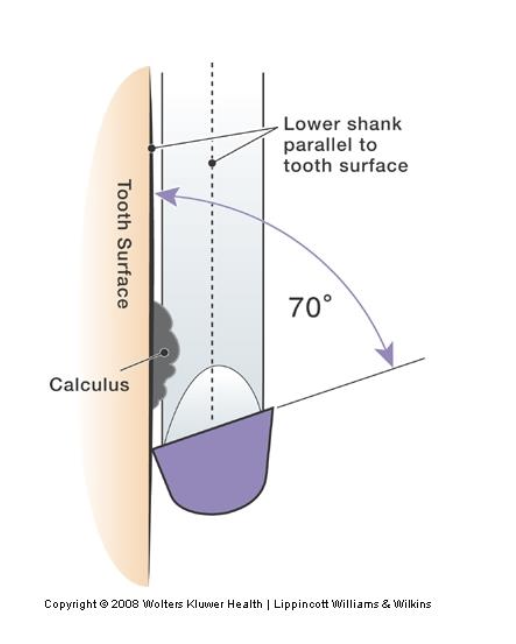
self-angulated
lower cutting edge already 70 when lower shank parallel
gracey series
dr. clayton gracey
worked with hugo friedman to dev 14 area specific graceys
used to be more rigid (limits tactile info) but now more flex
used to have larger, stronger working end & shank
moreso medium deposits
easier control & less energy for stroke
variations in shank length
Standard
slight flexion with moderate to heavy
instrumentation pressure
application: healthy or maintenance clients
area specificity allows for deep scaling, root
planing, and periodontal debridement
blade = offset relative to the lower shank,
curved upward with a curved blade producing
an elongated cutting edge
Rigid - Extra rigid
Larger and stronger, less flexible shank
applic: Moderate to heavy tenacious calculus
removal
longer shank by 3mm = deep perio pockets
blade = length shorter by ½ of standard for deep narrow perio pockets and furcations

Gracey 1/2
fxn = ant teeth, all surfs
loc = limits for shallower pocket depths
shank = straight but shorter
Gracey 5/6
fxn = ant + premolar teeth all surfs
also all surfs EXCEPT DISTAL for molars
shank = straight but longer
Gracey 3/4
fxn = ant teeth all surfs
loc = limits to shallower pocket depths
shank = bent but shorter
Gracey 7/8
fxn = ant + premolar teeth all surfs
also post teeth facial + lingual
shank = similar shank bend but longer


Gracey 9/10
ant + premolar all surfs
post’s facial + lingual surfs
shank = bend more than 7/8
Gracey 11/12 (like 15/16)
ant teeth (mesial + distal)
post teeth all except distal
shank = slightly angulated at two points
Gracey 13/14 (like 17/18)
ant teeth (mes + dist)
post teeth (distal)
shank = angulated for adaptation to distal
Gracey 15/16 (not part of orig series)
mimics 11/12 but more complex shank (fulc will be farther and shank parallel
post teeth all except distal
Gracey 17/18 (not part of orig series)
mimics 13/14 but more complex shank (fulc will be farther and shank parallel)
post teeth distals


ant teeth sequence
face tilt toward tooth (hidden from view bc adapted)
RH = 8-9
LH = 3-4 (towards)
GRZ = midline
adapt tip 1/3 (hug tooth)
terminal shank parallel to scale
work across facial
as approach mesiofacial line angle, pivot & roll
when in interprox, terminal shank slightly overlap tooth
posterior sequence
lower shank parallel to prox surface & fxnal shank up and over
typically paired (need 2 double ended instrums for post teeth debride)
11/12 + 13/14 (traditional pairing)
14 for distal, 11 for facial/lingual to mesial
Modified pairing (only 1 double ended gracey)
one end is 11 one end is 14
advantage = no need change instrument
RH = 9
LH = 3
Distal (13/14 or 17/18)
GRZ = distofacial line angle
lower handle (toward tooth working on)
hug face, insert
if right, face-tooth angulation is 70
Facial/Mesial (11/12 or 15/16)
start at distofacial line angle toward mesial
tip 1/3 adapt
oblique/hor strokes on facial/lingual
lower angle, enter 0-40
roll and pivot
vertical strokes for interprox

gracey overall
good for
root debriding
light calc
(if rigid) medium-tenacious calc

root debriding (RDS)
remove subg plaque biofilm
remove residual calc deposits or surf irregularities
insert at 0 degree
slide into ging margin
tilt lower shank 60-70
light shaving stroke (lighter and longer than CRS)
modes of calc attachment
to pellicle
pellicle = thin coating of salivary proteins attaching to tooth surf minutes after cleaning
act like double sided tape for tooth & calc
tooth surf = enamel
attach strength = weak
to surf irregularities
tiny openings in root surf where PDL fibs are detached
grooves in cemental surfs (over-instrumentation)
tooth surf = root surf
attach strength = strong
interlocked with organic crystals of tooth
matrix of the calc deposit firmly interlocked with org crystals of root surfs
tooth surf = root surf
attach strength = extremely strong
planning for calc removal: 2 approaches
full mouth debridement
sext/quad debridement
full mouth debride
ppl might not want long appts
1-2 longs appts vs, 2-6 1hr appts
minimize appts bc can also be issue for the practice for that many appt
sext/quad debride (mult appt.)
complete calc removal on teeth treated at each appt
only does as many as one can thoroughly debride in that appt
several teeth = more difficult cases
a sext/quad = more typical, adjacent teeth if time
can complete 2 quads on same side of mouth (max+mand)
^give patient untreated side to chew comfortably with
when local anaesthetic need
gross calc removal
gross scaling - removing large calc at first appt
not good bc proliferation of microorgs
leave behind rough irreg deposits covered with bact plawque
as marginal tissue shrink, closes off entrance to pocket wher orgs mult
can lead abscess formation (localized collection of puss in perio tissue)
occur on teeth w deep probing depth, while gross scale only remove deposits above & slight beneath margin

root concavity - difficult for plaque remove
linear dev depression in root surf
when healthy, covered in alveolar bone & help secure tooth to mouth
in periodontitis, bone loss expose these
commonly found mesial/dist surfaces of teeth
facial & lingual surfs of molars
best explorer = 11/12 w extended shank
important to adapt
when exploring
vert & hor
should be explored for facial/ling

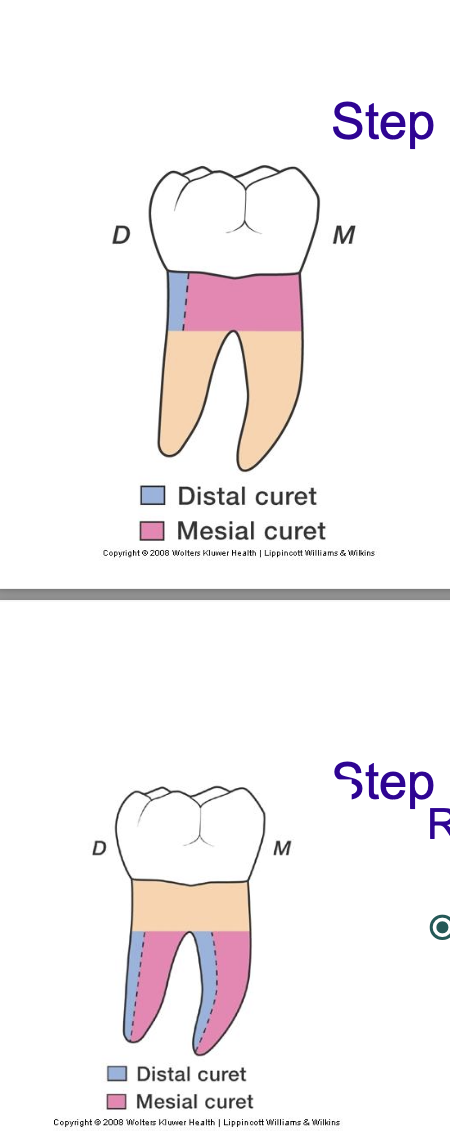
root furcation
treat each root as separate root
D curet for distals of each root
M curet for mesial portions of each root
for furcation roof & concavities = M curet (toe against roof, then for concavity curet is toe-down with hor stroke)

root trunk
distal curet from distofacial line angle to distal surf
mesial curet from distofacial line angle to mesial surf
root branches
treat each branch as if its each a tooth
distal curet for its distal
mesial curet for its mesial

standard area specif vs modified curet
standard = perio pockets 4mm or less in depth
modified = perio pockets more than 4mm in depth
an extended one is 3mm longer lower shank + thinner working end by 10%
miniature working end
shorter + thinner
good for tiny roots of mand anteriors
modified gracey w mini work ends
longer lower shank
thinner working end
shorter by 50%
