bchm exam 3
 Call Kai
 Learn
 Practice Test
 Spaced Repetition
 Match
 Flashcards
 Knowt Play
1/52

There's no tags or description
Looks like no tags are added yet.
53 Terms
what does lysozyme do
cleave bacterial cell wall (made of peptidoglycan)
size of lysozyme and # disulfide bonds
129 AA, 14.3 kDa, 4 disulf bonds
what two amino acids participate in lysozyme’s catalysis?
Glu35 and Asp52 - acid/base catalysis
what bond does lysozyme cleav?
NAM-NAG glycosidic bond, or Mur2Ac-GlcNAc
what ph does lysozyme work best at?
between the pKa of asp (3.9) and glu (4.2), ~4 so glu is protonated and can act as acid but asp is deprot and can act as base
lysozyme catalysis mechanism

lysozume sn1 vs sn2: for each, what acts as:
general acid
general base
covalent
electrostatic
sn1/sn2:
general acid: glu/glu
general base: h2o/h2o
covalent: none/asp
electrostatic: asp/none
what do lipids form and what do they not form
are they all hydrophobic? are they all amphipathic?
form esters. NOT polymers
all hydrophobic; not all amphipathic
saturated vs unsaturated
sat = no DB, solid at room temp
unsat = 1 or more DB - in line, NOT opposite directions; liquid at RT (reduced melt temp)
#of carbons and structure
myristic acid
palimitic acid / palmatate (ate = missing H)
palmitoleic
stearic
oleic
linoleic
alpha-linoleic
#Carbons, X:Y where X = #C and Y = #DB, cis or trans, and position
14 C, 14:0
16C, 16:0
16C, 16:1cΔ9
18:0
18:1cΔ9
18:2cΔ9,12
18:3cΔ9,12,15

triglycerol structure and properites
backbone + 3 fatty acids
all nonpolar, for storage

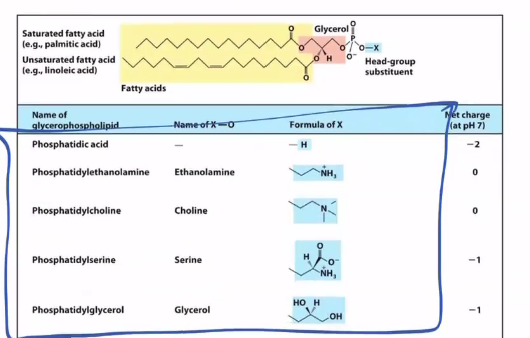
glycerol phospholipids strucute - ones to know
which is the unsat lipid tail?
similar to backbone of triglyc but last C has phosphate attached to X (various possibilites) = head group, so two tails
fatty acid 2 is unsat
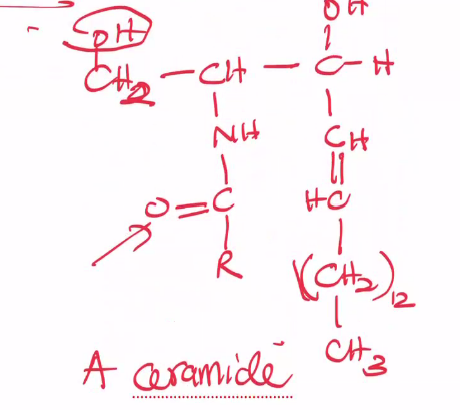
sphingolipids

ceramide
any fatty acid with C=O
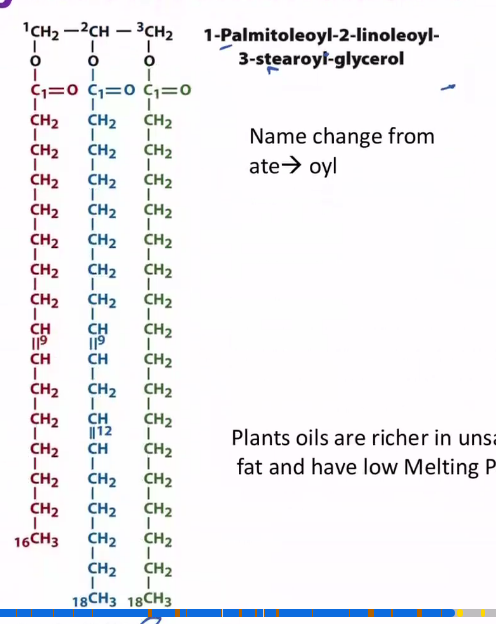
triglyceride nomenclature
plasamogen - what does it have in structure and what does that make it resistant to
has ether linked alkene / vinyl ether bond
resistant to oxidation = antioxidant

platelet actiivating factor

cerebroside vs ganglioside
types of glycospingolipids
cerebroside = 1 monosacch attached to ceremaide
ganglioside = oligosachh
what makes blood groups diff

tay sachs
mutation/not working enzyme in the enzyme chain that cleaves various parts (usually carbs/monosacchs) off a glycolipid → acculumation of improperly cleaved glycolipids
strucutre of choloestrol (must know)
signaling lipids are derivatives of
Enzymatic oxidation of arachidonic acid
Lipid-soluble vitamins and functions
A: Photoreceptor In Low Light Conditions
D: D2 and D3
E: Prevents Oxidative Damage (antioxidant)
K: Participates in Blood Clotting
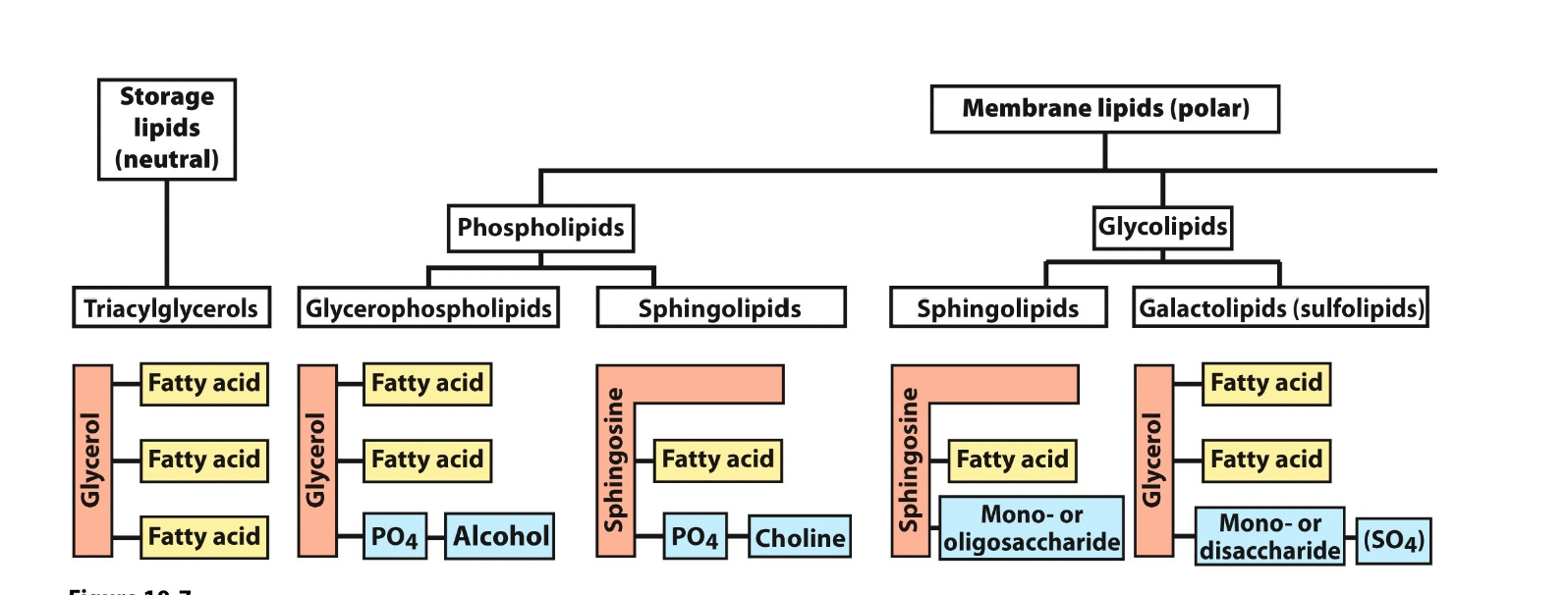
lipids comparison
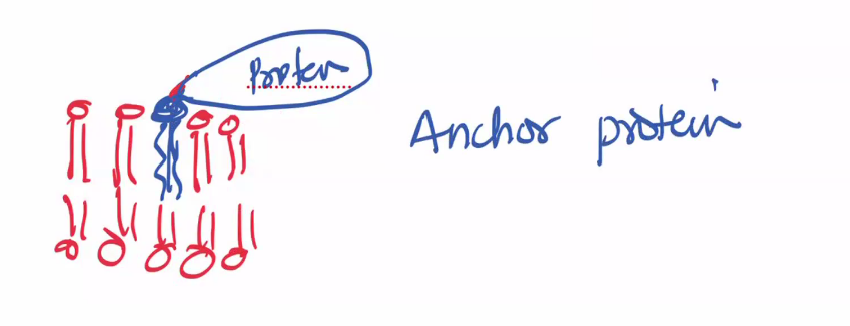
Anchor Proteins
Post-Translational Modifications to protein that attach lipids to them so they can stick in the membrane

redox metabolism rxns
NAD+ → NADH + H+
FADH2 →
ATP →
sotage form of fats and carbs
fats - TAGS (triglycerides)
carbs - glyocgen


w notation: start from the opposite end and count # of carbons to DB → w-# fatty acid
can also do #Cs - # of last DB from reg side (left) = w#

glycolipid: how is the carb linked to the lipid?
what is the parent compound?
what are the types?
a carbohydrate is bound to the hydroxyl group of a lipid by a glycosidic linkage.
parent: ceramide
types: Gangliosides (one monosac attached to lipid) and cerebrosides (multiple sacch attached to lipid)
Sphingolipids vs phospholipids/fatty acids
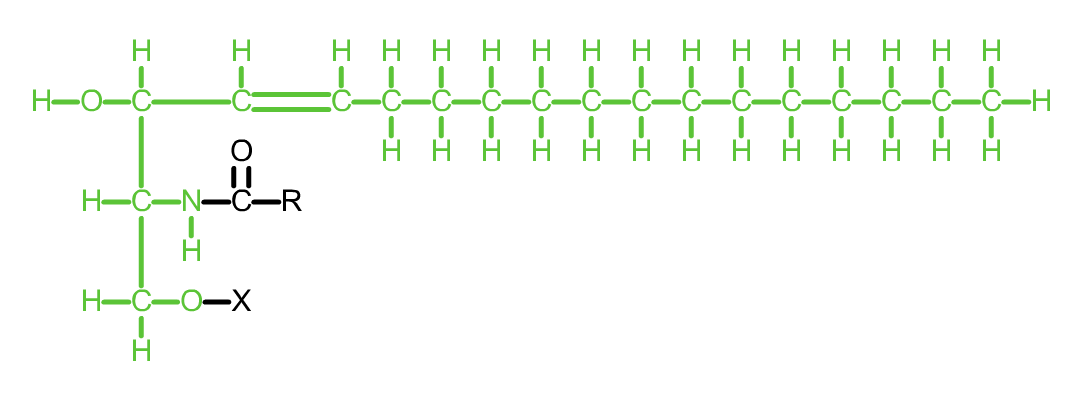
long‑chain amino alcohol sphingosine, a long‑chain fatty acid, and a polar or charged head group. The backbone of sphingolipids is sphingosine instead of glycerol.
Sphingolipids are a class of membrane lipids derived from sphingosine that contain two nonpolar tails and a polar head group. Sphingosine is an amino alcohol. The general structure of a sphingolipid is illustrated in the image, where X may be one of several different polar head groups, such as phosphocholine, and R is a fatty acid tail. Sphingosine is highlighted in green.

what does dificiency in these vitamiins cause:
- A, B1, B12, C, D, E, K
Vitamin B1 (thiamine) deficiency: beriberi, with symptoms including weakness (first symptom), nerve pain, paralysis, and heart failure.
scurvy = tooth and hair loss
Vitamin E prevents the oxidation of vitamin A and fatty acids. A deficiency can lead to neurological problems, muscle weakness, and retina damage.

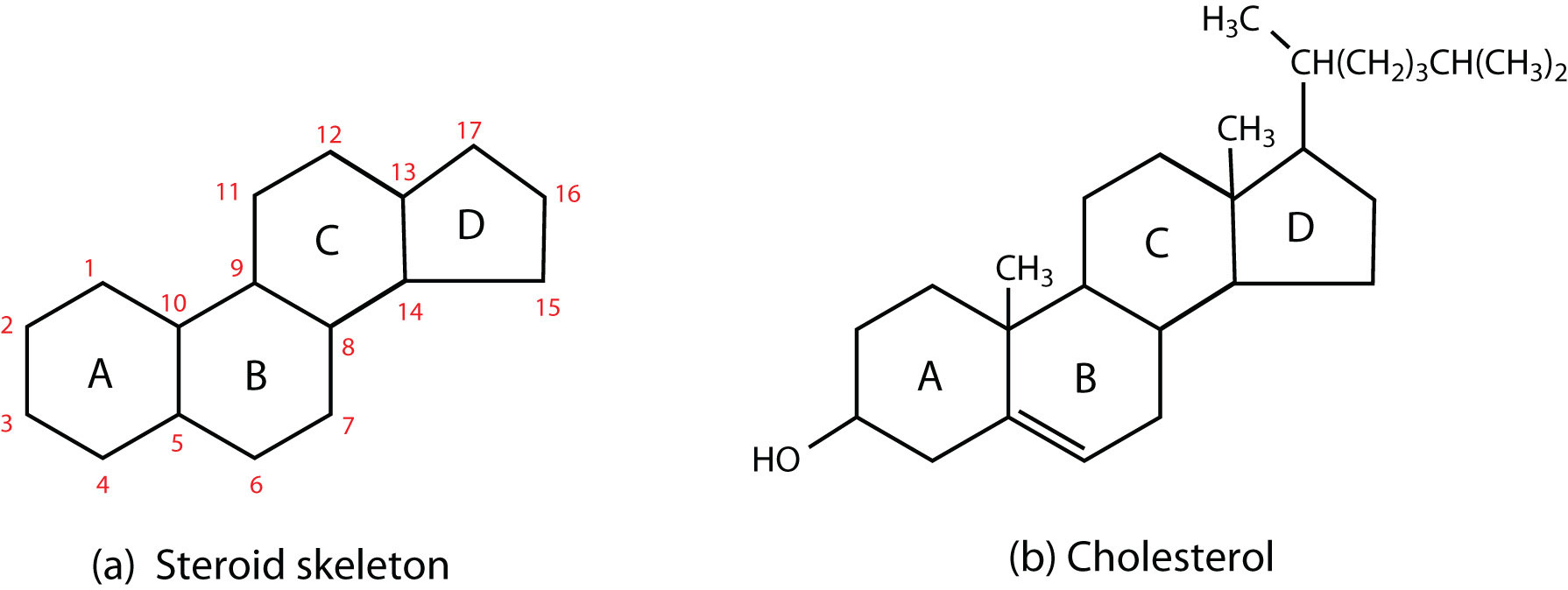
basic structure of a steroid + structure of cholestrol
how do NSAIDs prevent fever
prevent oxidation of arachidonic acid into other molecules that cause sickness

differenec between D2 and D3
D2, for plants, has one doubel bond
d#, for animals, no DB
define:
integral membrane protein
anchor protein
peripheral membrane prot
integral: spans entire membrane, mostly nonpolar (at least 20 np AAs to span memrane)
achor: covently linked to a lipid in the membrane
peripheral: on top/below the membrane, mostly hydrophilic
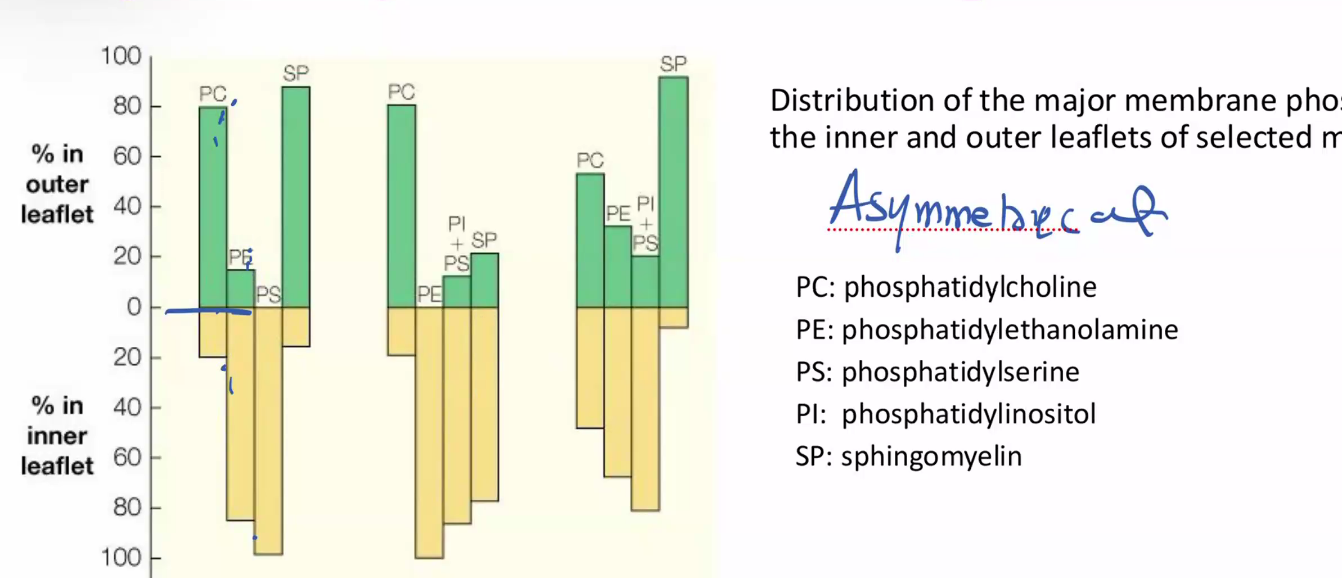
distribution of lipids within the membrane is ______
asymmetrical
what is the function of translocon channel proteins
assist with insertion of hydrophobic regions of a protein into the membrane to create transmembrane proteins
explain function of flippase, floppase, and scramblase and which ones use ATP
flippase: flips lipid from outer to inner leaflet using ATP
floppase: flops lipid from inner to outer leaflet using ATP
scramblase: can flip lipids in either direction wihtout ATP toward equilibrium


which are oxidized and which are reduced?
lose H = oxidized (like OH = reduced, =O = oxidized, lost H) → lost electrons
gain H = reduced, gained electrons and used them to bind H

difference between digestion and catabolism
digestion = breaking polymer into monomers
catabolism = breaking monomer into smaller molecules
enzyme that breaks down carbs in saliva? what bond does it break?
amylase, alpha 1-4 glycosidic linkage
enzyme that breaks down peptide bonds
enzyne that breaks lipids
protease
lipase
what other enzyme does glycogen breakdown? what bonds is it breaking in glycogen?
glycogen phosphorylase
glycogen bonds: alpha 1-4 and alpha 1-6 linkages
phosphorylates at C1 to make glucose-1-phosphate
what are the 4 processes involved in going from carbohydrate to ATP?
what hormones are involved in catabolims (2) and anabolism (3)?
what are amino acids digested into to go into the krebs cycel and where does excess go (two places), and what are fats digested into to go into the krebs cycle
digestion: carb → glucose
glycosysis: catabolism of glucose → pyruvate, which then is transformed into Acetyl CoA
citric acid cycle: acetyl coA → NADH & FADH2, high energy carriers
oxidative phosphorylation: NADH & FADH2 → ATP
hormones:
catabolism: insulin, sex steroids
anabolism: glucagon, epinephrine, glucocorticoid
amino acids: turned into pyruvate, excess forms amine → urine or becomes fat
fat digested into a) glycerol → pyruvate, b) fatty acids → acetyl coA

why is glycolysis 10 steps instead of 1
to prevent lots of energy loss as heat
which steps of glyoclysis are irreversible?
1 3 and 10

what step of glycolisys is the flux control point and why?
step 3, because step 1 can be bypassed and step 10 is at the end (all the irrevirible steps)
why does ATP → ADP + P release so much energy
Pi is highly stable because of resonance and less repulsion between neighboring O- groups
overall glycolysis rxn
steps 1-5 are called _________
steps 6-10 are called __________
glucose + 2NAD+ + 2ADP+2Pi → 2pyruvate + 2NADH + 2H+ + 2ATP + 2H2O
1-5 = energy investment phase
1-6 = energy payoff phase
glycolysis steps: write reactants&products, enzyme&cofactor, favorability and why, type of catalysis
glycolysis steps:
phosphorylation:
glucose + ATP → glucose-6-phosphate + ADP using hexokinase, Mg2+CH2OH on glucose C6 → CH2OPO3
Mg2+ stabilize negative charges of O- on ATP (cofactor for enzyme hexokinase)
induced fit model: once glucose binds, hexokinase closes up/tightens
electrostatic catalysis
isomerization
G6P ←→ fructose-6-phosphate using G6P isomerase, Mg2+changes aldose to ketose, pyran to furan (5 member ring)
not favorable/spontaneous but made favorable due to consumption of product in next step; low product concentration shifts equil to right
general acid catalysis
phosphorylation:
fructose-6-phosphate + ATP→ fructose 1,6-biphosphate using phosphofructokinase 1 (PFK 1), Mg2+electrostatic catalysis
splitting ring:
opening ring ←→ split C3 and C4 ←→ DHAP (triose) + GAP (triose)covalent catalysis (Lys), gen acid/base cat (Asp)
GAP formation:
DHAP ←→ GAP using triose phosphate isomerasegen acid base cat - His and Glu