RMS sem 1 part 3 '26
 Call Kai
 Learn
 Practice Test
 Spaced Repetition
 Match
 Flashcards
 Knowt Play
1/88

There's no tags or description
Looks like no tags are added yet.
89 Terms
What three major ethic violations does the Tuskegee Syphilis study illustrate?
1) Harming participants; witholding a cure and harmfull tests
2) Disrespecting participants; no informed consent and coercion
3) Targetting disadvantaged social group; low income & poc
How does the Milgram obedience study show a difficult ethical balance?
Do the risks to participants (stressfull, no informed consent and dishonest debriefing) outweigh the benefits (social impact)?
What are the three core principles of ethics in research?
1) Justice; fair balance between the kinds of people who participate in research and the kinds of people who benefit from it
2) Beneficience; keeping the physical/mental well-being of the participants in mind
3) Respect for persons
What are the two applications of the ethical principle ‘‘respect for persons’’?
1) Participant are equal and have their own autonomy; informed consent/no coercion
2) Groups with less autonomy (e.g. children) should be protected
What are the two core values of the moral framework for animal research?
1) Social benefit; the valuable outcomes of animal research to both humans and animals
2) Animal welfare; the need to prevent sentient animals (have brain regions for emotion and consciousness) from suffering

What are the three principles of each core value in the moral framework for animal research?
Social benefit
1) Sufficient value to justify harm (benefits outweigh costs to animals)
2) Expected net benefit (research is worthwhile for society)
3) No alternative method possible
Animal welfare
1) Limits to harm done (no severe or prolonged pain; otherwise research should not be done)
2) Basic needs are met (appropriate food, housing conditions, exercise and social engagement)
3) No unnecessary harm (principle of refinement)

What are the three R‘s in animal care guidelines?
1) Replacement; find alternatives to animals if possible (e.g. machines/cells)
2) Refinement; design the study/enviroment in a way that there is minimal harm done
3) Reduction; use a study design that requires the least amount of animals
What are the three forms of research misconduct?
1) Data fabrication; making up data
2) Data falsification; changing data/influencing study to get the data you want
3) (Self-) plagiarism; copying someone else’s work
What are the two types of deception in a study?
Deception through omission; not telling participants everything about a study
Deception through commission; actively lying to participants in a study
What ethical guidelines does research misconduct violate?
Openness; sharing raw data via websites (Merton’s norm of communality)
Transparency; report all the results in a study article
Anonymous vs confidential study
Anonymous; no personal data collected
Confidential; personal data collected, but kept secure
What do the three types of frameworks of animal research entail?
1) Legal; countries laws (grounded in the three Rs) must be followed
2) Institutional; committees must approve animal research projects & monitor the treatment of animals throughout the research process
3) Moral; guides whether to conduct animal research at all (balance the social benefit of research while still supporting animal welfare)
Chapter 12 Morling
What are the three criteria for factorial designs?
Within- vs Independent-groups factorial designs
How do you use marginal means to look for main effects in a factorial design?
Cell of a factorial design
Are interactions or main effects more important in a factorial design?
Participant variable
Factorial design
Why do researchers combine independent variables in a factorial design?
What are the three types of factorial designs?
How does increasing the number of levels of an independent variable in a study affect the factorial design?
3-way vs 2-way interactions of a factorial design
How does increasing the number of independent variables in a study affect the factorial design?
Participant variable
Independent-groups vs within-groups variables
Is an interaction effect or main effect more important in a study?
How do you recognize interaction effects in a graph?
What is an interaction and when can an experiment show it?
How do you identify a factorial design in an article?
ch 11 morling
Confounding vs obscuring variables
What are the 6 potential threats to internal validity in a (one-group) pretest/posttest design?
1) History
2) Testing
3) Instrumentation
4) Attrition
5) Regression
6) Maturation
How can the 6 internal validity threats in a (one-group) pretest/posttest design be prevented?
Add a comparison group (makes it just a pretest/posttest design)
Make it just a posttest design
Different tests in pretest and posttest
Maturation threat to internal validity
Patients improve just because time passes

Selection-history threat vs selection-attrition threat
Selection-history threat; certain kind of participants ..
Selection-attrition threat; certain kind of participants systematically drop out
Instrumentation threat to internal validity
The way a variable is measured is different in pretest and posttest
Testing threat to internal validity
Pretest has influence on participants behavior in posttest (e.g. same test twice; better bc already practiced/worse bc of boredom)
Attrition threat to internal validity
Participants drop out;
systematically in one condition (bad)
randomly (not bad)

Regression threat to internal validity
Participants with extreme scores are typically less extreme at another measurement

History threat to internal validity
An external factor independent of the study influences most participants

How can a study be designed to minimize possible obscuring factors?
What are the 3 potential threats to internal validity that are related to how the study was set up?
Noise
How can you keep the within-groups variability to a minimum in a study?
Power
What 3 factors could cause within-groups variability in a study?
Manipulation check
Ceiling vs floor effects
What could prevent studies from having enough between-groups difference?
What are the 3 potential threats to internal validity in any design and what do they entail?
1) Design confound; difference in results bc of how study was set up (e.g. unintentional difference in conditions)
2) Selection effects; participants are vastly different between groups (e.g. bc of self selection)
3) Order effects; order of study conditions influences participants
Null effect
What are potential explanations for a null effect in a study?
Under what circumstances can a study with a null effect still be published?
One-group, pretest/posttest design vs pretest/posttest design
One-group, pretest/posttest; 1 group
Pretest/posttest; 2 groups (one is a comparison group), better internal validity
Spontaneous remission
Patients improve without known reason
ch 13
What are the four types of quasi-experimental designs?
Why would a reseracher use a quasi-experimental design?
Wait-list design
Quasi-independent variables vs participant variables
What are some disadvantages of studies with a small sample size?
What are the three types of small sample size designs?
What do the four validities in a small sample size study entail?
The five steps for perfoming a significance test
1) Assumptions (randomization)
2) Hypotheses
3) Test statistic
4) P-value
5) Conclusion
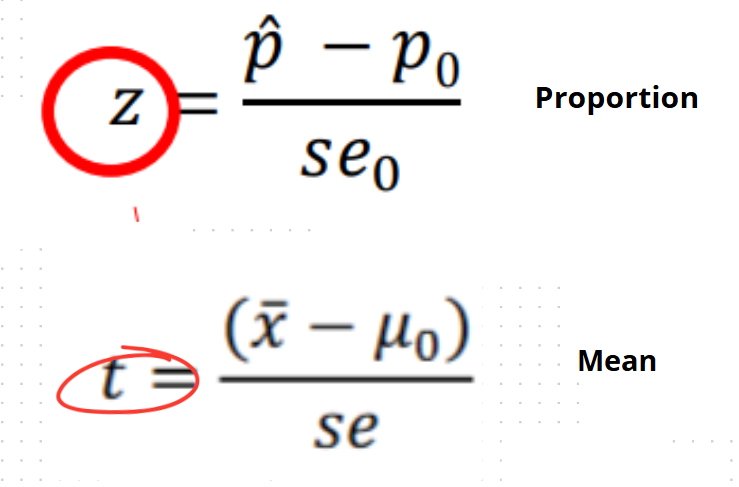
Test statistic
Distance between population parameter and point estimate (e.g. Z-score (for proportion); amount of sd’s p with ^ is from p (t-value for mean))
P-value
Probability of (if H0 is true) finding a test statistic that is equal or higher than p (smaller P-value is better)

Two types of hypotheses
H0; null, p= population parameter (single number)
HA; alternative, p= everyhting but the population parameter (range of numbers)

9.2
What are the three assumptions for a significance test of a proportion?
1) Categorical variable
2) Randomization
3) Sample size is largen enough (generalizable to population)
Two types of significance tests
Significance level
Standard normal distribution
Sampling distribution of z test statistic when H0 is true, with mean = 0 and sd = 1
Difference between z-score and z test statistic
Two types of alternative hypotheses
one-sided; HA= p<p0 (left-tail)or p>p0 (right-tail)
two-sided; HA= p ≠ p0 (right and left tail) (P-value has to be done x 2)

9.3
Central Limit Theorem
Robust method
9.4
Two types of errors in significance tests
Rejection region
9.5
Significance test vs confidence interval
9.6
Power
Significance level alpha