Module 1: Obesity - Development, diagnosis, and measurement
 Call Kai
 Learn
Learn Practice Test
 Spaced Repetition
 Match
Match Flashcards
 Knowt Play
1/227

There's no tags or description
Looks like no tags are added yet.
Name | Mastery | Learn | Test | Matching | Spaced | Call with Kai | Chat |
|---|
No analytics yet
Send a link to your students to track their progress
228 Terms
Obesity is a
global disease burden
obesity rates have ________ since 1975
tripled
_____ of adults are overweight
39%
_______ of adults are obese
13%
dramatic increases worldwide in
high and low income countries
rise of obesity is too rapid to be explained by
genetics alone, environemental and behavioral changes play a role
definition of obesity from Obesity Canada
a progressive chronic disease characterized by abnormal or excessive fat accumulation that may impair health
obesity is a leading cause of
type 2 diabetes
high blood pressure
heart disease
stroke
arthritis
cancer
etc.
obesity is one of the
leading causes of preventable death - smoking is another one
body mass index
universal definition of overweight and obesity
BMI =
weight (kg)/height (m)²
underweight BMI
<18.5
normal weight BMI
18.5-24.9
overweight BMI
25.0-29.9
obese class I BMI
30-34.9
obese class II BMI
35.0-39.9
obese class III BMI
> or equal to 40.0
there are many cautions in using ______ alone to determine obesity
BMI - because everyone stores body fat differently
Waist circumference (WC)
used alongside BMI to assess risk of Obesity-related complications
WC is associated with
chronic disease
2 ppl can have the same BMI, but one might have a larger WC
this is a strong indicator of obesity associated with health consequences
WC cut-off point for risk of developing health problems - men
> or equal to 102 cm or 40 in
WC cut-off point for risk of developing health problems women
>or equal to 88 cm or 35 in
unit for BMI
kg/m²
having a higher BMI and higher WC is a strong indicator of
increased reisk of type 2 diabetes, hypertension, and CVD
NHLBI guidelines not that increased WC can indicate increased disease risk
even in individuals considered normal weight
BMI only takes body size into account, and not
body composition
BMI has
no information on fat distribution
BMI is hard to
interpret across ethnic groups or those losing muscle mass (elderly people)
some ethnic groups have
greater risk of disease at given BMIs than other groups
As an older person,
Losing weight very fast is a concern as it could be due to sarcopenia (losing muscle mass), regardless of BMI
BMI can be normal, but
weightloss can be seen as unhealthy (sarcopenia)
ethnic disparities are major in health
it comes down to genetics
more than two times as likely to develop diabetes at a given age
Asians (followed by Hispanics, and then Black people)
have a higher body fat for a given BMI
Asians
at the same BMI, 5% more body fat in _______ than Dutch people
Indonesians
BMI caps should be different for different ethnicities because
cut offs should be lower for ethnicities that have a higher body fat at given BMIs. which is often missed when blanket BMIs are used
Why is BMI often used when it is imperfect and imprecise
it is simple, makes it the best
BMI is imperfect and impercise because
it does not measure fat tissues, which defines obesity
body composition
the body’s relative amounts of fat and lean body tissue(FFM)
FFM
fat-free mass
components of FFM or lean body tissue
muscle
bone
water
organ tissues
components of fat mass
essential fat
stoarge fat
essential fat is
required for normal physiological function. having too little is a risk factor
essential fat consists of
major organs
muscles
central nervous system
essential fat accounts for ______ total body weight in males
3-5%
essential fat accounts for _____ total body weight in females
8-12%
less than _____ essential fat making up total body weight in females is concerning
12%
males have a higher percentage of _____ in their body composition
muscle
males have a lower percentage of _____ in their body composition
essential fat
females have a higher percentage of _______in their body compostion
essential fat
females have a lower percentage of _______ in their body composition
muscle
females have more ________ than males
essential and storage fat

dual energy X-ray absorptiometry (DEXA)
gold standard direct method of measuring body composition
uses series of low-dose, transverse radiation scans, providing high degree of accuracy
provides measurements of bone mineral (density), and non bone lean tissue (able to measure visceral fat as well - fat mass, bone mass, nonbone mass - muscle, organs, water
con: very expensive

magnetic resonance imaging (MRI)
direct method (gold standard) of measuring body composition
better quanitification, more precise than DEXA
muscle mass
visceral fat

hydrostatic (underwater) weighing
indirect, lab-based method of measuring body composition
go into a pool of water
histortically most commonly used. lab technique for measuring % body fat
uses whole body density to calculate body composition based on Archimedes’ principle
cons: time-consuming, not feasible to test large numbers of athletes
how much water you displace based off info on body densities - can calculate what proportion of body fat and muscle after you displcae water
how does hydrosatic weighing work
measures underwater weight - exhale all air an submerge while on scale
bone and muscle are denser than water (sink), fat tissue is less dense (floats)
higher underwater weight means more lean mass, lower underwater weight means more body fat
higher underwater weight means
more lean mass, because bone and muscle are denser than water (sink)
lower underwater weight means
more body fat. because body fat is less dense than water and floats

bodpod
measures body composition through air displacement - fat mass, percent fat, lean mass
indirect, lab-based method of measuring body comp
calculates % BF from body density (similar to hydrostatic weighing)
uses computerized air pressure sensors to determine amount of air displaced
field/clinic methods of measuring composition
give ideas of fat mass and location of fat mass
skin folds
natural areas of body where skin overlaps and rubs against itself (field/clinical method)
waist-to-hip ratio
method of field/clicial method to see measuring of body composition
Archimedes’ principle
fat is more buoyant than lean tissue
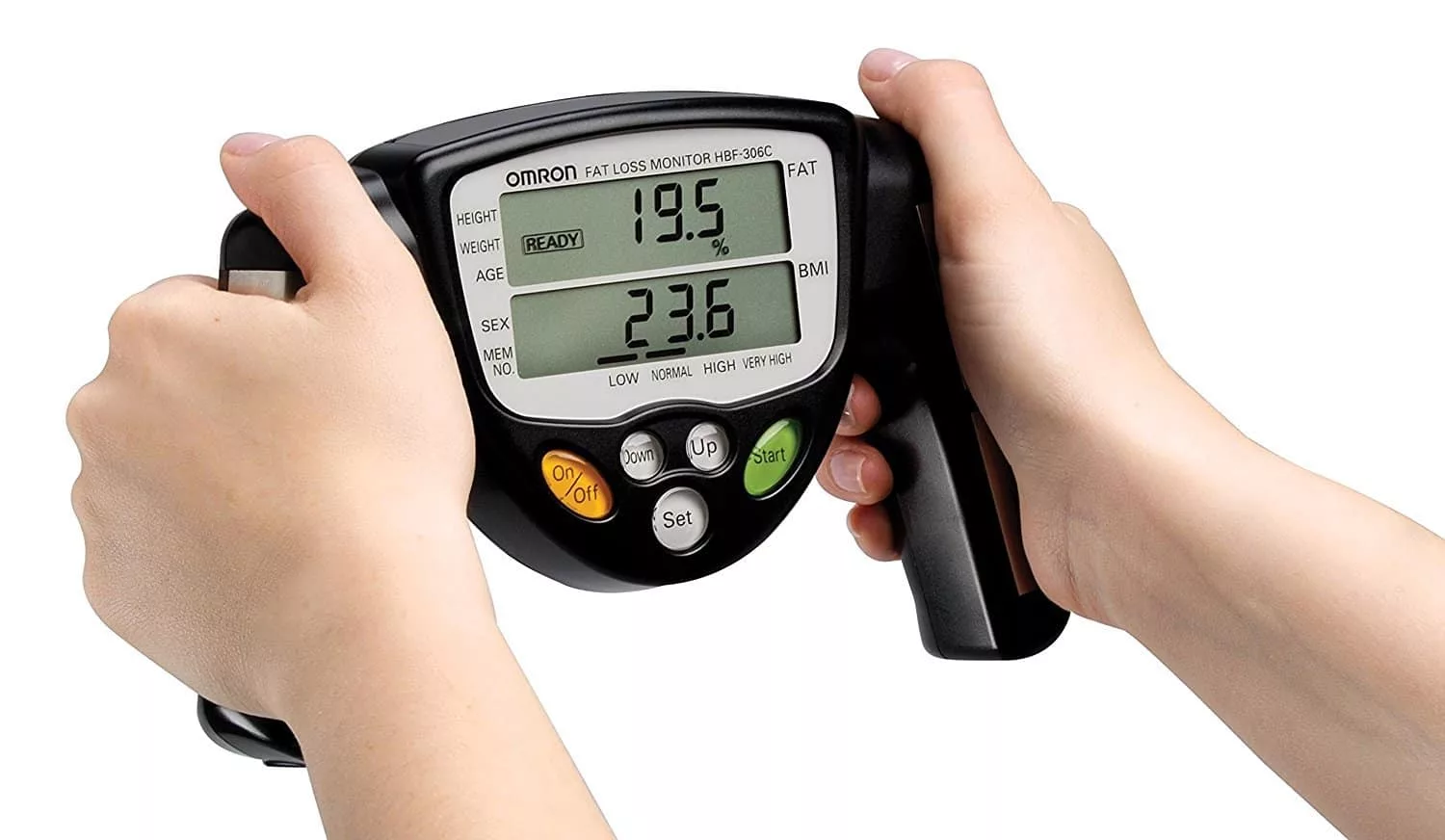
Biometrical Impedance Analysis (BIA)
rapid, noninvasive and inexpensive method of measuring body comp
sends electrical current through the body to estimate body fat (based on principle that fat is less conductive than lean tissue) - conductants of current
cons: possess a higher degree of measurement error (measurements may be affected by subject’s hydration status) - hard to control worldwide, become a global measure
fat is less conductive than
lean tissue
men risky - high body fat
over 30%
men excess fat
21-30%
men moderately lean
13-20%
men lean
9-12%
men ultra lean
5-8%
men risky (low body fat)
under 5%
women risky - high body fat
over 40%
women excess fat
31-40%
women moderately lean
23-30%
women lean
19-22%
women - ultra lean
15-18%
women risky - low body fat
under 15%
waist to hip ratio =
waist/hips
male excellet waist to hip ratio
under 0.85
male good waist to hip ratio
0.85-0.89
male average waist to hip ratio
0.90-0.95
male at risk waist to hip ratio
over 0.95
female excellent waist to hip ratio
under 0.75
female good waist to hip ratio
0.75-0.79
female average waist to hip ratio
0.80-0.86
female at risk waist to hip ratio
over 0.86
BMI pros
costless (requires no equipment)
noninvasive
easy for assessing large populations
BMI cons
does not account for % fat and FFM - not useful for athletic populations
Waist-to hip/ body girth pros
low cost
easy to measure/calculate
waist to hip/body girth cons
prediction equation possesses high degree of error
skinfolds pros
low cost
easy to use
time efficient
skinfolds cons
slightly invasive
requires certain degree of skill to measure accurately
hydrostatic weighing pros
high degree of accuracy
hydrostatic weighing cons
time consuming
requires pool/water tank
requires certain degree of skill to use
air displacement (bodpod) pros
easy to use
time efficient
high degree of accuracy
air displacement (bodpod) cons
very expensive
bioelectrical Impedance Analysis (BIA) pros
fairly low cost
easy to use (can be self-administered)
time efficient
biolectrical impedance analysis (BIA) cons
sensitive to subject’s hydration status - has high degree of error
DEXA pros
very high accuracy
noninvasive
includes measure of bone density