Principles of Infectious Disease & Epidemiology
 Call Kai
 Learn
Learn Practice Test
 Spaced Repetition
 Match
Match Flashcards
 Knowt Play
1/77

There's no tags or description
Looks like no tags are added yet.
Name | Mastery | Learn | Test | Matching | Spaced | Call with Kai | Chat |
|---|
No analytics yet
Send a link to your students to track their progress
78 Terms
Epidemiology
Study of the distribution and determinants of a disease in populations
Infection
Entry and multiplication of an infectious agent in a person/animal
Infectious Disease
Clinically manifest disease resulting from infection
Communicable Disease
One that can be transmitted from one human to another or from animals to humans
Aims of Infectious Disease Epidemiology
Identify focus of infection
Reduce spread of illness
Identify community risk factors
Identify new pathogens or variants of existing pathogens
Evaluate efficiency of treatment, prevention, and control measures
Incidence
measure of new cases (# of instances of illness commencing)
Incidence Rate
# of new cases of disease time/period / # persons at risk in population/time period
Prevalence
Total number of people infected within the population at any time – old and newly diagnosed cases
measure of disease “burden”
Prevalence rate
Prevalence @ time/ Population at risk @ time
Morbidity
Disease burden
Mortality rate
# deaths/time period / population @ risk
Case fatality rate (CFR)
Severity
Number of deaths/time / Number of cases/time
Attack rate
the proportion of people who become ill with a disease in an at-risk population initially free of the disease (from beginning to end of an outbreak)
Endemic
habitual presence of disease or infectious agent within geographic region or population group
Epidemic
occurrence of cases of disease (or outbreak) with frequency clearly in excess of normal expectancy
Something that is initially epidemic can turn endemic (ex. COVID-19)
Pandemic
epidemic spreads worldwide – cross continents
ex) 7 cholera pandemics; 2009 swine origin influenza; COVID-19
Sporadic
Random, isolated cases, unpredictable
ex) meningitis
Common source outbreak
epidemic from contaminated substances (e.g., water supply, food source)
Propagated outbreak
person to person (horizontal) transmission
Outbreak descriptive studies comprehensively characterize
Person, place, time
Chain of Infection
Certain conditions must be met in order for infectious disease to be spread from person to person
Can only occur all six links: disease organism (agent) - reservoir - mode of escape - mode of - transfer - mode of entry - susceptible host

Host
Person or living animal that affords subsistence or lodgement to an infectious agent under natural conditions
Protists and helminths can pass successive stages in alternative hosts and different species (definitive and intermediate)
Reservoirs of Infection
Pathogen lives and multiplies in the reservoir (person, animal, insect, plant, etc)
Does not experience the systems of diseases when infected by pathogen
Types of Reservoirs
Human - carriers
Animal - zoonoses
Environmental - ex) soil and water
Modes of disease transmission (3)
Direct transmission
Indirect Transmission
Airborne transmission
Direct Transmission
Can be horizontal or vertical
Horizontal Direct Transmission
Direct contact - touching, biting, kissing or sexual intercourse
Direct Projections - droplet spray onto mucous membranes of conjunctiva, eye, nose or mouth during sneezing, coughing, spitting, or talking (<1 meter)
Vertical Direct Transmission
Vertical: congenital, perinatal
• Congenital -- congenital disorders are structural and functional defects present at birth and are the result of cross-placental infection
• Perinatal – shortly before, during, and after birth
Indirect Transmission
Can be vehicle or vector borne
Indirect Transmission: Vehicle-borne
(no multiplication in or on vehicle)
ex) Contaminated fomites, water, food, milk, biological products, injection, piercing
Indirect Transmission: Vector-borne
arthropods that transmit diseases to humans, e.g., ticks, flies, fleas, lice, mosquitoes
Mechanical vectors
– Transmission passively
– Disease transmission does not require replication in the vector
(e.g., flies and Vibrio cholerae)
Biological vectors
– Active transmission
– Pathogen replicates in vector; often necessary completion of microbial life cycle in vector
– An incubation period is required before transmission of infective form
(e.g., mosquitoes and dengue virus)
Airborne Transmission (aerosols)
dissemination of microbial aerosols to a suitable portal of entry, usually by the respiratory tract
– Aerosols – small residue result from evaporation of fluid from droplets
Particles 1-5 um are easily drawn into the alveoli of lungs, remain suspended for long periods
– Dust, soil particles
The reproductive rate – Ro
The number of people that one sick person will infect (on average)
Assumes completely naive population with zero immunity
ex) Measles has an Ro of 18!
Ro Value Meanings
>1 : Infection is growing, outbreak expanding
= 1 : Transmission is stable, infection rate is steady (endemic level)
< 1 : # of new infections shrinking, outbreak dying out
Re
Reflects real-world conditions – accounting for existing immunity, vaccinations, and public health interventions
The Host-microbe Relationship
Symbiosis association between two species
Mutualism, parasitism, commensalism, antagonism
Colonization – “normal flora“
Mutualism
both benefit
ex) bacteria in digestive tract, vitamin K
Parasitism
parasitic microbe benefits, host is harmed
spectrum—slight harm to death
Commensalism
one species benefits, other neither benefits nor is harmed
ex) skin bacteria
Antagonism
both species harm each other
Types of Pathogens
Pathogen, non-pathogen, opportunist
Pathogen
An organism that is capable of causing disease
Non-pathogen
An organism that is not usually capable of causing disease
Opportunist
An organism that only causes disease when the host is compromised
– AIDS
– Immunosuppressive drugs
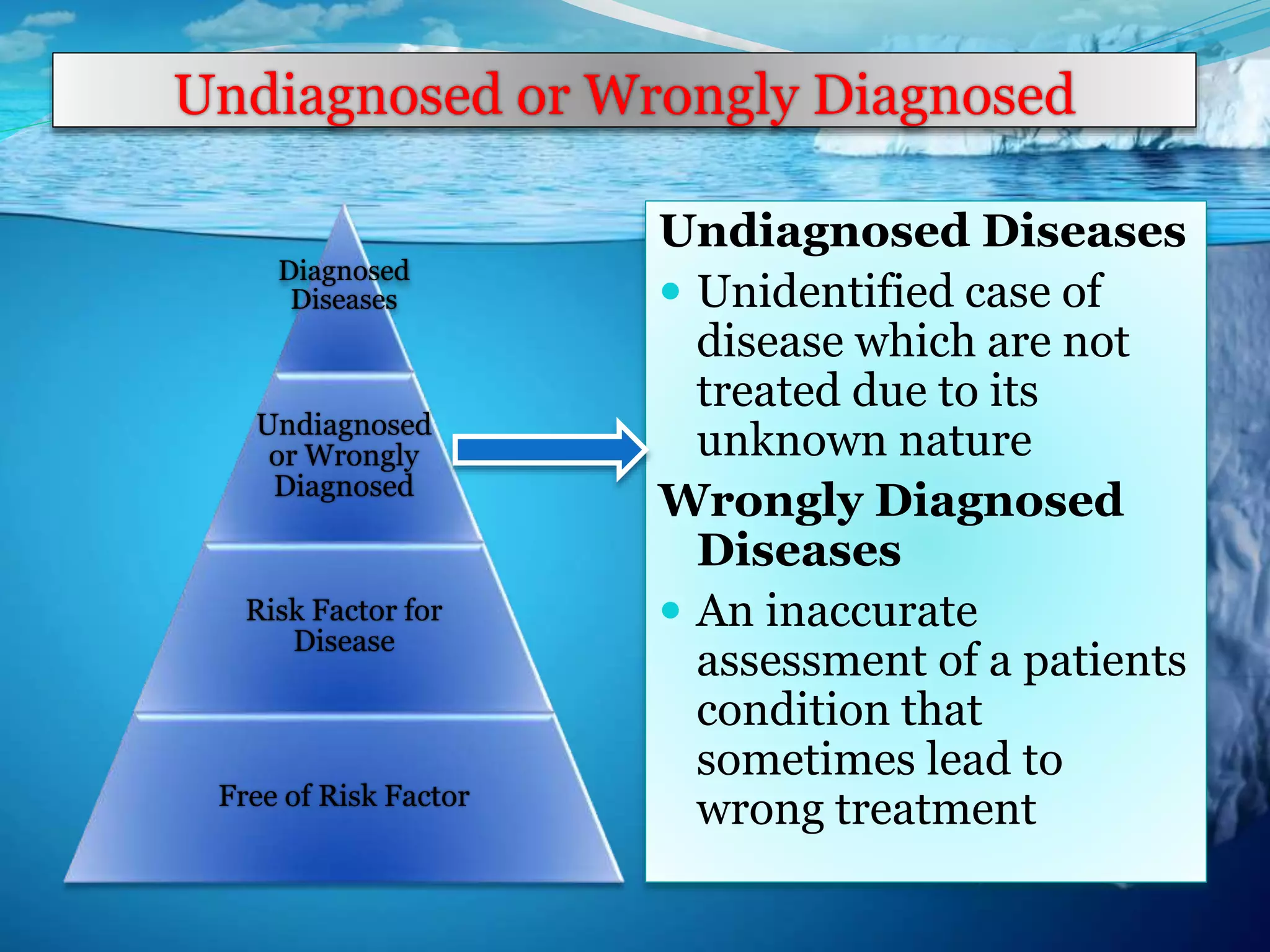
The Iceberg concept
Almost all infectious diseases are like a pyramid (disease on top, asymptomatic on bottom)
Visible: disease detected by surveillance, usually more severe cases
Under the surface: disease not detected by disease surveillance
Main takeaway: for most diseases, we only detect a small portion of the disease burden
People are infected but asymptomatic, but can still transmit the disease
Incubation period
The time interval between initial contact with an infectious agent and the first appearance of symptoms associated with the infection.
There is a gap between the incubation period and latent period: can easily infect people without knowing since you don’t have the symptoms yet but you are infected

Latent period
time between exposure and period of communicability

The epidemiologic triad
host, microbe, environment
Pathogenesis
The method by which an infectious agent produces disease in the host. The study concerns itself with the mechanisms by which microbial agents injure discrete populations of cells in different organs to produce the signs and symptoms of disease in a particular host.
Virulence
The capacity of an infectious agent, compared to other closely related infectious agents, to produce disease in a host. Virulence depends on a variety of microbes and host factors.
Disease
The sum of the effects on the host of microbial replication and of the immune response.
Co-evolution of host and microbe
Pathogens evolve to maximize their transmission and survival
If virulence aids transmission -> more virulent pathogens will out-compete
If severity decreases the likelihood of transmission -> less virulent pathogens favored
Attenuation
Weakening of the pathogen by sub- culturing on/in laboratory media, laboratory animals
Infectivity – “dose”
• Entry – Adherence
– Specific molecules for adherence to host cells (e.g., virus receptor)
• Colonization and Infection
– Nutrient availability – e.g., the battle for iron
• Host: transferrin, lactoferrin
• Bacterial pathogens: siderophores
Invasion
• Ability to invade host cells and tissues, cause disease and reach secondary sites
– Can be through direct extension into tissues
– Or via the blood and lymph systems
• Microorganisms in blood
– Bacteremia, Viremia, Parasitemia, Fungemia
Two main types of toxins
Exotoxins (proteins) and endotoxins (lipopolysaccharide; LPS)
Endotoxins
– Gram negative bacteria – LPS
– Cell-bound, released when cell lyses
Exotoxins
– Toxic proteins released from growing cells; generally heat labile
– Travel from site of infection and cause damage at distant site
Enterotoxins
Subset of exotoxins – exotoxins affecting the gastrointestinal tract, usually small intestine
Types of exotoxins
Cytolytic, AB, superantigen
Cytolytic toxins
• Secreted, soluble, extracellular proteins
• Damage host cell membrane, cell lysis (e.g., hemolysins, leukocidins)
AB toxins
• B component binds to host cell receptor—facilitates transfer of A
which damages cell
• Diphtheria, cholera, tetanus, botulism
Superantigen toxins
• Toxic shock syndrome
Host factors in infectious diseases
Genetics
– cell receptors
– genetic traits (sickle cell trait and malaria)
– HLA type (MHC)
• Age: old and young usually more susceptible
• Gender – e.g., structure of urinary tract (UTI)
• Pregnancy
• Nutritional status
• Co-morbidities: obesity, diabetes, hypertension
- Hormonal balance
– Glucocorticoids can depress immune system (stress, lack of
sleep)
• Integrity of organ system
– Abnormal urinary tract predisposes to urinary tract infections
– Smoking can predispose to respiratory tract infections
• Integrity of immune system – immunocompromised
• Immune status: previous exposure or vaccination
• Behavior: smoking, diet, drinking, sexual practices, exercise
COVID-19 examples of susceptibility
Males more susceptible
Infection in young people, deaths in old people
Environmental factors of susceptibility
Physical
– Weather, climate, geology
– Ecological zone
• Biological
– Sources of food, water, and air
– Presence of vectors, flora and fauna
• Social and cultural
– Density, crowding, adequate housing, war, sanitation,
availability of health care
• Agricultural practices
• Development, urbanization, suburbanization
• Interrupting the chain of infection (mitigation; flatten curve)
Primary Prevention
Methods to avoid occurrence of disease.
ex) population-based health promotion efforts
Secondary Prevention
Methods to diagnose and treat existent disease in early stages before it causes significant morbidity
Quarantine
restriction of activities for well persons or animals who have been exposed to
prevent disease transmission during the incubation period
Isolation
separation for a period at least equal to the period of communicability of infected persons to prevent or limit the transmission of an infectious agent
Monitoring
examination of inanimate objects for the presence of pathogens (air, food, water – threshold level)
Surveillance
systematic collection, analysis and use of epidemiologic data for planning, implementation and assessment of disease control
Information for Action: Passive
public health authorities; central collection of data – Notifiable disease reporting (physicians, laboratory)
Information for Action: Active
proactive, focused (e.g., CDPH UNEX [unexplained deaths])
• Search for cases
• Syndromic surveillance – e.g., for diarrheal diseases
• Surveys
• Sentinel Surveillance
• Field investigations of epidemics, cases
• Collection of data from affected populations
CDC Surveillance System (maybe include?)
Foodborne diseases active surveillance network: (FoodNET)
Waterborne Disease and Outbreak Surveillance System: (WBDOSS)
ArboNET: National surveillance system for arboviral diseases in the United States
National Antimicrobial Resistance Monitoring Systems: (NARMS)
Cholera & other Vibrio illness surveillance system: (COVISS) – Gulf coast
National Health & Nutrition Examination Surveillance: (NHANES)
California West Nile Surveillance Program
Human case surveillance
Mosquito testing
Sentinel chicken testing
Dead bird/tree squirrel surveillance
Animal case surveillance